
Automated Follow-Up for Identified Companies: Apollo, Hunter and a Page Written for Each One
Most of the companies that read your pricing page never fill in a form. If you run a company-identification tool such as Albacross or ZoomInfo, you already know some of their names: the provider recognises them from their office connections. Then the name sits in a report, and by the time anyone acts on it, the interest has cooled.
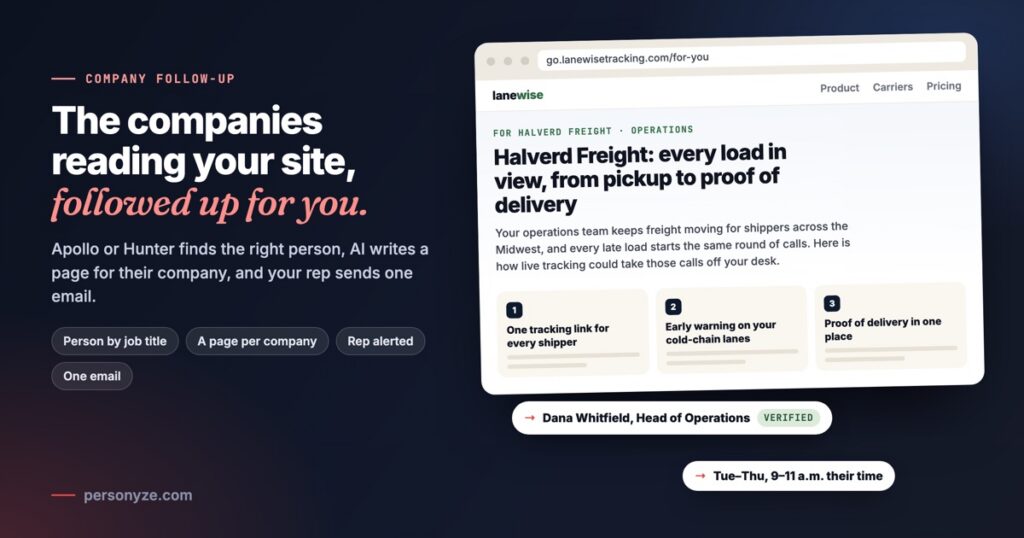
Company follow-up acts on it for you. When a company you can sell to reads your site, Personyze finds the right person there with your own contact finder (Apollo, ZoomInfo, Lusha, Snov.io or Hunter), has AI write a page for that company and that person’s role and one short email from that page, and alerts your rep. Your rep approves each email, and what your rep approves is sent from your rep, with the link. The message is tailored to their company and to what you sell, and everything up to your rep’s OK runs by itself, inside limits you set.
Companies read your site and leave no name
B2B buyers research quietly. An operations lead at a logistics company might read your tracking page, your integrations and your pricing over two visits, and never touch the demo form. Identification closes part of the gap: Albacross, Snitcher, Demandbase, ZoomInfo and Leadinfo name the companies they recognise, with their industry, size and country.
A company name is not a conversation, though. Before anyone is written to, someone has to:
- decide whether the company is worth a follow-up at all;
- find the person with the right job title, and a work address that will not bounce;
- write something about their business, not a template with the name swapped in;
- send it once, at a sensible hour, and not again next week.
Done by hand, that is a research job for every company. Company follow-up does all four, the same way every time, and your rep approves each email before it goes.
How it works, in six steps
It starts with one action, Follow up identified company, added to a Targeting and Personalization campaign. From there, each company the campaign matches goes through the same six steps.
- A company is named. Several visitors from one company count as one.
- Your targeting picks it: an industry, a size, the pages that show interest. Your visitor sees nothing.
- The right person is found. Your contact finders are asked in turn until one finds the right person by your job titles, with a work email: Apollo first, at the ranks that decide (owners, founders, C-level, partners, VPs, heads and directors), then ZoomInfo people search (if you already connect ZoomInfo), Lusha, Snov.io and Hunter. Any one of them also works alone.
- A page is written for them, from the company’s own site and what you sell.
- Your rep is alerted on Slack and by email, with why the company fits and a LinkedIn note of up to 300 characters to copy. LinkedIn is never automated.
- Your rep approves the email. AI writes one short email per company and role from their page. It waits under Identified companies, on a phone too, straight from the alert: Approve & send, Edit, Skip, or Copy to send it from your own mailbox. What your rep approves is what is sent, from your rep, on a Tuesday, Wednesday or Thursday between 9 and 11 in the morning, their time.
Each contact finder gets the company’s web address and, except Hunter, your job titles; none is sent anything about your visitor. Of the person, only their name, title, LinkedIn and email, with its status, are kept.
What gets written for each company
The email is short on purpose. AI writes it from their page, what you sell, the person’s role and your rep’s own words, and it never says they visited your site. The real message is the page behind its link: your hosted landing page, filled with words written for one company and one role.
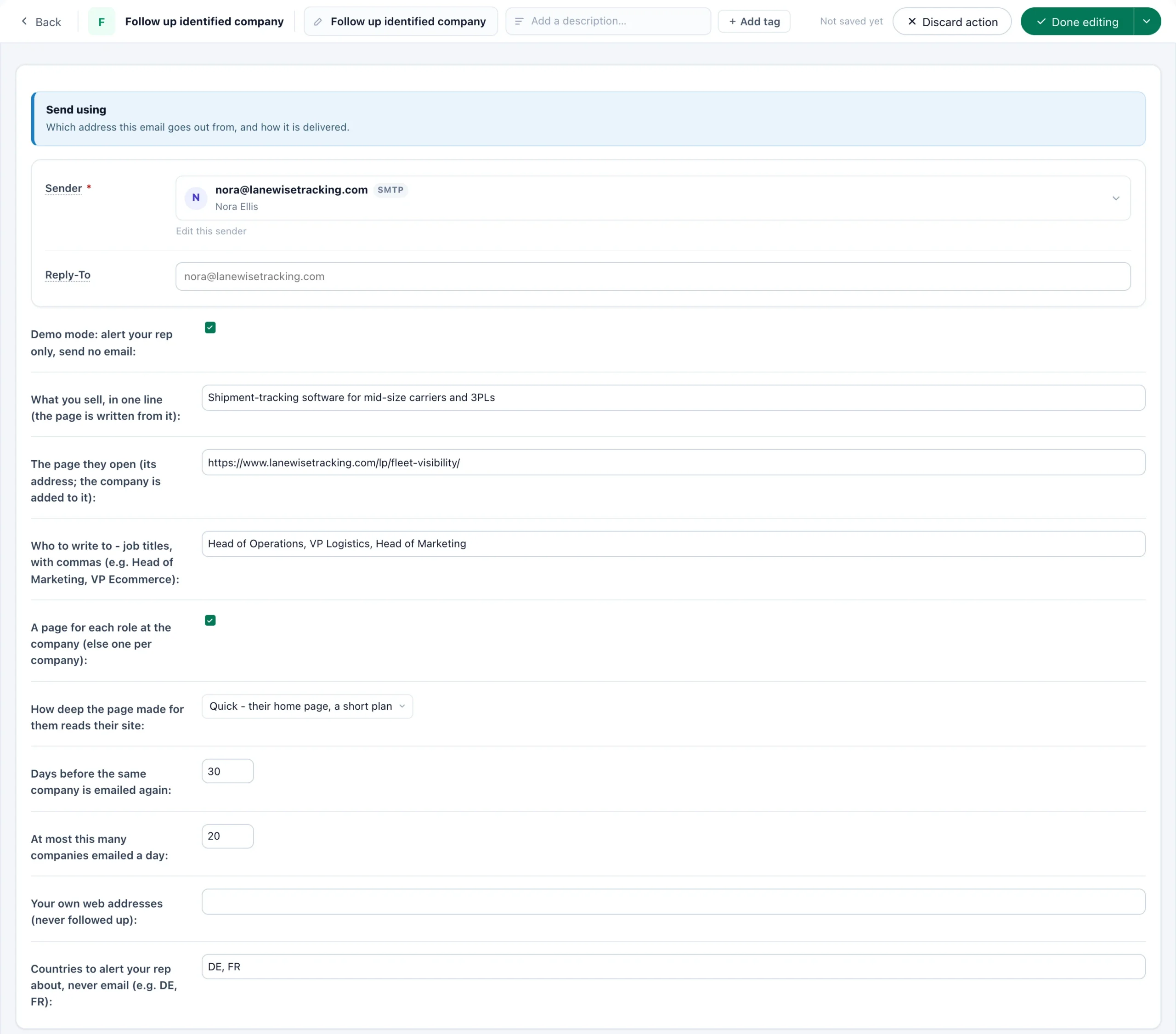
Take Lanewise, which sells shipment-tracking software to mid-size carriers and 3PLs. Halverd Freight, a Chicago logistics company of 1,200 people, reads Lanewise’s pricing and carrier-tracking pages. Apollo finds Dana Whitfield, Head of Operations, with a verified address at halverdfreight.com. This is the page her link opens:
- One line about what you sell. Every page is written from it, so each idea is how your product helps that company.
- A page per role, on by default: a head of marketing and a CTO at one company each get their own.
- Quick or Thorough: their home page, or more of their site.
- Not rewritten for 30 days. Pages use your AI credit.
The link carries the company and the role, never the person, and it opens their page for 90 days. Opened without it, the page shows none of the written parts, so give it words that stand on their own. Hosted landing pages explains how a page is built once and filled per visitor.
The safeguards: who gets an email, and who does not
Automatic outreach is only worth running if it is careful. These limits work from the start, and you can tune most of them in the action:
- Demo mode first. The person is found, the page made, the email written and your rep told, but nothing is emailed until you start sending.
- Your rep approves each email. Nothing is sent without your rep’s OK, and what your rep approves is what is sent.
- A daily cap. 20 companies a day unless you change it; the rest wait for the next day.
- Once per company. A company is emailed at most once in the days you set, 30 unless you change it, and an alert counts too.
- Verified addresses only, at the company’s own domain. Anyone else goes to your rep instead.
- Companies you cannot sell to are never looked up. Webmail, internet providers, hosts, VPNs and coworking spaces, universities, government and your own domains are excluded, with the reason shown.
- Countries to hear about, never email, such as DE or FR.
- No paying twice. What a contact finder answers about a company is kept for 30 days, so repeat visits cost nothing.
Every company the action notes is on the Identified companies screen, under Analytics → Off-site campaigns, in tabs: Waiting for you, All, Coming up, Rep alerted, Emailed, Excluded and Failed. Waiting for you holds the emails for your rep to approve. Afterwards you see what happened to each company: sent, opened, opened their page, replied, bounced; replies go to your rep, and into the panel’s Inbox. Make pages writes the pages the companies you tick still need, Export downloads the people and page links as a CSV to send from another tool, and Queue again puts an excluded or failed company back in line.
What you need
- The Company follow-up add-on, with Email sending. Activate it, or start its free trial, on the Add-ons page.
- A company-identification integration that records the company’s web address. No identification yet? Personyze customers can start a free two-week Albacross proof of concept from the Albacross card in Integrations, with no card and no key to copy.
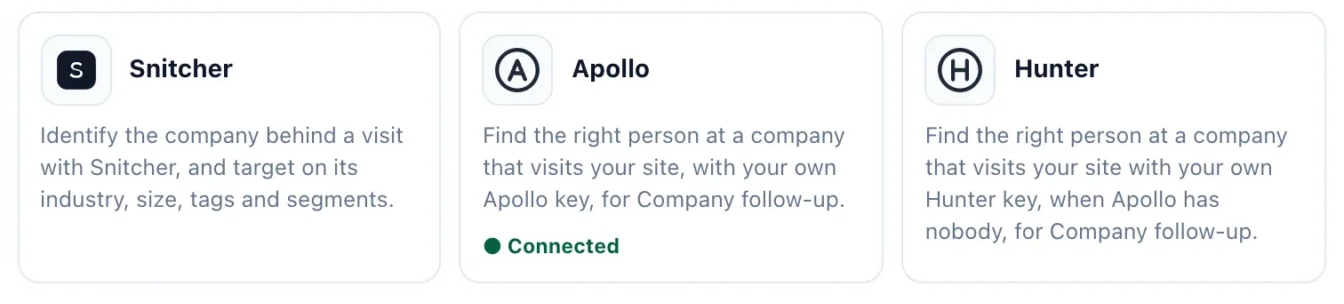
- A contact finder: Apollo (Connect with Apollo), ZoomInfo, Lusha, Snov.io or a Hunter key, or several, connected in Integrations. ZoomInfo people search is for teams that already connect ZoomInfo. They are your own accounts and credits: each person found uses your own credits with that tool, such as one Apollo credit for each person Apollo reveals, or one Hunter search for each company Hunter looks up. Apollo connects by signing in to Apollo and pressing Authorize, with no key to create or paste.
- A hosted landing page for the link to open, with places for the headline, the intro and the three ideas.
- Slack, connected in Integrations, if you want the alerts there as well as by email.
How to start: demo mode first
- Connect your identification integration, then a contact finder: Apollo (Connect with Apollo), ZoomInfo, Lusha, Snov.io or your Hunter key.
- Build the page once, in your own look, with the written parts dropped in.
- Add the action to a campaign whose targeting picks the companies you want: an industry, a size, the pages that show interest.
- Fill in the action: the sender, the one line about what you sell, up to ten job titles with the one you prefer first, and your own web addresses.
- Leave demo mode on. Every company is looked up and its page and email written; your rep gets every alert, and nobody is emailed.
- Company
- Halverd Freight · halverdfreight.com · Logistics · 1,200 staff · Chicago, US
- Why it fits
- Logistics, 200+ staff · read Pricing · Carrier tracking
- Person
- Dana Whitfield, Head of Operations (operations) · dana@halverdfreight.com (verified) · LinkedIn
- Their page
- go.lanewisetracking.com/for-you?cf=… Ready
Read a few days of alerts the way your rep will: the right company, the right person, a page you would be glad to send? Then start sending: from then on, each email waits for your rep’s OK, and once approved it goes in the person’s next weekday-morning window. Your site can greet those same companies while they read: see B2B personalization. Every setting is documented in the Company follow-up guide.
Questions people ask
How does Personyze follow up with companies that visit my website?
When your identification integration names a company and your campaign’s targeting matches it, Personyze finds the right person there by job title through your own contact finder (Apollo, ZoomInfo, Lusha, Snov.io or Hunter), writes a page for that company and role and one short email from it, and alerts your rep on Slack and by email. Your rep approves each email, and it goes from your rep with a link to their page.
What does the person receive?
One short email from your rep, which your rep approves before it goes, sent on a Tuesday, Wednesday or Thursday between 9 and 11 in the morning, their time, with a link to a page written for their company: a headline naming it, an intro for their role and three ideas of how what you sell helps them, read from their own site. Neither the email nor the page says they visited your site.
Is anything sent without my rep?
No. Each email waits for your rep under Identified companies, on a phone too, straight from the alert: Approve & send, Edit, Skip, or Copy to send it from your own mailbox. What your rep approves is what is sent, from your rep, and replies go to your rep.
Do I need my own Apollo, ZoomInfo, Lusha, Snov.io or Hunter account?
Yes. Personyze uses your own account with each tool you connect (ZoomInfo people search is for teams that already connect ZoomInfo). The tools are asked in turn, Apollo first and Hunter last, until one finds the right person by the job titles you choose, with a work email; any one of them also works alone. Each person found uses your own credits with that tool: one Apollo credit for each person Apollo reveals, one Hunter search for each company Hunter looks up. Answers are kept for 30 days, so repeat visits cost nothing.
Which identification tools does it work with?
Any company-identification integration that records the company’s web address, such as Albacross, Snitcher, Demandbase, ZoomInfo or Leadinfo. Personyze customers without one can start a free two-week Albacross proof of concept from the Albacross card in Integrations.
Could it email the wrong people, or the same company twice?
Your rep approves every email before it goes. Only an address the provider verified, at the company’s own domain, is emailed; anyone else goes to your rep. A company is emailed at most once in the days you set, 30 by default, and at most 20 companies a day by default. Webmail, internet providers, universities, government and your own domains are never looked up.
Can I try it without emailing anyone?
Yes, and that is how it starts. In demo mode every company is looked up, its page and email are written, and your rep gets every alert, but nobody is emailed. Start sending when the alerts look right; from then on, your rep approves each email.
Book a demo with a personalization expert
30 minutes with a personalization expert. Bring your stack, your goals, your skepticism. We'll show you what changes when every visit feels like the only one.