
Personyze
Scan your siteA first AI personalization plan for your site: the best ideas drawn on your own pages, before you have any data.
Starts right away · about 4 minutes · no email needed
Website & app
Website PersonalizationContent, offers and layout shaped to each visitor — one profile across every page and every session.Recommendation EngineWhat each visitor wants next, ranked by the algorithm you pick or one you write.A/B TestingA winner per audience, promoted mid-campaign rather than after it.Dynamic Landing PagesThe whole page recomposed per visitor — headline, imagery and offer from the ad they clicked and their own interests. On pages you already run.AI Search & Chat AgentAnswers from your own pages and catalogue, and a search box that replies in a sentence.Banners & Pop-UpsYou decide who sees each banner or pop-up — by behavior, source, location or CRM field — and when it appears.AI Promotion ManagerYou list the offers; the AI picks the one each visitor sees and keeps learning from what converts.Social ProofLive scarcity, ratings and what other people just did.
Email, push & SMS
Email PersonalizationContent and recommendations picked per reader at open time — sent from Personyze or pasted as one block into your ESP.Push, SMS & WhatsAppFired by what they just did rather than by a schedule.Hosted Landing PagesThe same per-visitor page, served by us — your domain or ours, no site to deploy to.
Targeting & analytics
Behavioral TargetingSegments that update themselves from what people actually do.Audience DiscoveryPlain-language audiences found in your own data — visitors who convert several times more often than average, targetable in a click.ABM MarketingThe company behind an anonymous visit, joined to your CRM.Website AnalyticsSessions, bounce and revenue — then click a row and there is a person.
Platform & integrations
MCP ServerRun your account from Claude, ChatGPT or any MCP client.IntegrationsHubSpot, Salesforce, Twilio Segment, Tealium, GTM and the REST API.App MarketplaceThe integrations built in to every plan, and apps from other companies that Personyze reviews before listing.APIs, SDKs & AutomationOne REST endpoint over every object, server and mobile SDKs, rules and reports that run on their own.Inspire meType your site: who visits, what to show each of them, and the best ideas drawn on your own pages.
Reviews, surveys & chat
Reviews & TestimonialsReviews from 17 platforms and your own site, matched to each visitor.Surveys & NPSOne question or a whole survey — every answer ready to target.AI Chat AgentAnswers visitors’ questions from your own pages, and hands over to a person.Meeting SchedulerThe right visitors book time with your team, on your own page.
PricingVideosProduct TourShort narrated videos of the real platform, one feature at a time.
All playbooksEmail Marketing Playbook

Email that writes itself per person.

A full email-personalization playbook — assemble each message from recipient data, automate behavioral triggers, and recover abandoned carts.

Start Now →
9 playbook topicsBehavioral triggersCart recovery

1Start here

Create a campaign and choose Email & SMS. A campaign that sends from Personyze runs these steps:

  1. Your people — where the recipients come from: a list you upload, your CRM, your own site.
  2. Target — which of them get it, and who is excluded.
  3. Content — the email, or a sequence of them, with each person’s own details and products. The same step can send an SMS, or a webhook into another system.
  4. Sending — who it is from and where replies go.
  5. QA — the checks before anything goes out.
  6. Performance — what each email did, step by step.

Would rather keep your own ESP? Personyze recommendation and banner blocks paste into Mailchimp, Klaviyo or any other ESP and fill in when the email is opened — see the open-time recommendations playbook. A whole campaign built step by step: a personalized email invitation sequence.

2Your people: lists, CRM and your own site

Recipients can come from several places at once, and every field they bring can be printed into the email or used to target it.

Upload a list

Upload a CSV under Imported user data › New import. Personyze reads the header row and suggests a profile field for each column; for a column that is yours alone, choose Create a field for this column. Nothing is imported until you confirm the mapping. A list can also be kept in sync from a feed, an API push or files on SFTP.
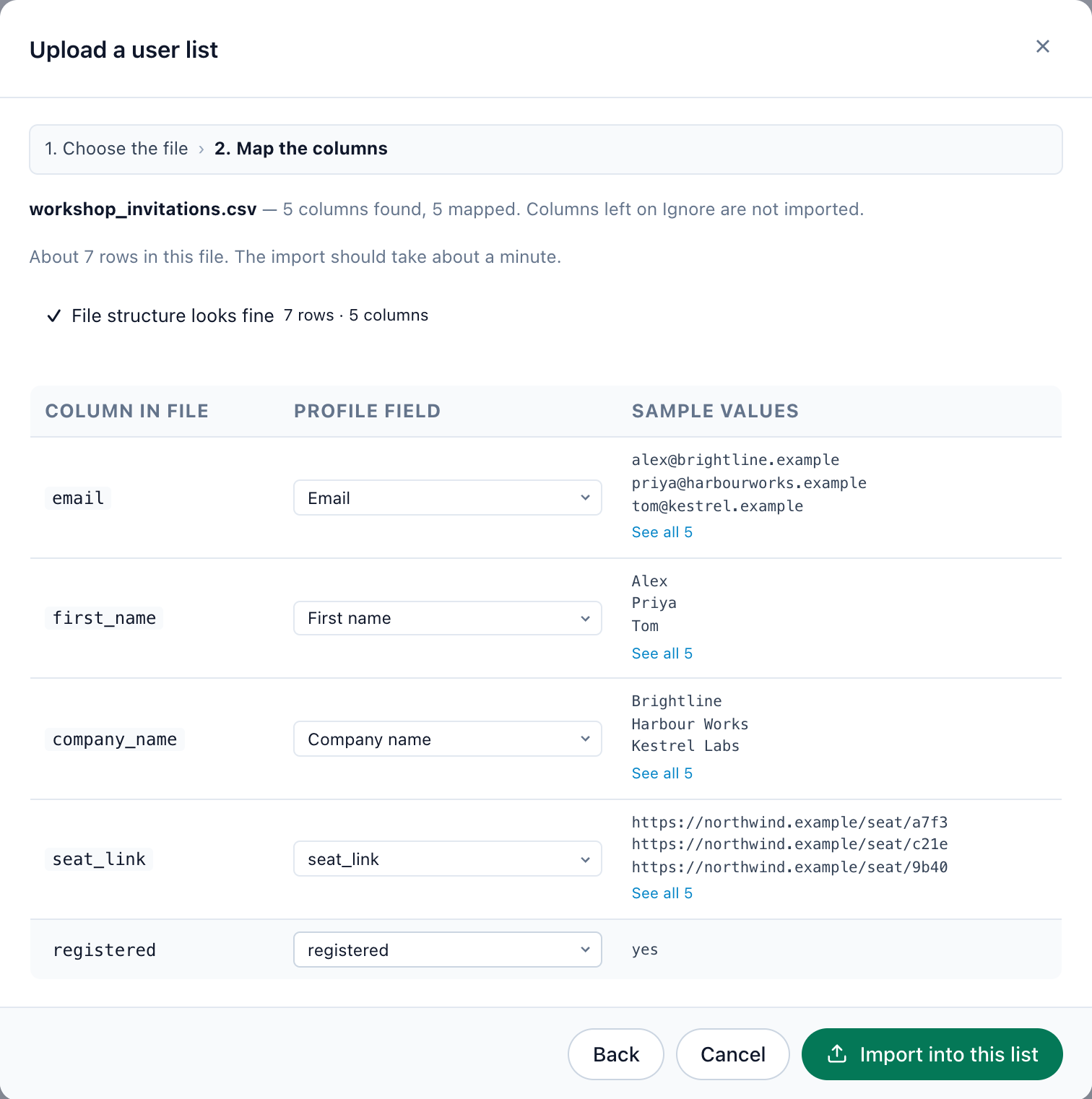
Uploading a list: five columns mapped to profile fields, including two custom fields
Map the columns. Email, first name and company are recognised; a personal link and a registered flag become custom fields.

Bring in your CRM

Connect HubSpot or Salesforce and switch on Import contacts: every contact arrives with its fields. Zoho, Eloqua, Klaviyo, Mailchimp, Segment and others connect from the same Integrations page.

Pick it up on your own site

Personyze can take the address from a link in an email you sent, from a sign-up or checkout field, or from your Google Tag Manager data layer — so visitors become recipients without a new form.

3Who gets it

The Target step narrows your people to the ones this email is for. The rule most campaigns need first is User Lists → in <your list>. The second keeps it polite: an Exclude rule on whoever already did what you are asking — registered, bought, booked.
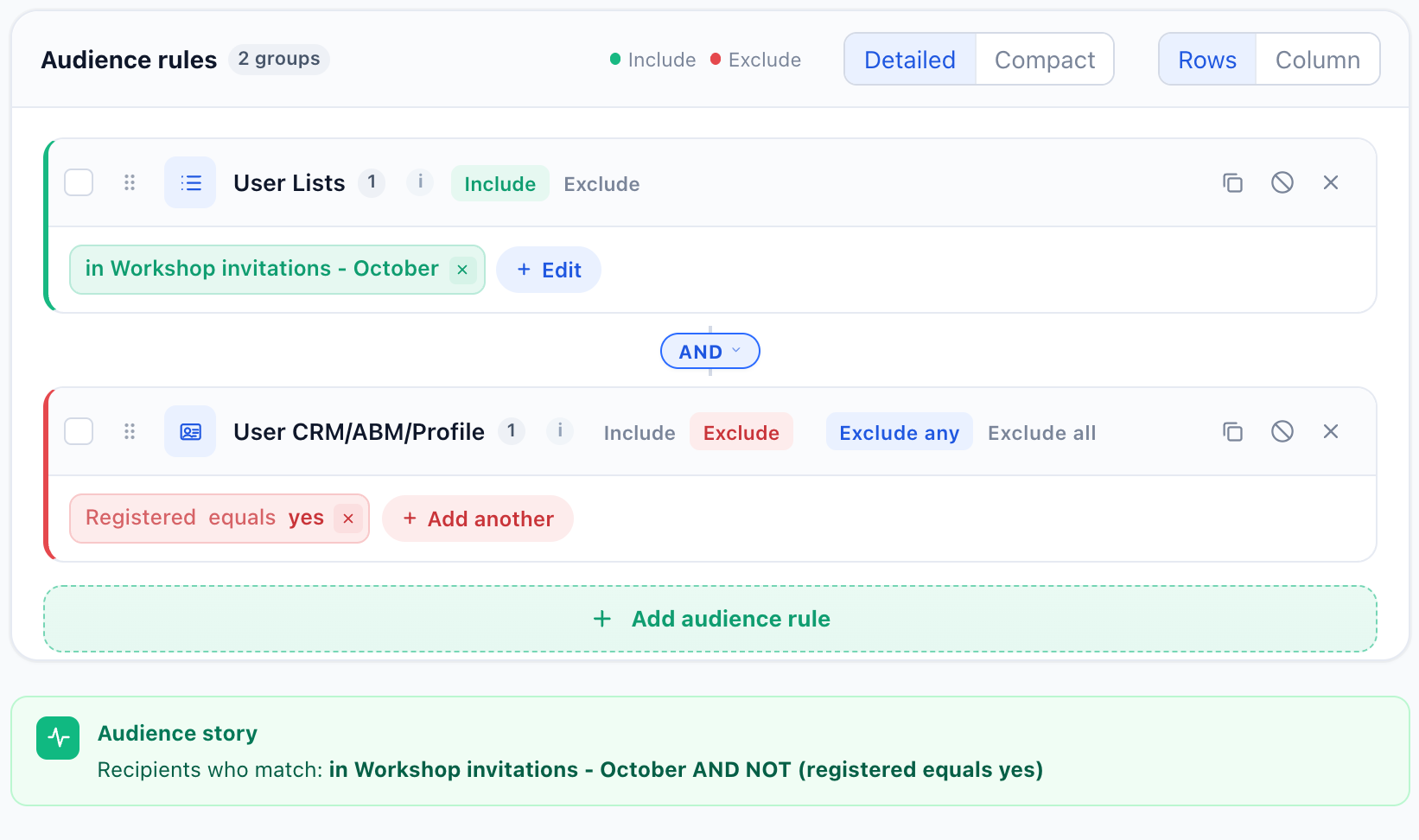
Audience rules: include everyone in the uploaded list, exclude anyone whose registered field equals yes
Two rules. Everyone in the list, and not anyone already registered. The Audience story says it back in one sentence.

The audience is checked again each time an email is due, not once at the start — somebody who acts after the first email simply never gets the reminders. Unsubscribes are excluded automatically.

4Products in email

A recommendation block fills in each recipient’s own products when the email is sent. The algorithms built for email:

  • Left in Cart ItemsWhat is still sitting in their cart.
  • Left in Cart Items Now DiscountedCart contents whose price has changed since their last visit.
  • Cross-Sells for Items in CartItems bought together with what is in the cart.
  • Recently ViewedThe items they viewed, most recent first.
  • Wishlist Now DiscountedSaved items whose price has changed since their last visit.
  • Buy it AgainWhat they purchased before — for anything that runs out.
  • New in StockRecently added, or new since their last visit.
  • Personalized RecommendationsFrom their profile and similar people’s behaviour.

Every text in the email can carry a variable — any field you uploaded or imported — with a fallback, so an empty field never leaves a hole in the sentence:

Hi ${first_name:default('there')},

Write in the email editor, or open HTML Source (advanced) to write the HTML yourself.

5Articles in email

For a newsletter or a digest, recommend articles instead of products:

  • Content Recommended for You Published Since Your Last VisitWhat they missed, from the topics they read.
  • Content Recommended for YouFrom their reading history.
  • Most Read ContentWhat everyone is reading.
  • Recently PublishedThe newest articles first.

6Send it as you

The Sending step decides who each email is from and where replies go: a sender of your own with a person’s name, a Reply-To address, and Track replies, which counts replies in the report while they still reach you.
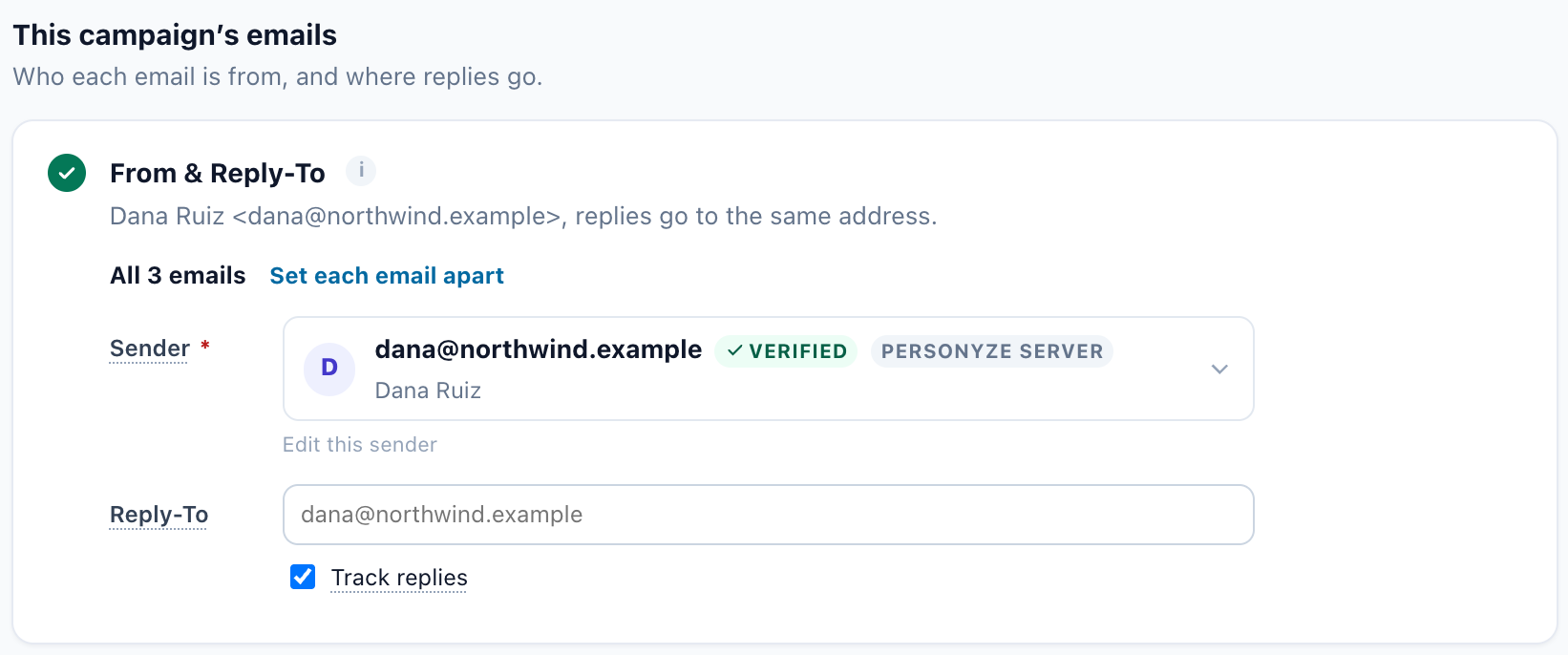
The sender for all three emails: a verified address with a person’s name, the Reply-To address and Track replies switched on
From and Reply-To. One sender for every email of the campaign, or a different one per email.

The rest is set once for the whole account, so your next campaign finds it done: your sending domain (verify it, and your email is signed with DKIM in your own name), your mailing address, your unsubscribe page, and single or double opt-in. Send me a test sends every email of the campaign to an address you type. Why the domain matters: send email from your own domain.

7The sequence, and when it goes

In the Content step, the first email starts when someone joins the audience — for an uploaded list, straight away. Add a step for each follow-up, then set how long it waits after the email before it and who gets it: always, only those who didn’t open, only those who opened, or a sharper rule such as did not click in it.
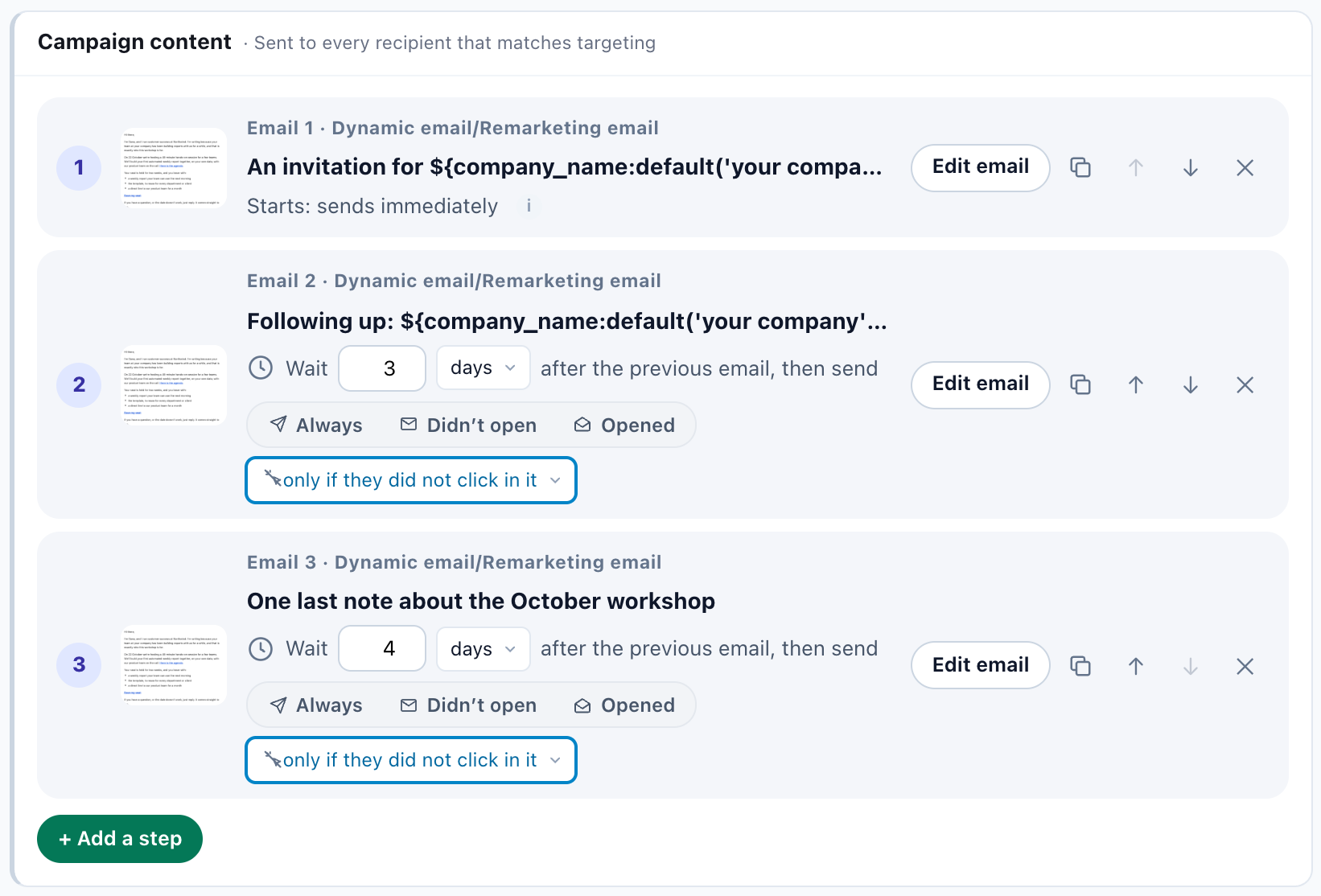
Three emails in a sequence: the first sends at once, the next ones wait days and go only to people who did not click
Three emails, one list. Each waits a few days and goes only to people who did not click the one before.

Each email’s Timing decides when it may go: the hour of day, in each person’s own time zone, the days of the week, how often one person may get it, and a send speed limit so a large list goes out at a pace your domain can carry.
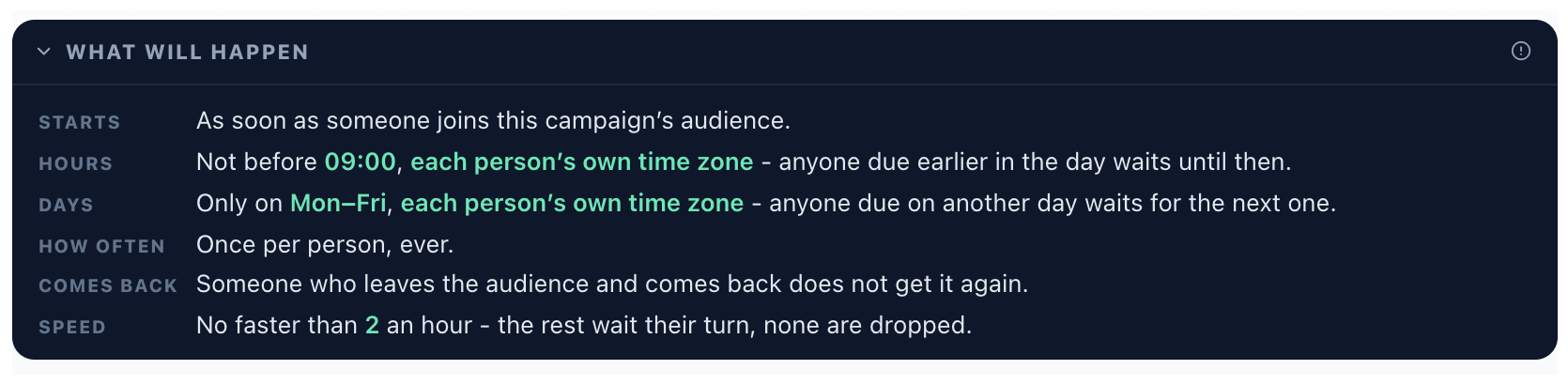
What will happen: not before 09:00 in each person’s own time zone, Monday to Friday, once per person, no faster than 2 an hour
The settings, said back in words. Nobody gets it at 3 a.m., and the rest wait their turn rather than being dropped.

Planning longer sequences that stop on their own: email sequences that know when to stop.

8Subject tests that call their own winner

Write the subject and the preheader side by side with an inbox preview on a desktop and a phone, so you see what the phone cuts off. Add up to three subject lines to one email: they share the sends, and with Pick the winner automatically everyone gets the winning subject once it is sure.
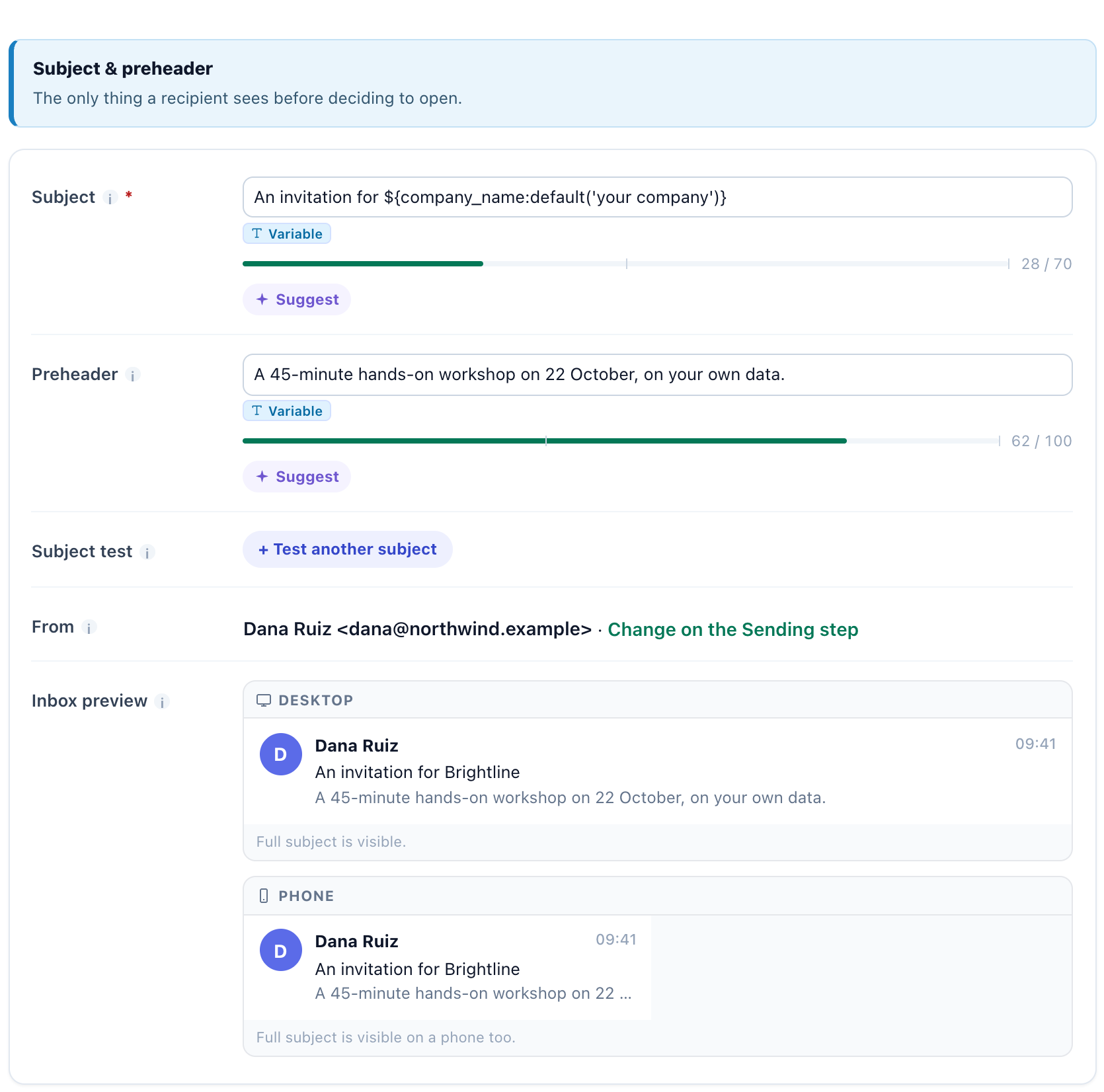
The subject with a variable and its fallback, the preheader, and the inbox preview on desktop and phone
Subject and preheader, with the inbox preview of the same email on a desktop and a phone.

Subjects are judged on click rate, not opens: Apple Mail opens every email it receives, read or not. How to write and test both lines: the subject line and the preheader.

9Check it before it goes out

  • Preview by user renders any email of the sequence exactly as one person will get it, with their own details. Try someone with empty fields to see the fallbacks.
  • Send a copy mails that exact message to you.
  • Check for spam scores the email with a spam filter and runs the deliverability checks: the unsubscribe header and link, a postal address, the subject and preheader, text against images, the links, the size, and whether your domain is verified and signed.
  • Staging mode runs the campaign exactly as it will run — rules evaluated, waits counted — but sends every email to one test address.
  • Sample recipients lists people who match right now, with what has been sent to each.
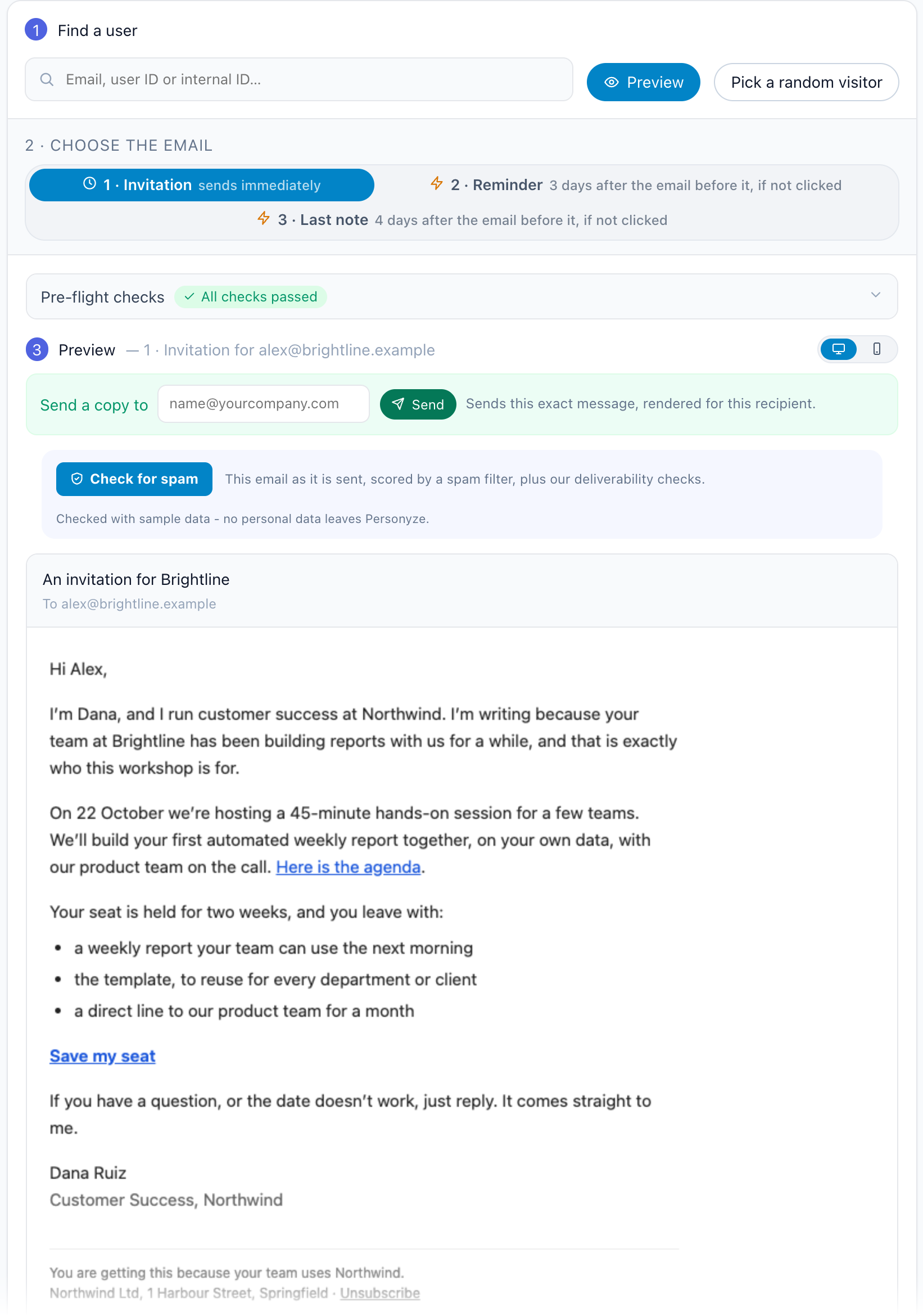
Preview by user: the first email of a three-email sequence rendered for one person with their own name and company
Preview by user. The first of three emails, rendered for one person; the other two are a click away.

10Read the results

The campaign’s Performance step shows each email’s journey — sent, delivered, opened, clicked and converted, with bounces, spam complaints, replies and unsubscribes beside it — and a sequence step by step: who each email reached, who went on to the next, who is still waiting, and who left.
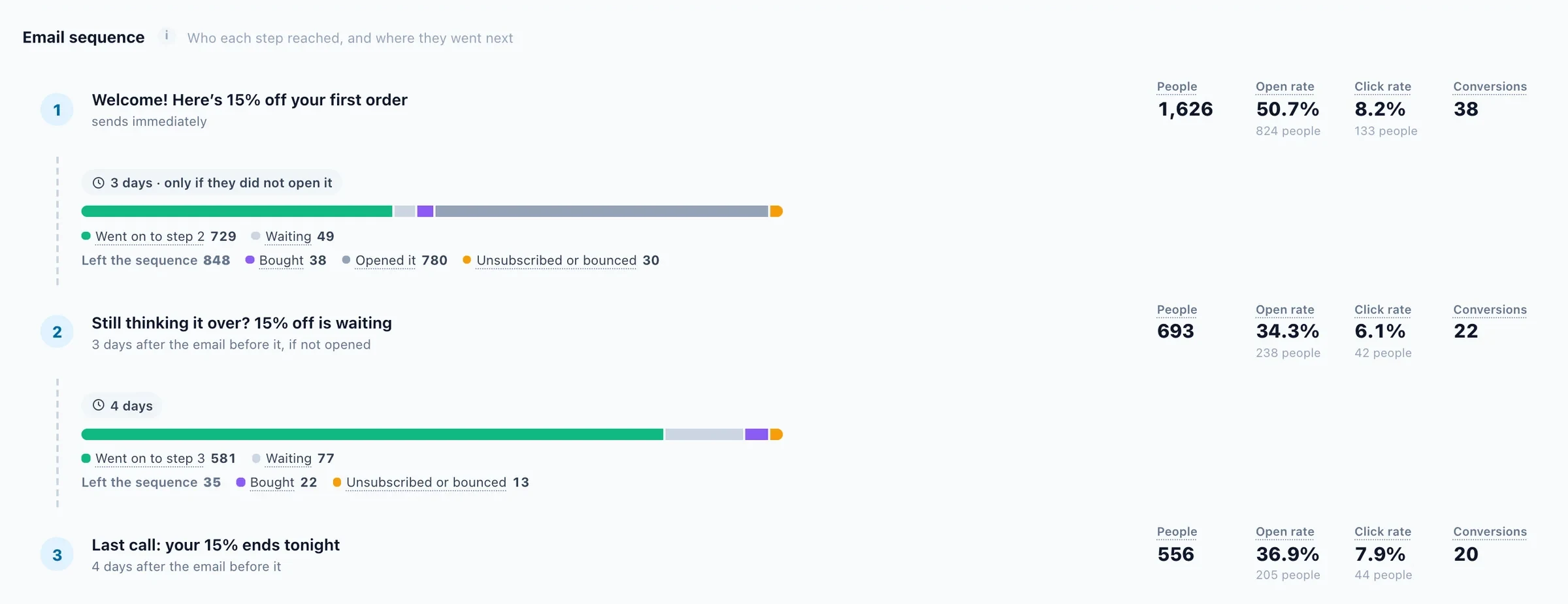
A three-email sequence report: who each step reached, who went on to the next one, who is still waiting and who left
A sequence, step by step, on a demo account. The numbers are illustrative.

What each number means

  • Opened — messages whose tracking pixel loaded. Blocked images undercount opens, and Apple Mail overcounts them.
  • Clicked — messages with at least one link click.
  • Purchased — recipients who completed a purchase on your site after the email.
  • Share of site revenue — the revenue attributed to the campaign as a share of the site’s total in the period.
FAQ

Playbook questions, answered.

Common questions about email marketing automation and personalization. Anything else, our team is one message away.

Does Personyze replace my current ESP (like Mailchimp)?

It can, or it can work beside it. Personyze sends sequences and triggered emails itself, from your own domain; or its recommendation and banner blocks paste into your Mailchimp, Klaviyo or other ESP templates and fill in when the email is opened.

How do you get the user's email?

From a list you upload, from your CRM (HubSpot, Salesforce and others import their contacts), through the API, or on your own site: from a link in an email you sent, from a sign-up or checkout field, or from your Google Tag Manager data layer.

Who do my emails come from?

From a sender of your own, with a person’s name, set on the campaign’s Sending step together with the Reply-To. Verify your sending domain once for the whole account and your email is signed with DKIM in your own name — the spam check on the QA step tells you whether it is.

What is "Open-Time" Personalization?

This refers to generating the email content (like product recommendations) at the exact moment the user opens the email, rather than when it was sent. This ensures the products shown are still in stock and the pricing is current.

Can I A/B test subject lines?

Yes. Add up to three subject lines to an email; they share the sends, are judged on click rate, and with Pick the winner automatically everyone gets the winner once it is sure.

What happens if a recommended product goes out of stock?

If you use our "Open-Time" widgets (embedded images), the system checks stock status in real-time. If an item is out of stock when the user opens the email, it is automatically replaced with the next best recommendation.

Can I limit how many emails a user receives?

Each email’s Timing sets how often one person may get it, which hours and days it may go, and a send speed limit for the whole campaign. A sequence step can also go only to people who did not open or click the one before.

How do I track revenue from emails?

Links carry the UTM parameters you set. When a recipient clicks through and buys, the tracker on your site attributes the purchase to the email: it appears as Purchased in the email’s journey and in the campaign’s share of site revenue.

Can I send SMS instead of Email?

Yes. An Email & SMS campaign’s content can be an SMS, or a webhook that hands the message to another system.

How do users Unsubscribe?

Every email carries an unsubscribe link and the one-click unsubscribe header, and points to the unsubscribe page you set once for the account. Unsubscribed people are excluded from every campaign automatically.

Can I recommend articles in emails?

Yes. Just like products, you can recommend "Articles You Missed" or "Trending News" based on the user's reading history. This is ideal for weekly digests or publisher newsletters.

Do I need to know HTML?

No. The email editor has templates to start from and builds the email visually; HTML Source (advanced) opens the raw HTML when you want to write it yourself.

What is a "Beacon" or "Pixel"?

This is a tiny, invisible image included in the email. When the email loads, the image loads, telling Personyze that the email was "Opened." This allows us to calculate Open Rates.

How fast are emails sent?

A step goes out when its wait is over and its Timing allows: within the hours and days you set, in each person’s own time zone, no faster than the send speed limit. A list without limits goes out straight away.

Ready to launch

Send email that converts.

You have the full email playbook — now send messages assembled from each recipient’s own data.

Free to start · No credit card · Setup in minutes