Personyze
Scan your siteA first AI personalization plan for your site: the best ideas drawn on your own pages, before you have any data.
Starts right away · about 4 minutes · no email needed
Website & app
Website PersonalizationContent, offers and layout shaped to each visitor — one profile across every page and every session.Recommendation EngineWhat each visitor wants next, ranked by the algorithm you pick or one you write.A/B TestingA winner per audience, promoted mid-campaign rather than after it.Dynamic Landing PagesThe whole page recomposed per visitor — headline, imagery and offer from the ad they clicked and their own interests. On pages you already run.AI Search & Chat AgentAnswers from your own pages and catalogue, and a search box that replies in a sentence.Banners & Pop-UpsYou decide who sees each banner or pop-up — by behavior, source, location or CRM field — and when it appears.AI Promotion ManagerYou list the offers; the AI picks the one each visitor sees and keeps learning from what converts.Social ProofLive scarcity, ratings and what other people just did.
Email, push & SMS
Email PersonalizationContent and recommendations picked per reader at open time — sent from Personyze or pasted as one block into your ESP.Push, SMS & WhatsAppFired by what they just did rather than by a schedule.Hosted Landing PagesThe same per-visitor page, served by us — your domain or ours, no site to deploy to.
Targeting & analytics
Behavioral TargetingSegments that update themselves from what people actually do.Audience DiscoveryPlain-language audiences found in your own data — visitors who convert several times more often than average, targetable in a click.ABM MarketingThe company behind an anonymous visit, joined to your CRM.Website AnalyticsSessions, bounce and revenue — then click a row and there is a person.
Platform & integrations
MCP ServerRun your account from Claude, ChatGPT or any MCP client.IntegrationsHubSpot, Salesforce, Twilio Segment, Tealium, GTM and the REST API.App MarketplaceThe integrations built in to every plan, and apps from other companies that Personyze reviews before listing.APIs, SDKs & AutomationOne REST endpoint over every object, server and mobile SDKs, rules and reports that run on their own.Inspire meType your site: who visits, what to show each of them, and the best ideas drawn on your own pages.
Reviews, surveys & chat
Reviews & TestimonialsReviews from 17 platforms and your own site, matched to each visitor.Surveys & NPSOne question or a whole survey — every answer ready to target.AI Chat AgentAnswers visitors’ questions from your own pages, and hands over to a person.Meeting SchedulerThe right visitors book time with your team, on your own page.
PricingVideosProduct TourShort narrated videos of the real platform, one feature at a time.

AI Product Finder

An AI product finder that asks what they need.
And picks from your own catalogue.

An AI shopping assistant on your page. Shoppers describe what they need in their own words — “something warm for walking to work in the snow” — and get picks from your own catalogue, weighed against everything they viewed and bought and ranked by your recommendation engine, each with the reason it fits.

4.84.6
How it works

Tell it what you need.
Get a shortlist, with reasons.

A bar sits on the page, with a first line written for the shopper in front of it. They describe the need in their own words, and it answers with a short summary and up to four picks from your catalogue — each with the reason it fits — plus a few more worth a look.

A card cannot invent anything

The AI writes the summary and the reasons; the picture, price, stars and link on every card come straight from your catalogue. A sold-out item never appears as a pick.

They can ask about the picks

Under the results, “Ask about your picks”: which one is warmer, does it come in navy — answered without starting over.

In the shopper’s language

It answers, and writes every reason, in the visitor’s language — and searches your catalogue in the catalogue’s own.

The picks follow them

Results stay for the whole visit: “See your picks” brings them back on the next page, in a whole page, a box or a side panel.

Private by design. What a shopper viewed and bought shapes the picks; it is never said back to them.

More than their words

It knows what they viewed and bought.
Your engine ranks the picks.

The question says what they need. Their history says what they like: every product they viewed, carted and bought. The finder weighs both, and your personalized recommendation engine ranks the fits by how likely this shopper is to buy each one — the same scoring behind your recommendations.

What they ask

“Something warm for walking to work in the snow”

What they already did
  • Viewed 3 parkas, 2 pairs of boots
  • Carted merino socks
  • Bought a rain shell, in March
  • Size M, from past orders
What your store sells
TRENDINGMOST POPULARBEST SELLERSNEW ARRIVALSVIEWED TOGETHER
Ranked for this shopperLikely to buy
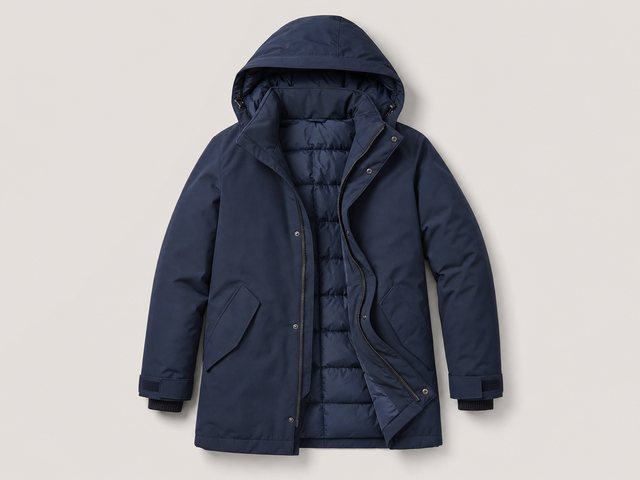
Insulated Parka
Insulated ParkaWindproof, with room for a layer
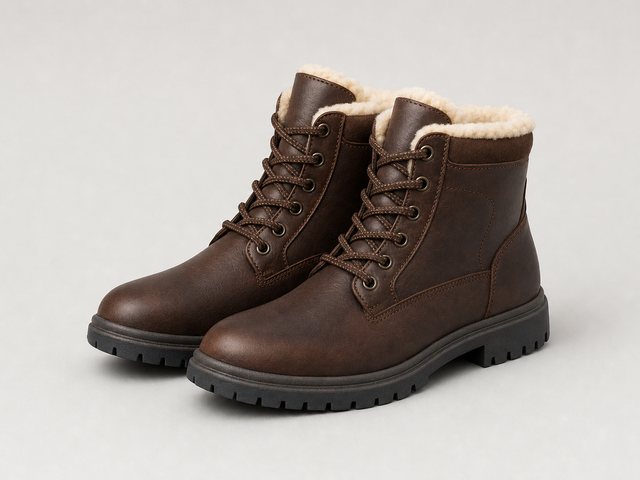
Winter Boots
Winter BootsLined, and they grip on ice
Merino Crew
Merino CrewStays warm when damp
Knit Gloves
Knit GlovesTouch-screen tips for the walk

Shoppers see the picks and the reasons. What they viewed and bought shapes the order, and is never said back to them.

Their words decide what fits

Only products that answer the need are in the running — not every item that happens to share a keyword.

Their history decides the order

What they viewed, carted and bought, on this visit and the ones before, moves the likely ones to the top.

Your engine, not a second one

The ranking comes from your personalized recommendation algorithm, so the finder and your recommendation widgets agree on what this shopper will want.

After the picks

The results page
sells the next step too.

Under the picks you choose what comes next, so a question can end in a cart, a coupon or a booking — without the shopper leaving the page.

Add to cart

Straight from a pick, where your store’s add-to-cart is set up in product tracking.

Your picks, in one list

Everything picked, side by side, with up to two buttons of your own — See the range, Book a fitting.

Also worth a look

Up to three more items under the main picks, for the shopper who wants options.

An offer, when it fits

Let it mention your offers, and the right coupon can appear with the picks.

A meeting, when it fits

Let it offer a meeting, and a calendar opens in the results for the shopper who wants a person.

Your own sections

Up to three of your other actions under the picks — reviews, a survey, social proof, recommendations, a form.

1,500+
Brands running campaigns with Personyze
4.6/5
G2CapterraCrozdesk
Average rating from customer reviews
11
Languages its own buttons and messages come in
In the panel

See it in Personyze,
screen by screen.

The wizard’s steps, then the designer with each of its settings open — real screens from the panel, one after another. Or watch both finders set up, start to finish.

The wizardThe designerWatch
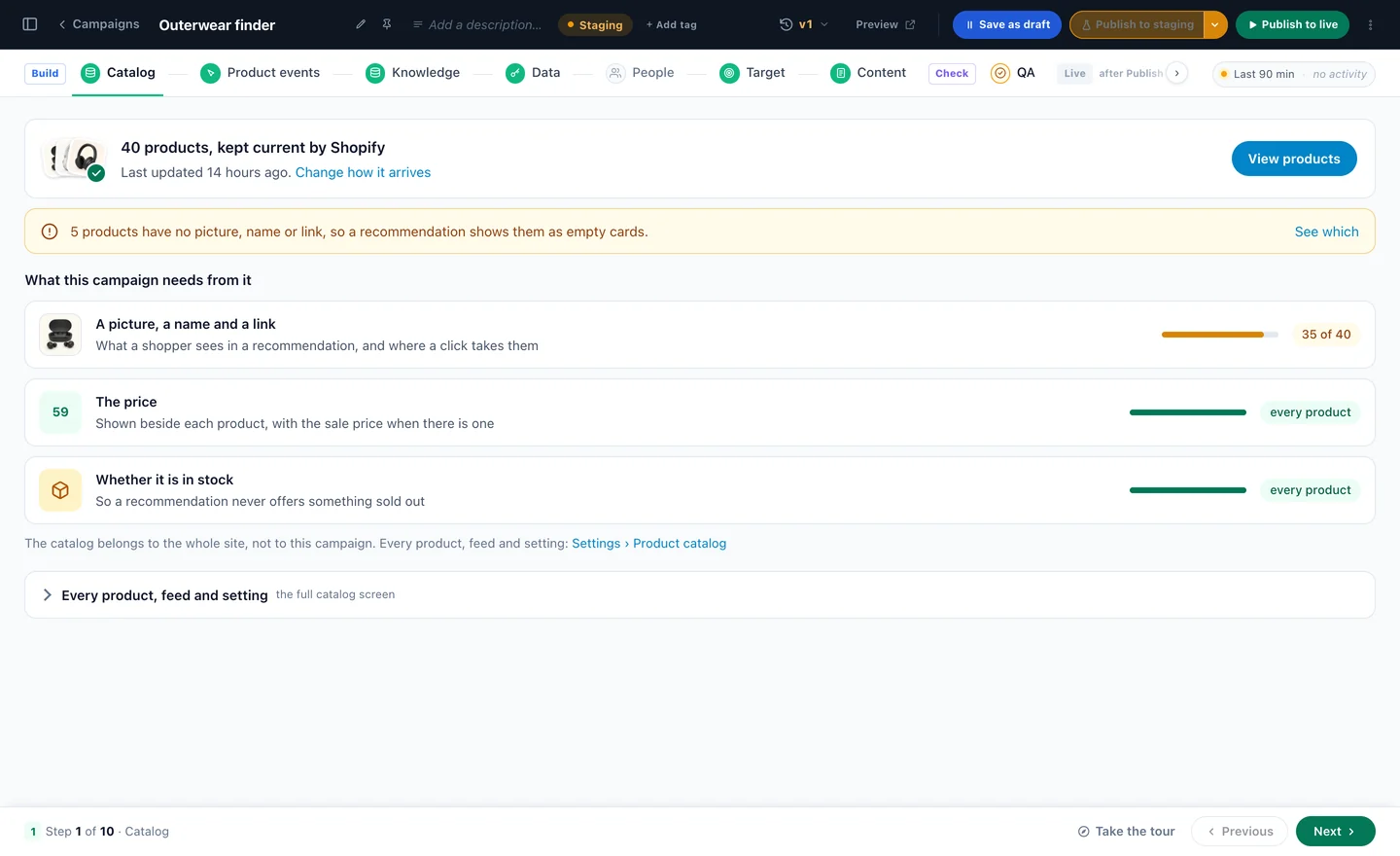
The finder campaign's Catalog step in Personyze: 40 products kept current by Shopify, and what each card needs - a picture, a name and a link, the price, whether it is in stock
Open full size ↗
The wizard

Your products, kept current

The first step checks what it picks from: how many products, where they come from, and what every card needs — a picture, a price, whether it is in stock.

The wizard

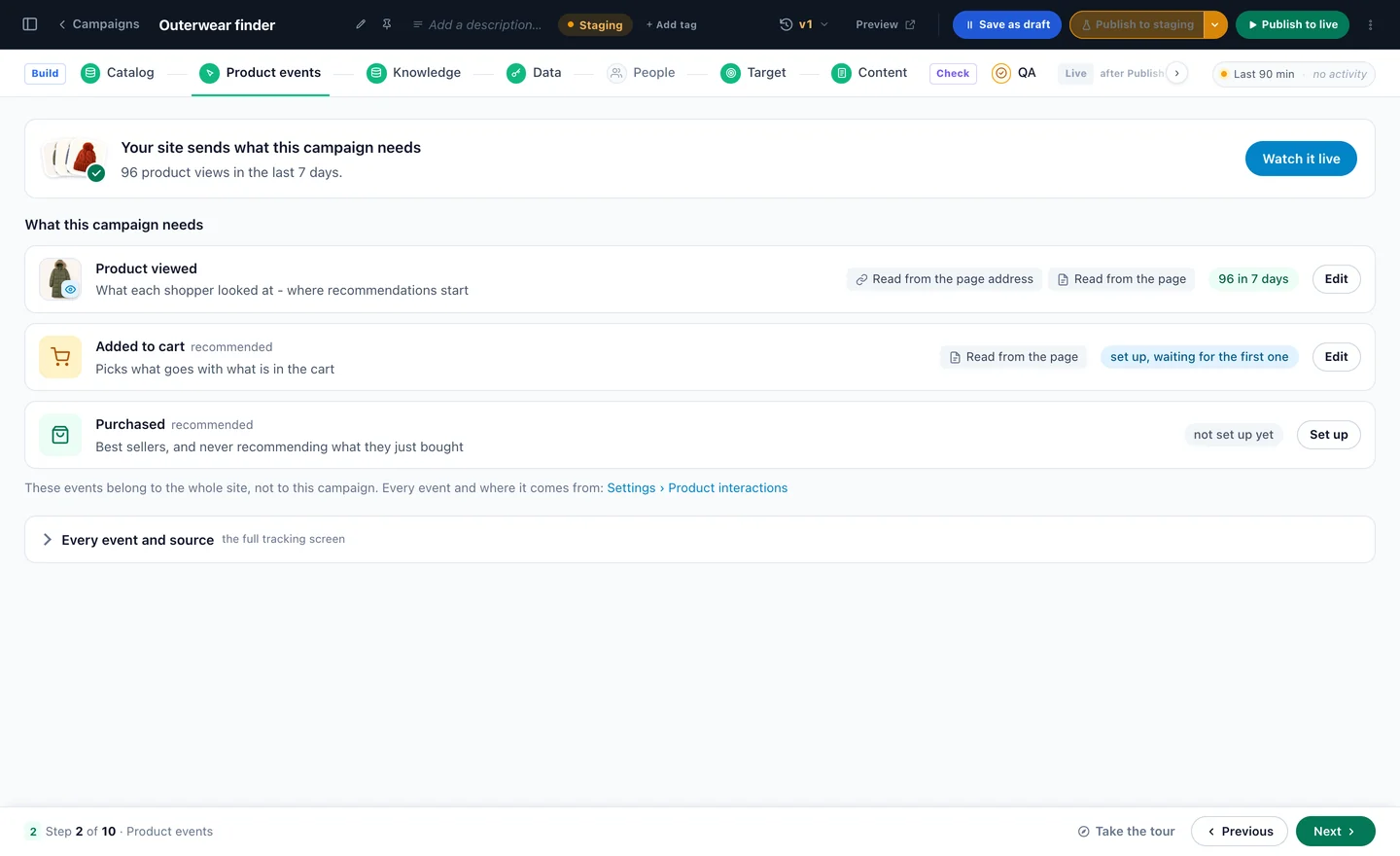
What shoppers do with your products

Viewed, added to cart, purchased — the events behind the rankings, and behind what it knows about each shopper.

The wizard

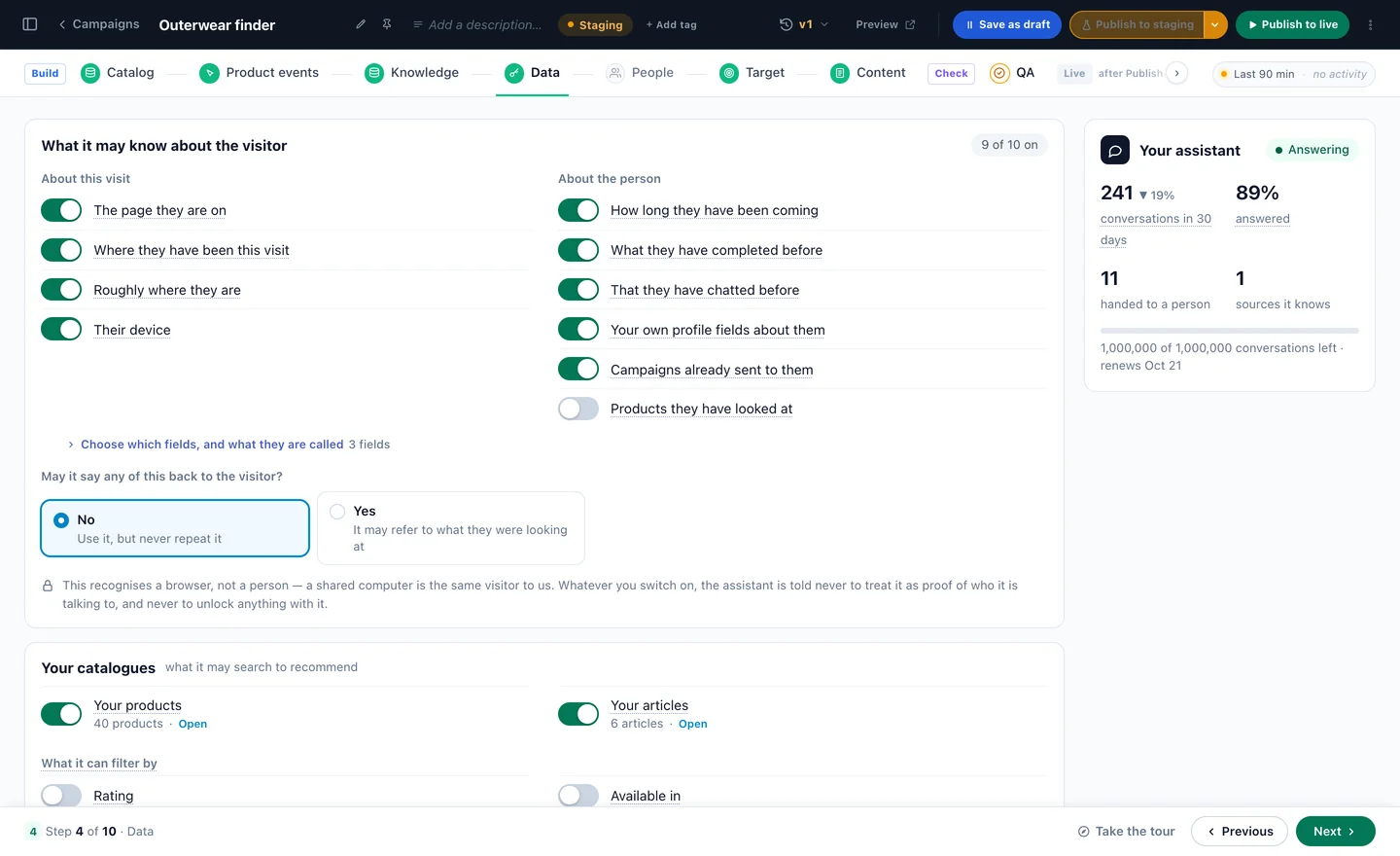
What it may know about the visitor

You switch on what it may use: the page they are on, this visit, earlier visits, what they finished before.

The wizard

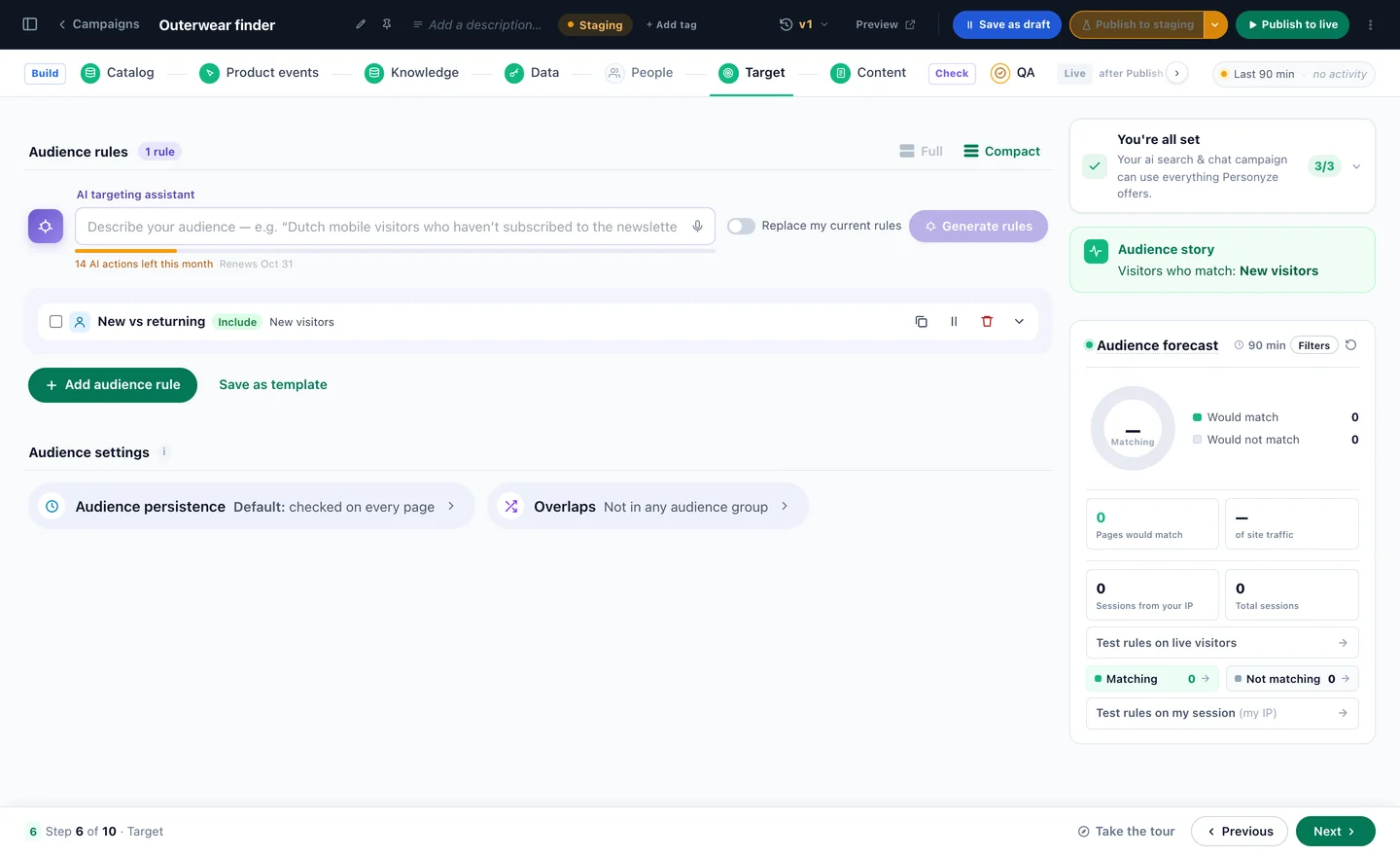
Who gets this finder

Audience rules in plain words or built from conditions, with a forecast of who will match.

The designer

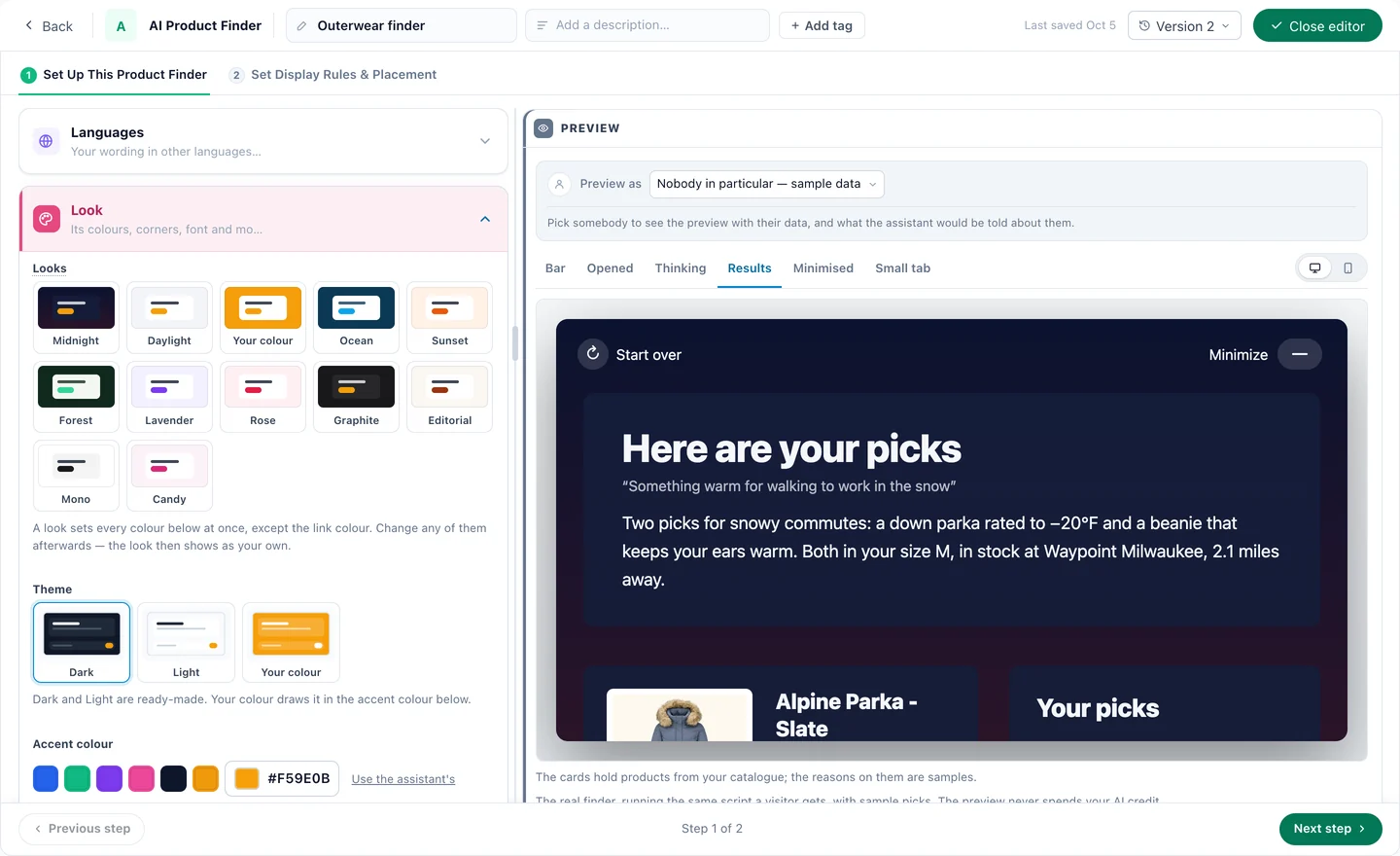
Twelve looks, or your own colours

Dark, light or your colour, then every surface, corner, font and the way it arrives — previewed beside you.

The designer

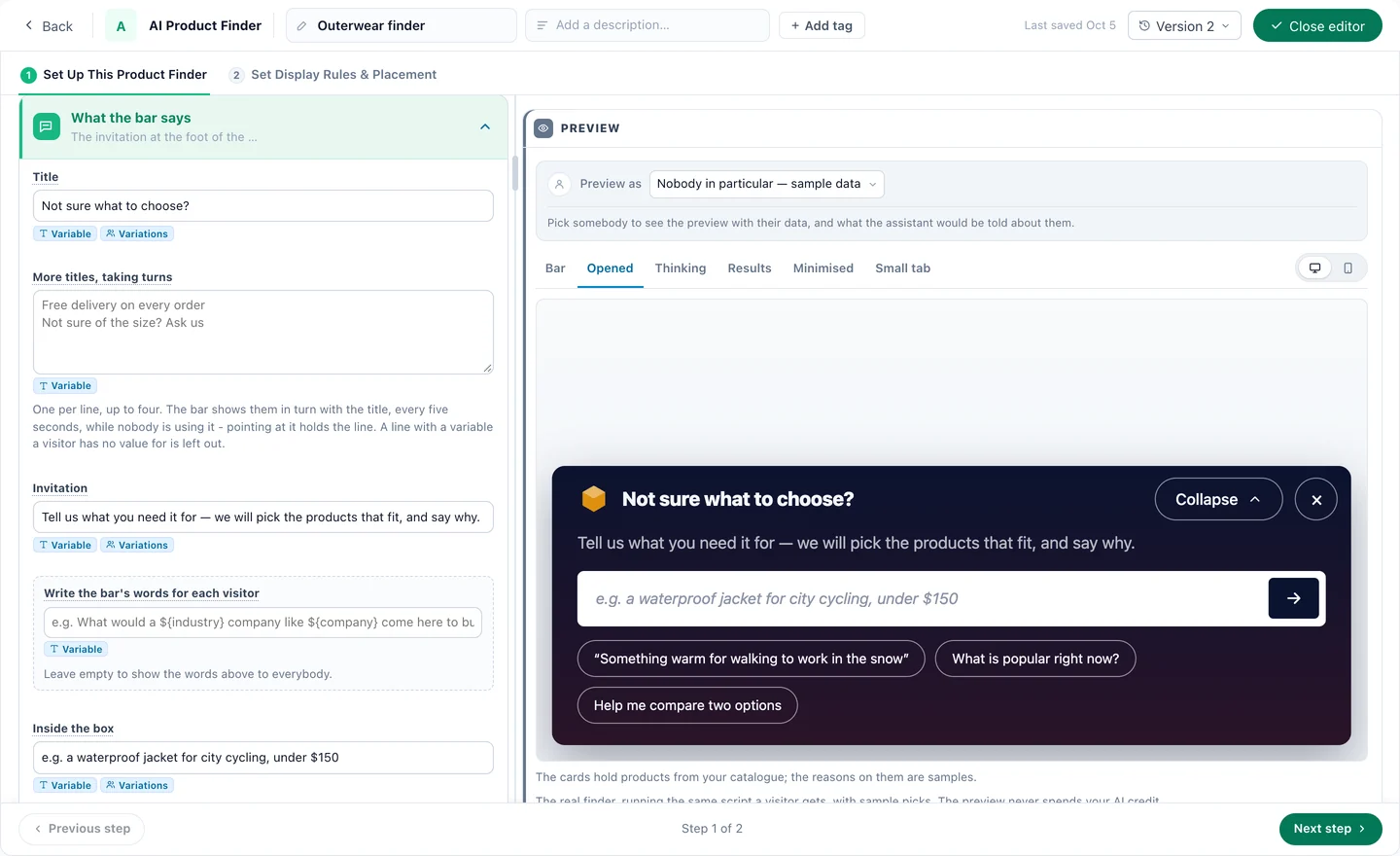
What the bar says

A title, more titles taking turns, the invitation and examples to tap — or words written for each visitor.

The designer

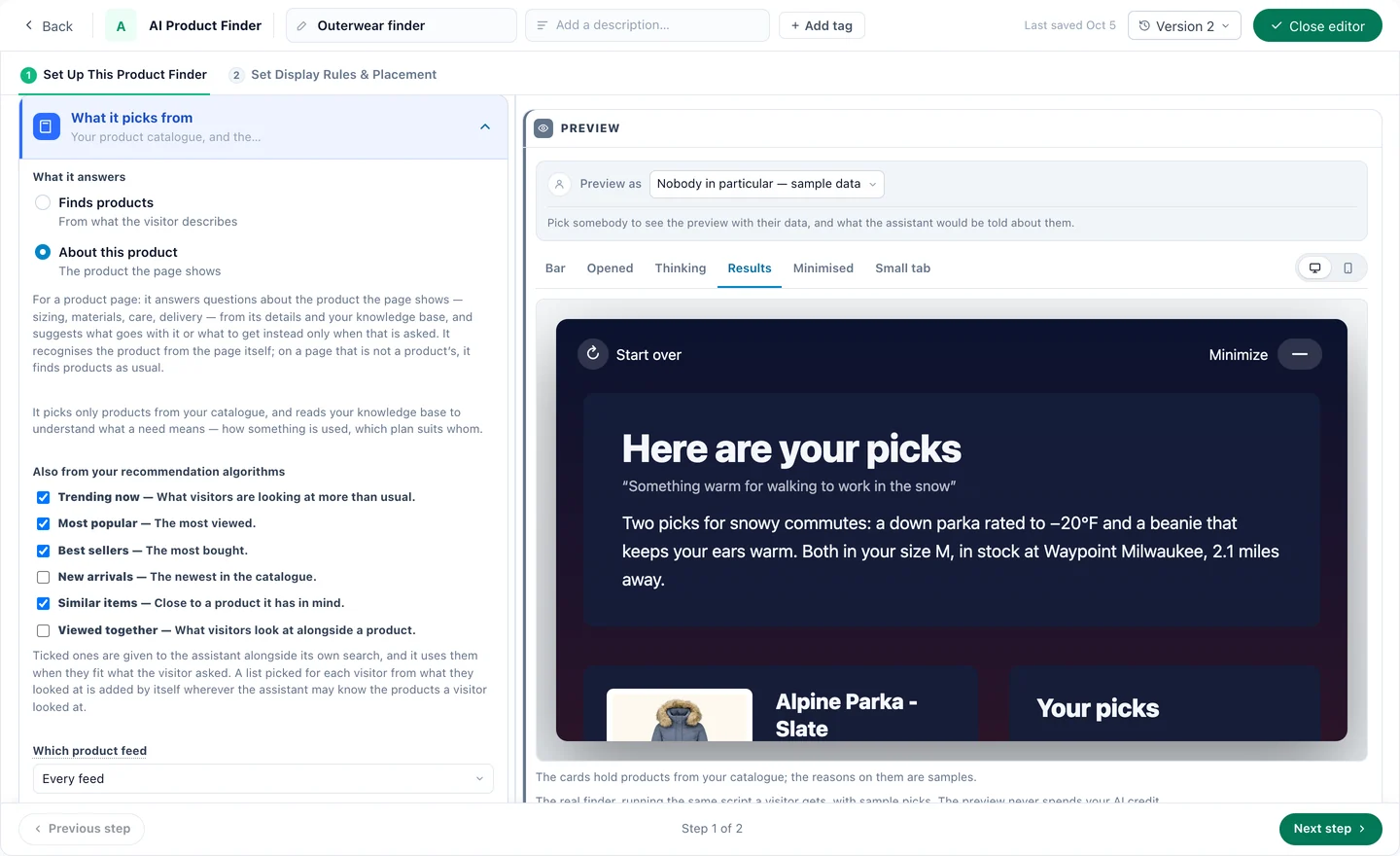
What it picks from

Your catalogue, plus the recommendation algorithms it may lean on — trending, best sellers, new, similar, viewed together — and “Only recommend” rules.

The designer

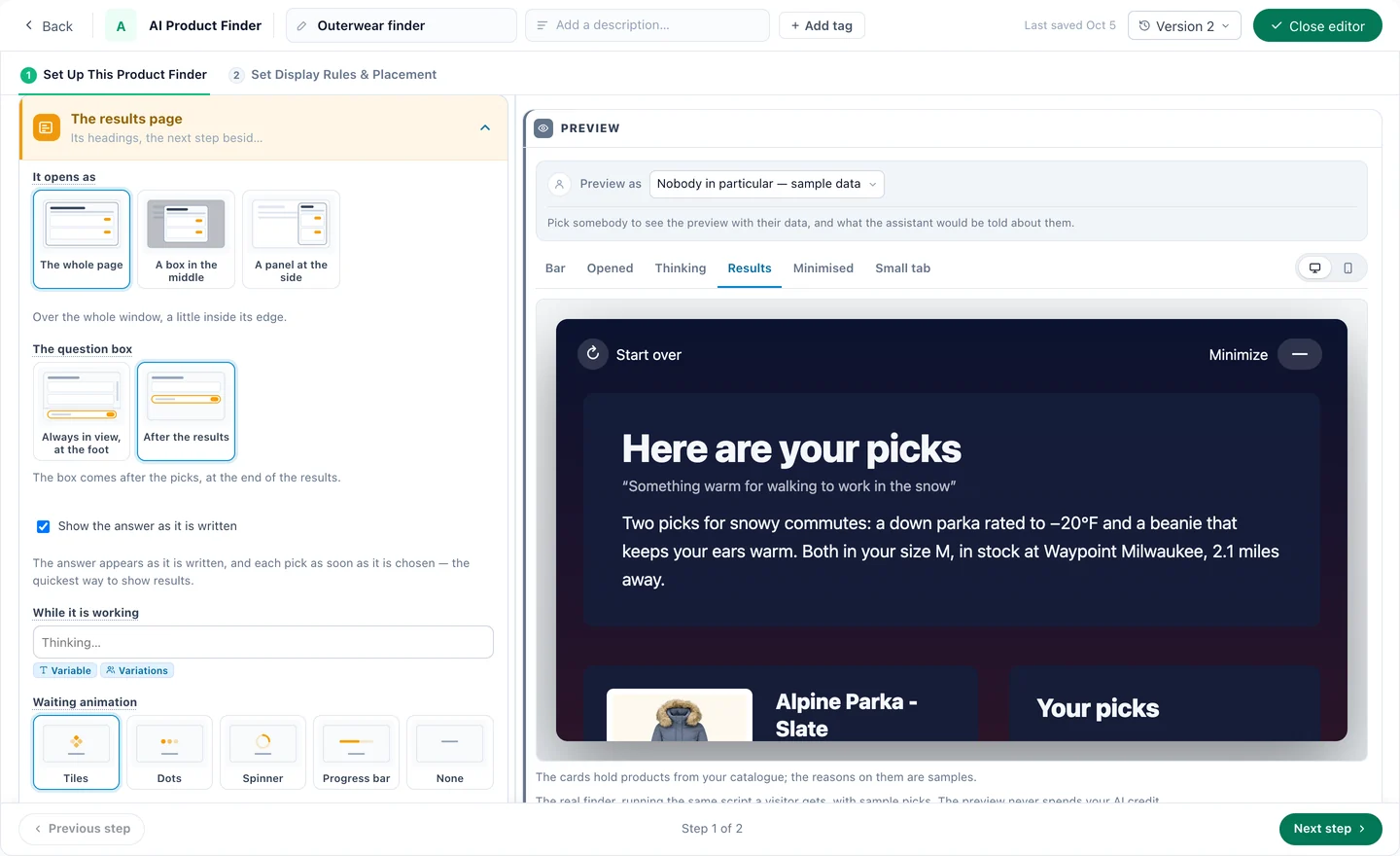
The results page

The whole page, a box or a side panel; the question box, the waiting animation and the next-step buttons.

The designer

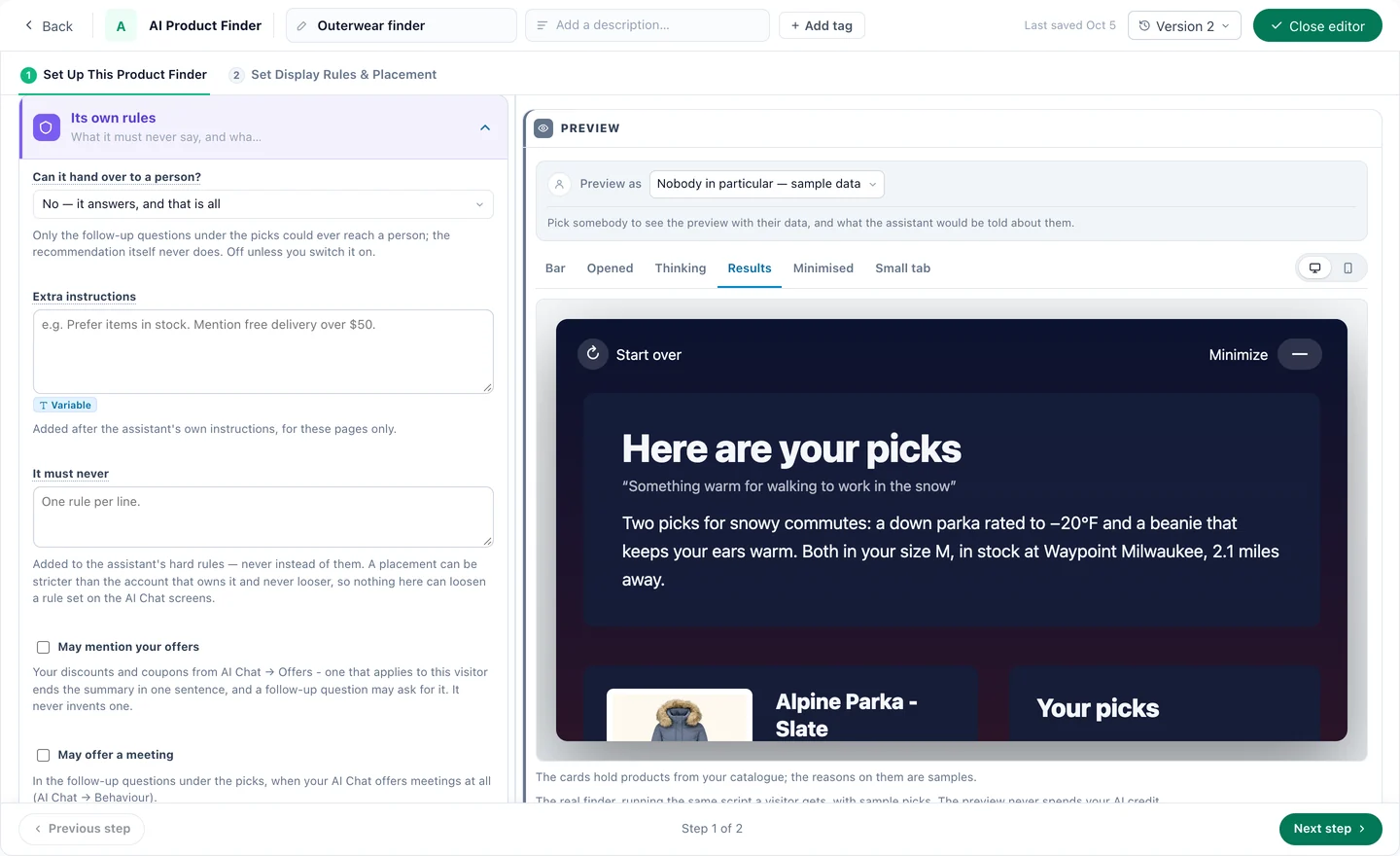
Its own rules

Whether it hands over to a person, extra instructions, what it must never say — and whether it may mention offers or a meeting.

The designer

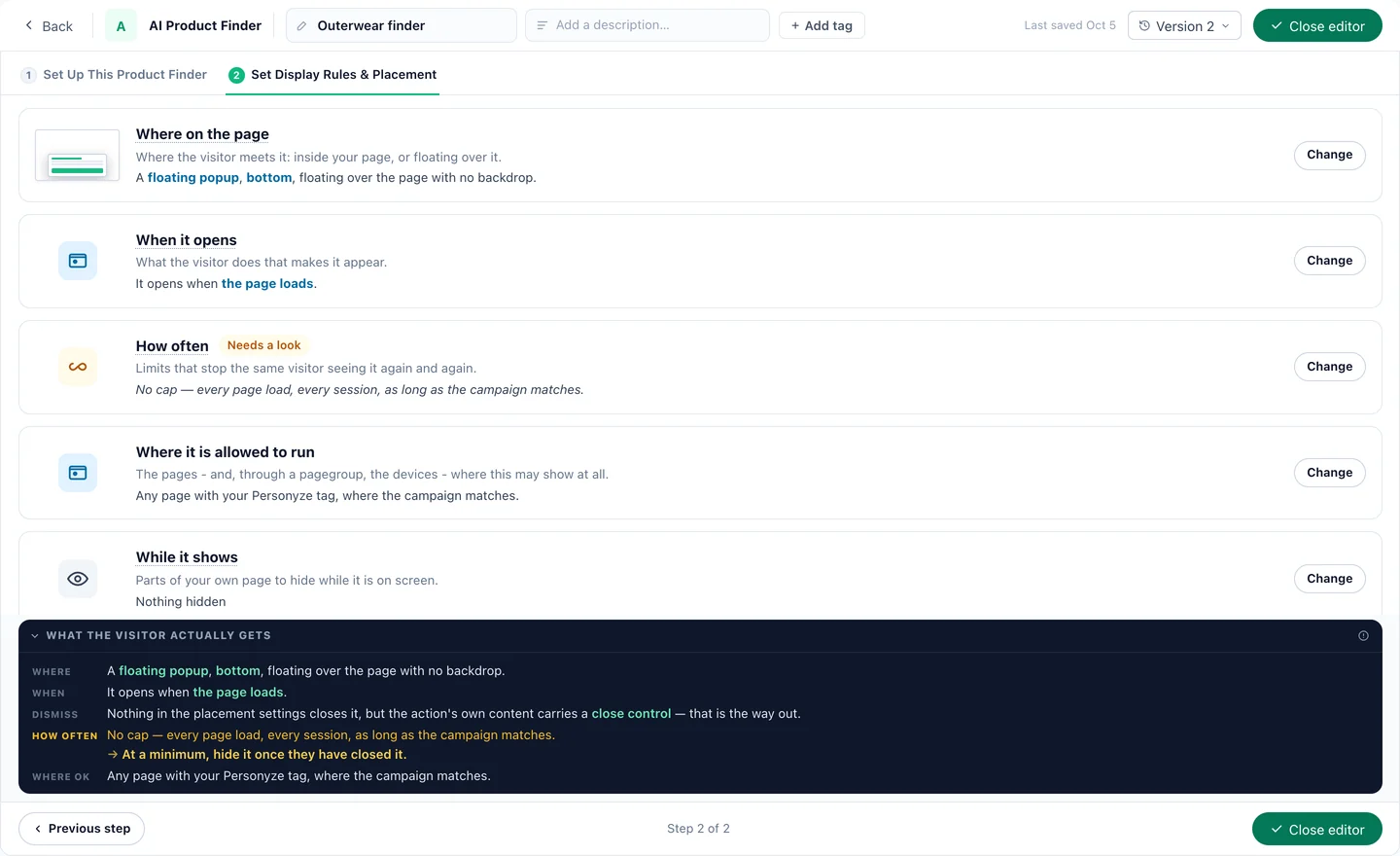
Where and when it shows

Where on the page, when it opens, how often and where it may run — with a summary of what the visitor actually gets.

Watch

AI Product Finder 1:53

A shopper describes a need, and the assistant picks the products — each with a reason.

Watch

AI Content Finder 1:56

A reader asks a question, and the assistant picks what to read next.

1 / 12

Screens from a Personyze demo shop. The products and numbers are illustrative.

Finder, quiz or recommendations

Three ways to help them
find the right product.

A finder is not always the best one. All three run in Personyze on the same catalogue — use each where it works.

The wayThe shopperBest when
AI Product FinderThe shopperDescribes the need in their own wordsBest whenThe range is wide and needs are specific: they know what it is for, not which item it is.
A quiz with picturesThe shopperTaps an answer, picture by pictureBest whenThere are a few clear paths — a size, a style, a use — and you want every answer kept for targeting.
RecommendationsThe shopperAsks nothing; the page shows themBest whenThey are browsing, not asking: what they viewed, what is trending and what goes together fills the page.

AI product finder vs. product recommendation quiz — the longer answer →

Getting it live

Four steps, and it is
on the site.

Nothing reaches a shopper until the last one — and even then it can start in testing, visible from a staging address only.

01
Step 1 · Your catalogue

Bring the catalogue

A connected store, a feed, a file, SFTP — or Personyze reads the products off your site. With several feeds, choose the one it picks from. The content finder also reads your site’s own pages.

02
Step 2 · Words and look

Write the first line

A title, the invitation and up to four examples to tap — or let it write the bar’s line for each visitor. Then one of twelve looks, your colour and your font.

03
Step 3 · What it may pick

Set the rules

“Only recommend” rules like your recommendation filters, the rankings it may lean on, a list of what it must never say, and whether it may mention offers or offer a meeting.

04
Step 4 · Who and where

Place it, then test it

A bar at the foot of the page, a side spot or inside your page, and the campaign decides who sees it. Preview it as a real visitor, then start it in testing.

Questions

The things people ask
before they switch it on.

What is an AI product finder?

A bar on your store where a shopper describes what they need in their own words and gets a short list of products from your catalogue, each with the reason it fits. It is the conversation they would have with someone in the shop, answered from your own range.

Is it an AI shopping assistant?

Yes, in the sense shoppers mean: it helps them choose. It answers questions about the picks too — which one is warmer, which fits a small kitchen — and on a product page it can answer questions about that one product.

How is it different from site search?

Search matches keywords and returns the same page of results to everybody. The finder reads the whole sentence — the trip, the budget, the person it is for — and answers with a short summary and a handful of picks, each with its reason. The same assistant also comes as an AI search box that answers in a sentence.

How is it different from a product recommendation quiz?

A quiz asks fixed questions with fixed answers, so it works when there are a few clear paths. The finder takes one free-text question, so it works when needs are too varied to script. Personyze runs both: a quiz is a survey with picture answers, and every answer can be kept for targeting.

Where do the picks come from?

From your product catalogue only. The AI writes the summary and the reasons; every card is drawn from a catalogue row, so a card cannot show an invented product, price or link, and a sold-out item never appears as a pick. You can limit what it may recommend with the same rules as your recommendation filters.

Does it use what the shopper viewed and bought?

Yes. Their words decide what fits; their history decides the order. The finder weighs every product they viewed, carted and bought — on this visit and the ones before — and your personalized recommendation engine ranks the fits by how likely this shopper is to buy each one. What they viewed is never said back to them.

Do I need a product feed?

The product finder needs a product catalogue: a connected store, a feed, a file, SFTP, or Personyze reading the products off your site. The content finder picks from your articles and your site’s own pages.

Does it work for articles and guides?

Yes. The AI Content Finder is the same assistant pointed at your content: a reader asks a question and gets the articles that answer it, each with its reason.

Which languages does it speak?

It answers, and writes the reason on every card, in the visitor’s language, and searches your catalogue in the catalogue’s own. Its built-in buttons and messages come in eleven languages, and your own wording can be translated per language.

Can different visitors see a different finder?

Yes. A finder is an action in a campaign, so the targeting you already use applies — audience, page, country, device. Its words can change per audience, and its first line can be written for each visitor from what you know about them.

How do I see what it did?

The campaign report counts shows, clicks and goals, and its Conversations tab shows reach, conversations and what it could not answer. Every question shoppers asked is kept and searchable, so you can read what they wanted in their own words.

Ready when you are

Let them ask
for what they need.

Bring your catalogue, pick a look and write the first line — and shoppers get a shortlist with reasons instead of a page of keyword matches.

YOUR CATALOGUE · TWELVE LOOKS · THE SHOPPER’S LANGUAGE