
Gamification Marketing: 6 Mechanics That Lift Ecommerce Conversions
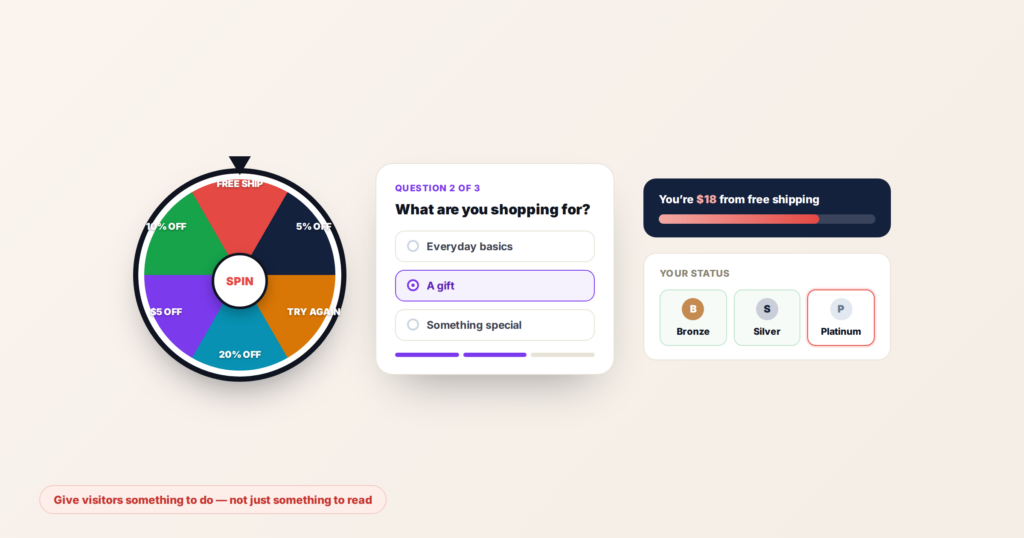
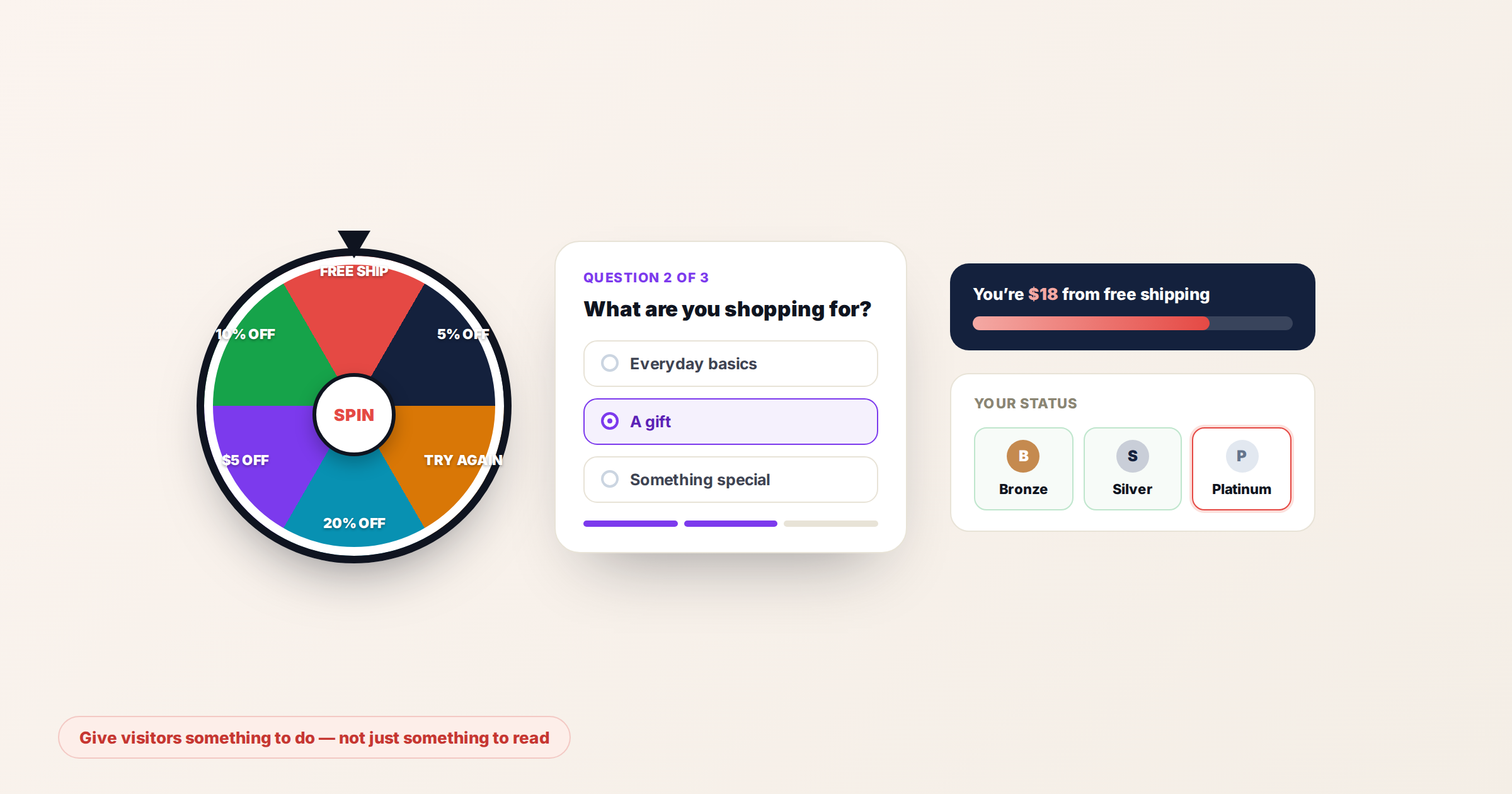
Most offers are handed to visitors. Gamification hands them something to do instead — a wheel to spin, a quiz to finish, a bar to fill. The mechanic is small, but the shift is real: a shopper who earns a discount treats it differently from one who was simply given it.
This is a practical guide to gamification marketing — what it is, the six mechanics that actually move numbers on a website, and where each one belongs in the funnel. Every mechanic below ships as a ready template in Personyze, so the examples are things you can launch rather than concepts to admire.
What is gamification in marketing?
Gamification in marketing is the use of game mechanics — chance, progress, competition, reward — inside a non-game experience, to make an action more engaging and more likely to be completed. On a website that usually means a prize wheel, a quiz, a progress bar, a tier, or a countdown.
It is not about turning your site into a game. The mechanic exists to serve a conversion goal that already existed: capture the lead, raise the order value, get the visitor to a product that fits. If the game is more memorable than the offer, it has failed.
Why gamification works
Four behavioural principles do most of the work:
- Agency. A reward the visitor produced feels earned, so it gets used rather than ignored.
- Surprise. Variable outcomes hold attention far better than a fixed banner offer.
- Progress. A partially filled bar creates a pull to complete it — the same instinct that empties a loyalty punch card.
- Commitment. Someone who answered three quiz questions has invested effort, and is measurably more likely to accept the recommendation at the end.
Six gamification mechanics that work on a website
1. Prize wheels (spin-to-win)
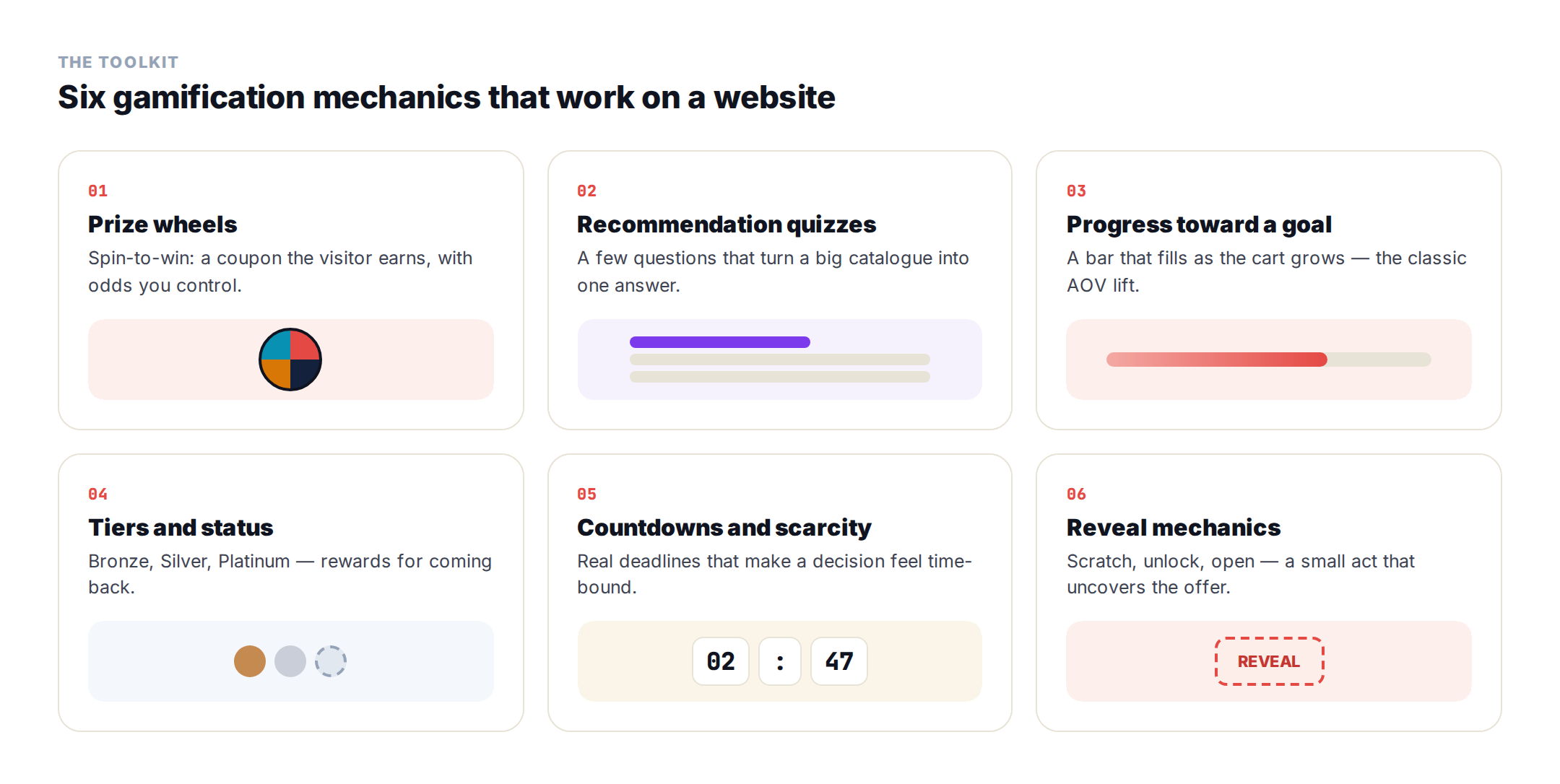
A wheel of prizes the visitor spins for a coupon, free shipping, or another reward, with odds you control. It is the highest-engagement mechanic on this list and the most likely to be overused — keep it to moments where a discount is genuinely on the table. See the Spin Wheel template, or the full write-up on how a gamified prize wheel lifts conversions. There’s also a gated version that locks the spin behind an email form when capturing the lead matters more than the play.
2. Recommendation quizzes
A few quick questions that end in a tailored product or content recommendation. Quizzes convert because they trade value for effort: the visitor gets a genuine answer, you get declared preference data no analytics tool can infer. Best on catalogues large enough that choosing is hard. See the Recommendation Quiz template.
3. Progress toward a goal
A live bar showing how close the visitor is to something they want — most commonly free shipping. “You are $18 away” is a specific, solvable problem, and it reliably lifts average order value. See the Free Shipping Status Bar and the Status Card, or read the AOV guide to progress bars.
4. Tiers and status
Bronze, Silver, Platinum. Tiers work because status is a reward that costs nothing to grant and is unpleasant to lose — which is exactly why loyalty programmes lean on them. Show the current tier, the next one, and the gap. See the Tiered Status Bar and Tiered Status Card.
5. Countdowns and scarcity
A live timer against a real deadline. The word real is doing the work: a countdown that resets on refresh trains visitors to ignore you. Use it where a deadline genuinely exists — a sale ending, a price rising, a webinar starting. See the Countdown Timer templates and the Event Progress Countdown.
6. Reveal mechanics
The lightest mechanic here: a coupon that must be clicked to reveal or copy. One small interaction converts a passive banner into a deliberate action, which makes the code more likely to be remembered and used. See the Coupon Popup template.
What is spin-to-win gamification?
Spin-to-win is the specific mechanic where a visitor spins an on-site prize wheel to win a discount, free shipping, or another reward. The operator sets the segments and the probability behind each, so the range of outcomes is controlled even though the individual result feels random.
It is the most recognisable form of gamification marketing because the payoff is immediate and the interaction takes one click. The version that earns its place does two extra things: it lets visitors play without an email wall, and it stores what each person won so later messaging can reference it. Details in the Spin Wheel template.
Gamification in ecommerce: where each mechanic fits
Matching mechanic to funnel stage matters more than the mechanic itself:
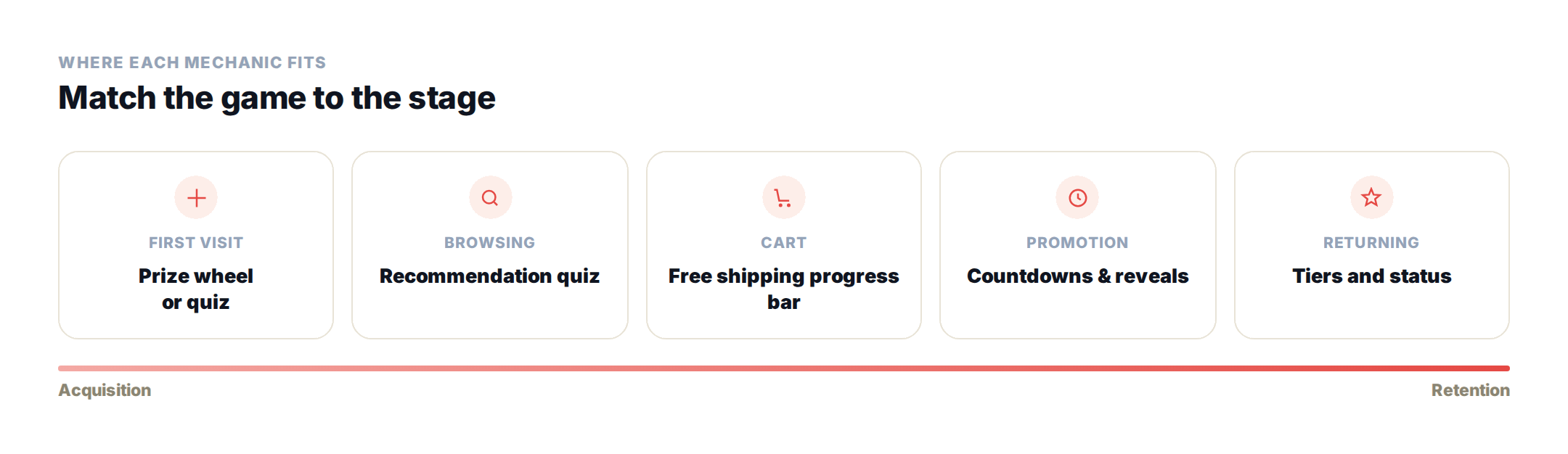
- First visit / acquisition — prize wheel or quiz. Both give a reason to engage before any intent exists.
- Browsing / consideration — recommendation quiz, to shorten a long catalogue into one answer.
- Cart / checkout — free shipping progress bar. This is where progress mechanics earn the most, because the gap is closable right now.
- Promotion windows — countdowns and coupon reveals, tied to a real deadline.
- Returning customers — tiers and status, which reward repetition rather than novelty.
These are on-site mechanics, so they pair naturally with the rest of your ecommerce personalization programme rather than sitting apart from it.
How to measure gamification
Engagement metrics flatter these campaigns. A wheel will always beat a banner on interaction rate, and that tells you very little. Measure instead:
- Redemption rate — of coupons won, how many were actually used.
- Average order value for sessions that saw a progress bar versus those that did not.
- Completion rate for quizzes, and conversion on the recommended item.
- Incrementality — hold out a share of traffic. If the discount would have been redeemed anyway, the game added cost, not revenue.
Any of these should be run as a controlled test rather than a before-and-after comparison. See A/B testing.
Four mistakes to avoid
- Gamifying every visit. Frequency capping matters more here than anywhere else — a wheel on every session becomes wallpaper.
- Fake scarcity. Countdowns that reset, or “only 2 left” that is never true, cost more trust than they earn in orders.
- Hiding the prize behind an email wall. As a rule, ask after the win, not before — it converts better and feels less like a toll. The exception is a deliberate lead-capture play like the gated spin wheel, where the reward stays fully visible (a greyed wheel with a padlock) so the ask feels fair rather than like a bait-and-switch.
- Forgetting the result. If you do not store what someone won or answered, you have run an entertainment campaign, not a marketing one.
Gamification marketing: FAQ
Does gamification work for B2B, or only ecommerce?
Both, but the mechanics differ. Prize wheels and discounts suit consumer ecommerce; B2B gets more from quizzes, assessments, and progress mechanics that qualify a lead while giving something useful back.
Will a prize wheel cheapen my brand?
It can, if it appears on every page for every visitor. Targeted to a segment and a moment — first-time visitors, or a defined promotion window — it reads as a campaign rather than a gimmick.
Do I need a developer to run gamified popups?
No. Each mechanic here is a configurable template — you set the copy, prizes, odds, and targeting in the interface. See the full popup template library.
What is a gamified popup?
A popup that requires an interaction to produce its outcome — spinning, answering, or revealing — rather than simply displaying an offer. The interaction is what separates it from a standard promotional overlay.
Get started
Every mechanic in this guide is a ready template you can configure and target without code. Book a demo or view plans.
Related reading
- Spin-to-win prize wheels — the mechanic in depth.
- Free shipping & tiered loyalty bars — the AOV play.
- Website popup templates — all 16 templates in one place.
- Ecommerce personalization — the wider programme.
Book a demo with a personalization expert
30 minutes with a personalization expert. Bring your stack, your goals, your skepticism. We'll show you what changes when every visit feels like the only one.