

Rules-Based vs AI Personalization: Which Decisions Belong to Which

Every personalization vendor now leads with AI, which makes the honest version of this comparison harder to find. So here it is: rules-based and AI-driven personalization are good at different things, and nearly every working programme runs both. The interesting question isn’t which wins — it’s which decisions belong to which.
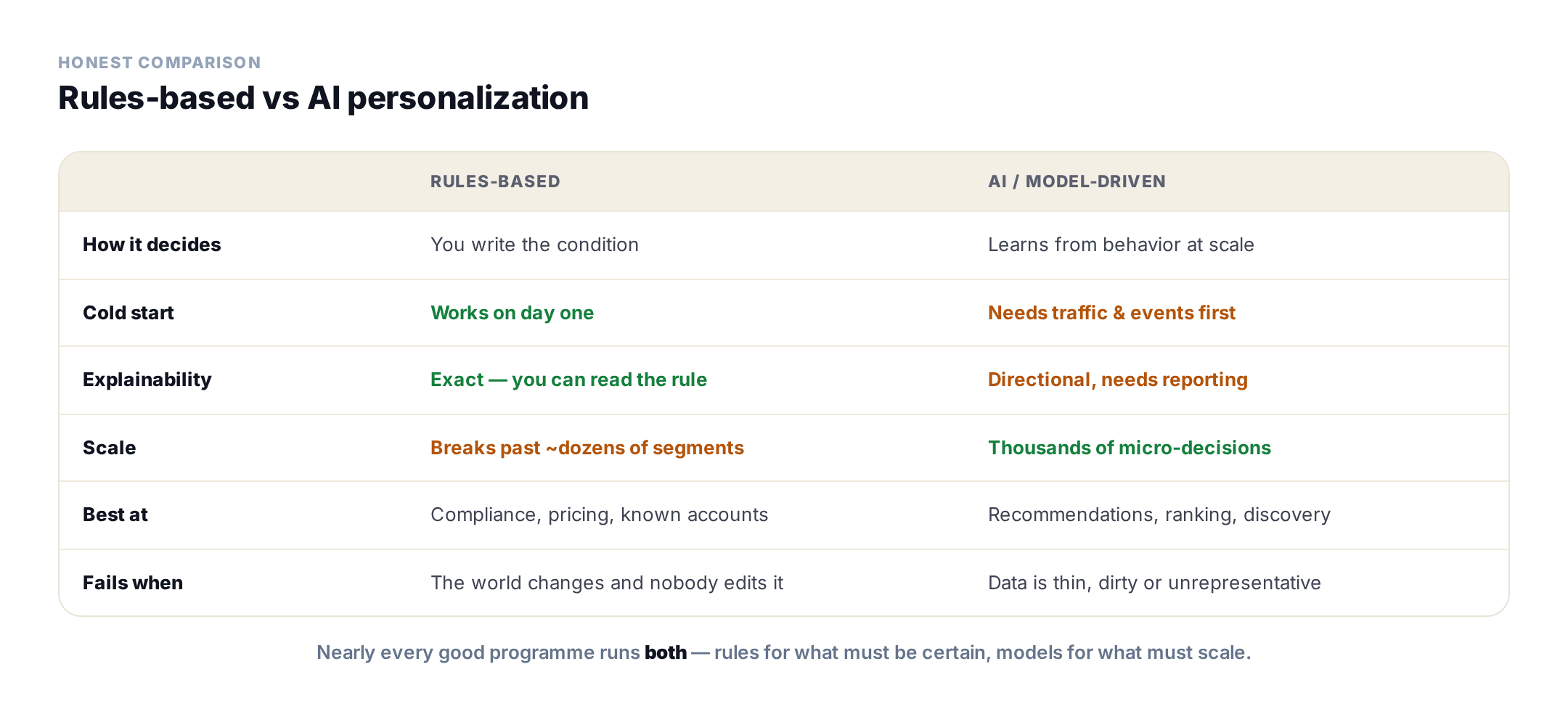
What each one actually is
Rules-based personalization is deterministic. You write a condition and an outcome: if the visitor is on the pricing page, from paid search, and hasn’t purchased, show this banner. It does exactly what you said, every time, forever — including after the situation changes and nobody updates it.
AI or model-driven personalization is probabilistic. You give it an objective and data, and it learns which content, product or ranking is most likely to produce the outcome for this visitor. It handles far more variation than a person can enumerate, and it cannot tell you with certainty why it picked what it picked.
Where rules win
- Day one. Rules work on a site with no history. A model needs traffic and events before it has anything to learn from — the cold-start problem.
- Certainty. When something must happen — a legal disclaimer in one market, a price for a contracted account, a shipping cutoff — you want a rule, not a probability.
- Explainability. A rule can be read. When a stakeholder asks why an enterprise prospect saw the SMB pricing, “the model decided” is not an answer that survives the meeting.
- Known accounts. ABM targeting on firmographics is inherently rule-shaped: you know the company, you know the message.
- Small catalogues and small traffic. Below a certain volume, a model has nothing to add over a sensible rule.
Where models win
- Scale of decisions. Rules degrade past a few dozen segments — someone has to write, order and maintain every one. Models make thousands of per-visitor decisions without a maintainer.
- Ranking and discovery. Product and content recommendations are the canonical case: no human can hand-rank a catalogue per visitor. See how the algorithms work.
- Signals you can’t articulate. Models pick up interaction patterns that nobody would think to write a rule for.
- Drift. A model retrained on recent behaviour adapts to a changing catalogue or season; a rule written in March is still March’s opinion in November.
How each one fails
This is the part vendors skip, and it’s the part that decides your architecture.
- Rules fail by rotting. They keep executing correctly against a world that has moved on. The classic symptom is a campaign that has been quietly showing a discontinued product for five months because nobody audits rules.
- Rules fail by collision. Past a few dozen, they overlap and contend, and the resolution order becomes an accident. Personyze surfaces audience overlaps and conflicts for exactly this reason.
- Models fail on thin or dirty data. A recommender fed an incomplete feed will confidently recommend out-of-stock items. Garbage in is not a cliché here; it is the primary failure mode.
- Models fail invisibly. A rule that breaks usually breaks loudly. A model that quietly degrades keeps serving plausible-looking output at a worse conversion rate, which is why measurement is not optional.
The split that actually works
The pattern that holds up in practice is simple to state:
Rules for what must be certain. Models for what must scale.
Concretely, on the same site: a rule decides that visitors from a target account see the enterprise message and never see the self-serve checkout prompt; a model decides which six products appear in the recommendation strip on that page. A rule decides the free-shipping threshold applies in this market; a model decides which items to suggest to close the gap.
The layer underneath both is the same — one visitor profile with behaviour, CRM and firmographic data on it. What changes is which decisions read from it deterministically and which are learned.
Where the AI agent fits
There is now a third thing that muddies the old dichotomy: an AI agent that writes the rules for you. You describe the audience in plain language and it compiles real, readable targeting rules — which means you get the explainability of rules without the labour of authoring them.
That is worth naming because it dissolves the usual trade-off. The historic reason teams under-used rules was maintenance cost, not distrust of rules. If generating and auditing them becomes conversational, the practical case for deterministic targeting gets stronger, not weaker.
How to decide, per use case
- Does it have to be right every time? Rule.
- Will a stakeholder ask why? Rule.
- Are there more options than a person can rank? Model.
- Do you have enough traffic and clean data? If no, rule — and revisit later.
- Would the answer change weekly? Model.
- Not sure? Run both as an A/B test. This is the only reliable arbiter, and it is cheaper than the argument.
FAQ
What is the difference between rules-based and AI personalization?
Rules-based personalization is deterministic: you write a condition and an outcome, and it executes exactly that every time. AI or model-driven personalization is probabilistic: you give it an objective and data, and it learns which content or product is most likely to produce the outcome for each visitor. Rules give certainty and explainability; models give scale and adaptation.
Is AI personalization better than rules-based?
Not universally – they fail differently. Rules work from day one, are readable and are right for anything that must be certain, but they rot as the world changes and collide with each other past a few dozen. Models scale to thousands of per-visitor decisions but need traffic and clean data first, and degrade invisibly. Most working programmes use both.
When should I use rules instead of AI?
Use rules when the outcome must be certain (legal or pricing content), when a stakeholder will ask why a visitor saw something, for account-based targeting on known firmographics, and when your traffic or catalogue is too small for a model to add anything over a sensible condition.
When is AI clearly the right choice?
When the number of decisions exceeds what anyone can enumerate – product and content recommendations, ranking, and discovery are the canonical cases – or when the right answer changes week to week and a hand-written rule would be permanently out of date.
What is the cold-start problem in personalization?
It is the period when a model has too little behavioural data to make good decisions – a new site, a new catalogue, or a new visitor with no history. Rules cover that gap, and good recommendation setups fall back to popular or trending items until enough signal exists.
Can AI write the targeting rules for me?
Yes, and it changes the trade-off. Personyze’s AI targeting assistant and AI agent compile a plain-language audience description into real, editable rules, so you keep the explainability of rules without the authoring cost that historically made teams avoid them.
Get started
Run rules and models on one profile instead of two systems. Book a demo or view plans.
Related reading
- Recommendation algorithms explained — what the models actually do.
- AI marketing agent — rules, written conversationally.
- Behavioral targeting — the rule engine itself.
- AI personalization agent — see it in action.
Book a demo with a personalization expert
30 minutes with a personalization expert. Bring your stack, your goals, your skepticism. We'll show you what changes when every visit feels like the only one.