
AI Visibility: Getting Found by Assistants Is Only Half the Job
“AI visibility” usually means one thing in practice: getting cited when someone asks ChatGPT or Claude to recommend a tool. That’s real, and worth working on. But it’s only half the problem, and the neglected half is the one that compounds.
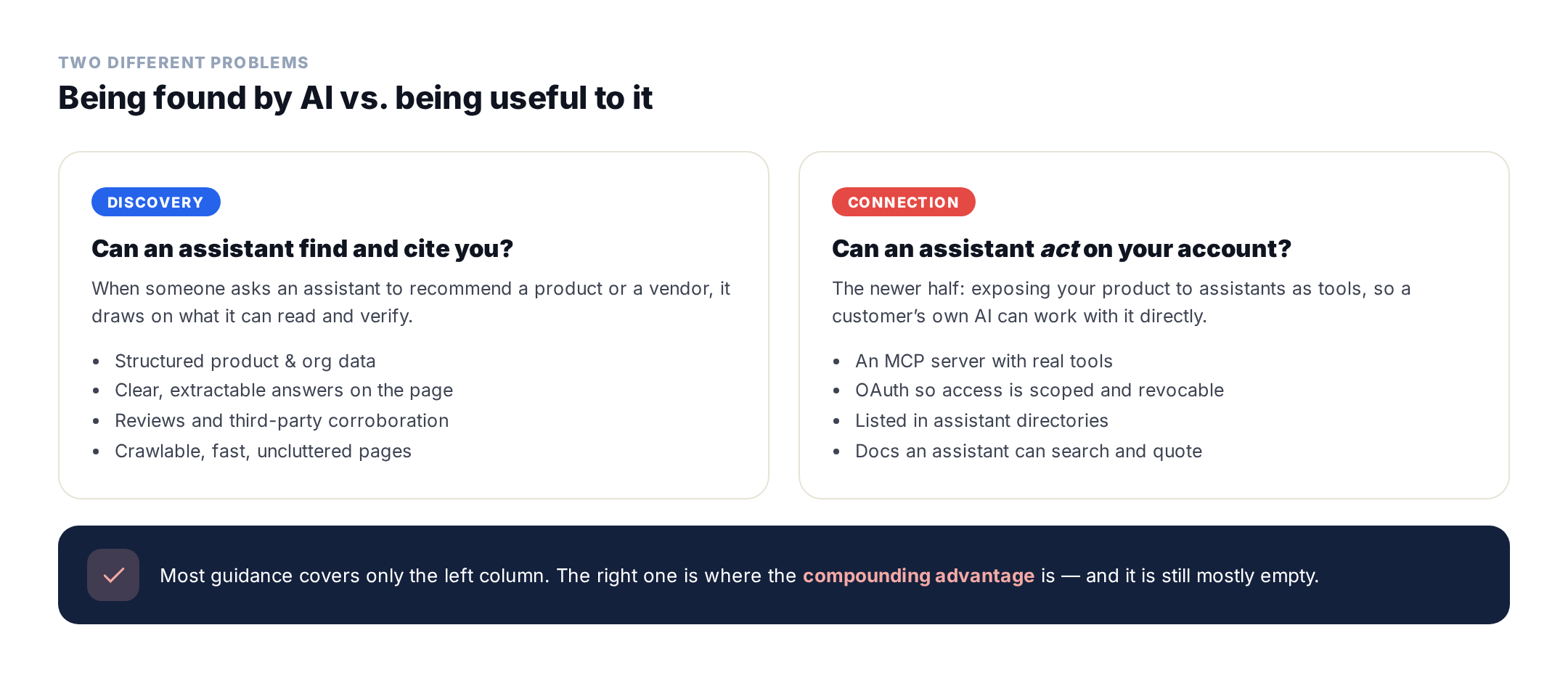
There are two distinct questions. Can an assistant find and cite you? And can an assistant actually work with your product on a customer’s behalf? Nearly all the published guidance answers the first. The second is where the durable advantage sits, because it is still mostly empty.
Half one: being found and cited
When an assistant answers “what’s a good website personalization tool?”, it draws on what it can read, extract and corroborate. This is often labelled GEO (generative engine optimization) or AEO (answer engine optimization), and it rewards a specific kind of content hygiene:
- Structured data — organization, product, FAQ and how-to markup that states plainly what you are and what you do.
- Extractable answers — a direct answer near the top of the page, not buried after 600 words of throat-clearing. Assistants quote what is easy to lift.
- Third-party corroboration — reviews, comparisons and mentions elsewhere. A model weighs claims it can verify against sources that aren’t you.
- Crawlable, fast, uncluttered pages — the same technical hygiene that has always mattered, with less tolerance for interstitials.
- Documentation that answers questions — a public knowledge base is unusually good AI-visibility material, because it is written as question-and-answer by nature.
Notably, none of this is new work if your SEO is healthy. It is the same discipline pointed at a reader that has no patience for preamble.
Half two: being connectable
The second question is different in kind. Once a customer is using an assistant to do their work, the winning position is not being mentioned — it is being usable. Can their assistant read their data in your product and take actions in it?
That is what MCP is for. A product with an MCP server becomes something an assistant can operate; a product without one becomes something the user has to leave the conversation to go and use. Over a few months of habit formation, that difference is significant.
The adoption curve makes this concrete: MCP went from Anthropic’s launch in November 2024 to over 10,000 active public servers by early 2026, and Forrester expects 30% of enterprise app vendors to launch one during 2026. The implication is that in 2027 the question in an RFP will not be whether you have an API, but whether the customer’s assistant can already use you.
What “connectable” actually requires
- Real tools, not a wrapper. A server that exposes only a search endpoint is a demo. Useful ones let an assistant read state and change it, within limits.
- Scoped, revocable auth. OAuth so access is granted per assistant and can be withdrawn instantly. Nobody should be pasting a permanent admin key into a chat window.
- Guardrails on write actions. Anything touching live customers should be confirmed in concrete terms and reversible — the pattern we use is that new work is created in staging and live changes are named before they happen.
- Searchable documentation. If the assistant can search your docs, it answers product questions correctly instead of inventing an answer.
- Directory presence. Being listed in the assistant’s connector directory turns a URL-paste into a one-click install.
How the two halves reinforce each other
They are not independent. Documentation written to be searchable by an assistant is also the material that gets you cited. An MCP server that answers product questions from your docs makes your own knowledge base the source of truth rather than a third-party summary of it. And being genuinely connectable is the kind of fact that ends up in comparison articles — which feeds discovery.
The practical sequence is: fix the content hygiene first because it is cheap, then build the connection layer because it is defensible.
Personyze practises this: the MCP server is listed in the Claude connector directory and the ChatGPT app directory — Personyze in the Claude directory.
Measuring it
This is the weakest part of the discipline today, and it is worth being honest about that. Assistant citations are not reported in a console the way search impressions are, so most measurement is manual: ask a set of buying-intent questions across assistants on a schedule, record whether you appear and how you are described, and watch the trend rather than any single answer. On the connection side the metrics are ordinary product metrics — connected accounts, tool calls, retention of connected users versus everyone else.
Treat both as directional. Anyone quoting precise AI-visibility share is estimating.
A practical checklist
- Add or repair structured data on your highest-intent pages.
- Put a direct, quotable answer in the first screen of each page that targets a question.
- Publish a real, crawlable knowledge base — and keep it current.
- Build (or expose) an MCP server with genuine read and write tools.
- Use OAuth with per-assistant, revocable credentials.
- Submit to the assistant connector directories.
- Run a monthly manual citation check across two or three assistants.
FAQ
What is AI visibility?
AI visibility is how well a brand appears in AI-generated answers – whether an assistant like ChatGPT or Claude finds, cites and recommends you. In practice it has two halves: discovery, meaning being found and quoted, and connection, meaning an assistant can actually work with your product on a customer’s behalf.
What is the difference between GEO, AEO and SEO?
GEO (generative engine optimization) and AEO (answer engine optimization) describe optimizing to be cited in AI-generated answers rather than ranked in a list of links. In practice the work overlaps heavily with good SEO – structured data, extractable answers, technical hygiene, third-party corroboration – applied to a reader with no patience for preamble.
How do I get an AI assistant to recommend my product?
Focus on what a model can read and verify: structured data that states plainly what you do, a direct answer near the top of the page rather than buried, corroborating third-party reviews and comparisons, fast crawlable pages, and a public knowledge base written as questions and answers.
Why does an MCP server matter for AI visibility?
Because being mentioned and being usable are different advantages. When a customer works inside an assistant, a product with an MCP server can be operated in the conversation, while one without it requires leaving the conversation. MCP went from launch in late 2024 to over 10,000 public servers by early 2026, and Forrester expects 30% of enterprise app vendors to ship one in 2026.
How do you measure AI visibility?
Imperfectly, and it is worth saying so. Assistant citations are not reported in a console like search impressions, so most teams ask a fixed set of buying-intent questions across assistants on a schedule and track whether they appear and how they are described. Connection-side metrics are ordinary product metrics: connected accounts, tool calls and retention.
Is AI visibility replacing SEO?
No. It is an additional surface with overlapping requirements. The content hygiene that helps you get cited by assistants is largely the same work that helps you rank, and organic search remains a major channel. The genuinely new part is the connection layer, which has no SEO equivalent.
Get started
Personyze publishes an MCP server so your assistant can work with your personalization directly. Book a demo or view plans.
See the Personyze MCP server.
Related reading
- Personyze MCP server — the connection layer in practice.
- Agentic commerce — when the agent is the buyer, not the researcher.
- Does personalization hurt your SEO? — the crawlability side.
Book a demo with a personalization expert
30 minutes with a personalization expert. Bring your stack, your goals, your skepticism. We'll show you what changes when every visit feels like the only one.