

Agentic Commerce: What Happens to Personalization When the Shopper Is an AI Agent
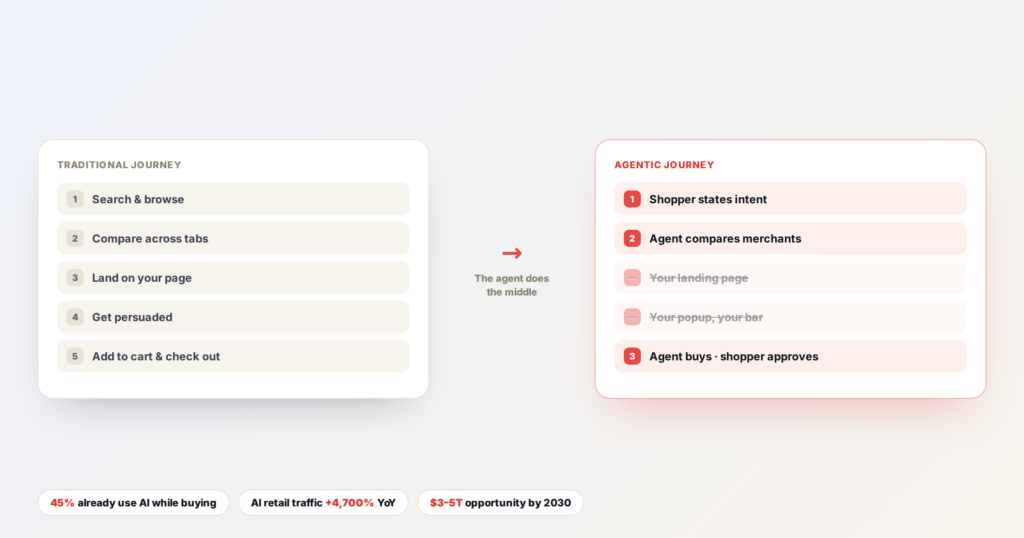
For twenty years the job was: get the shopper to your site and persuade them. Agentic commerce breaks that assumption. A shopper states an intent — “trail running shoes under $150, delivered by Friday” — and an AI agent handles discovery, comparison and checkout. Your landing page, your exit-intent popup and your carefully tuned hero never enter the picture.
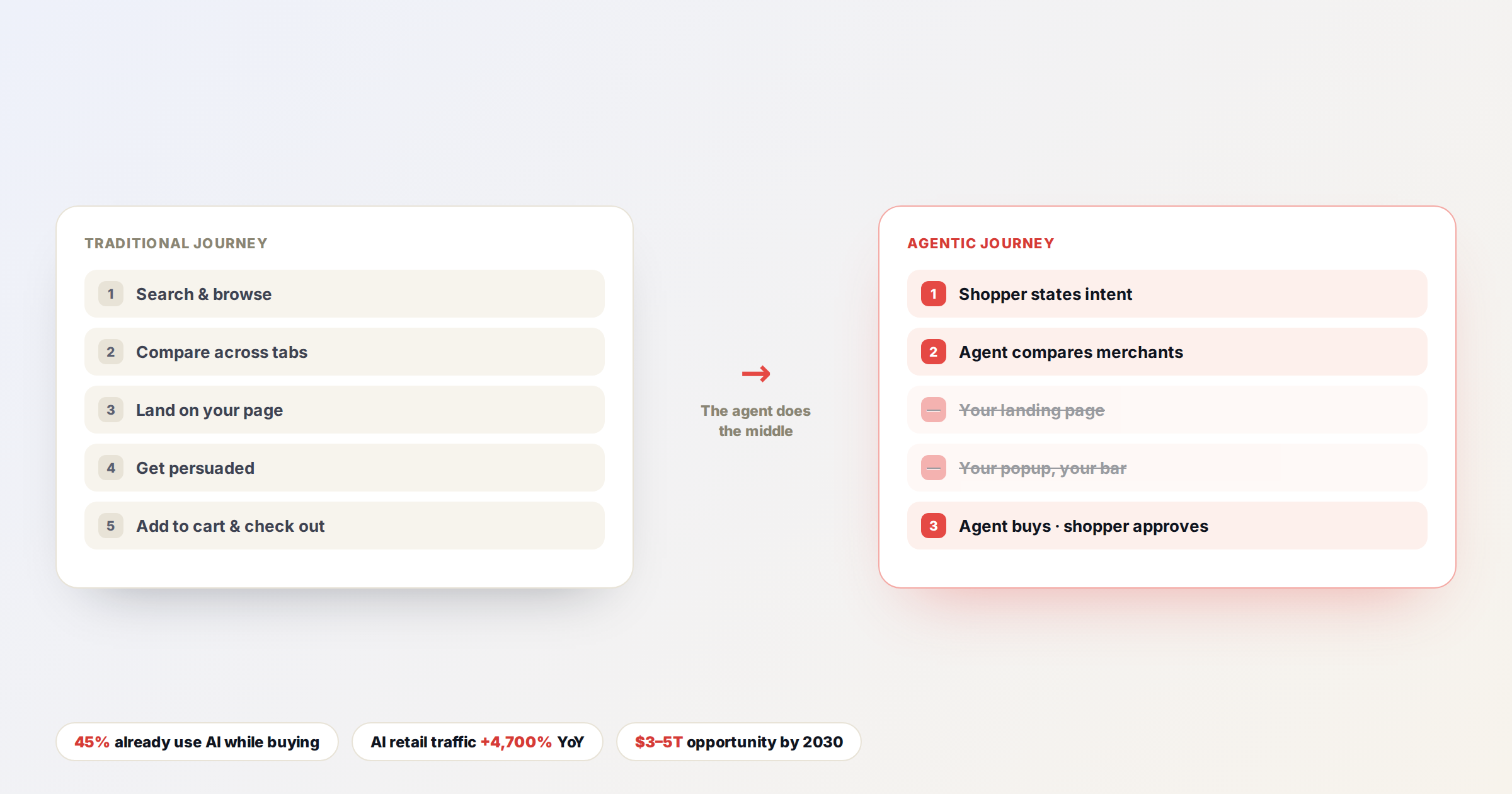
This is not a 2030 forecast. A 2026 IBM study found 45% of consumers already use AI for at least part of the buying journey; Adobe Analytics measured AI-driven traffic to US retail sites growing 4,700% year over year; and McKinsey puts the agentic commerce opportunity at $3–5 trillion by 2030. Shopify opened agentic storefronts to merchants in March 2026, letting products be discovered and bought inside ChatGPT.
So the honest question for anyone running personalization: which half of what you do survives, and what replaces the other half?
What agentic commerce actually is
Agentic commerce is delegated shopping. The customer sets intent and guardrails; an AI agent researches, compares and completes some or all of the purchase. The “click” becomes an approval rather than an exploration — which is why it’s sometimes called zero-click shopping.
It tends to start with repeat and routine purchases, where a shopper is comfortable approving the agent’s choice, and works outward from there. The practical consequence is a change in who you are selling to: for part of your traffic, the thing evaluating your store is a system optimising for clarity and certainty, not a person who can be charmed by a hero image.
The three protocols, and which one is yours
Three standards are converging on this, and they solve different problems. Confusing them is the most common mistake in the current discourse.
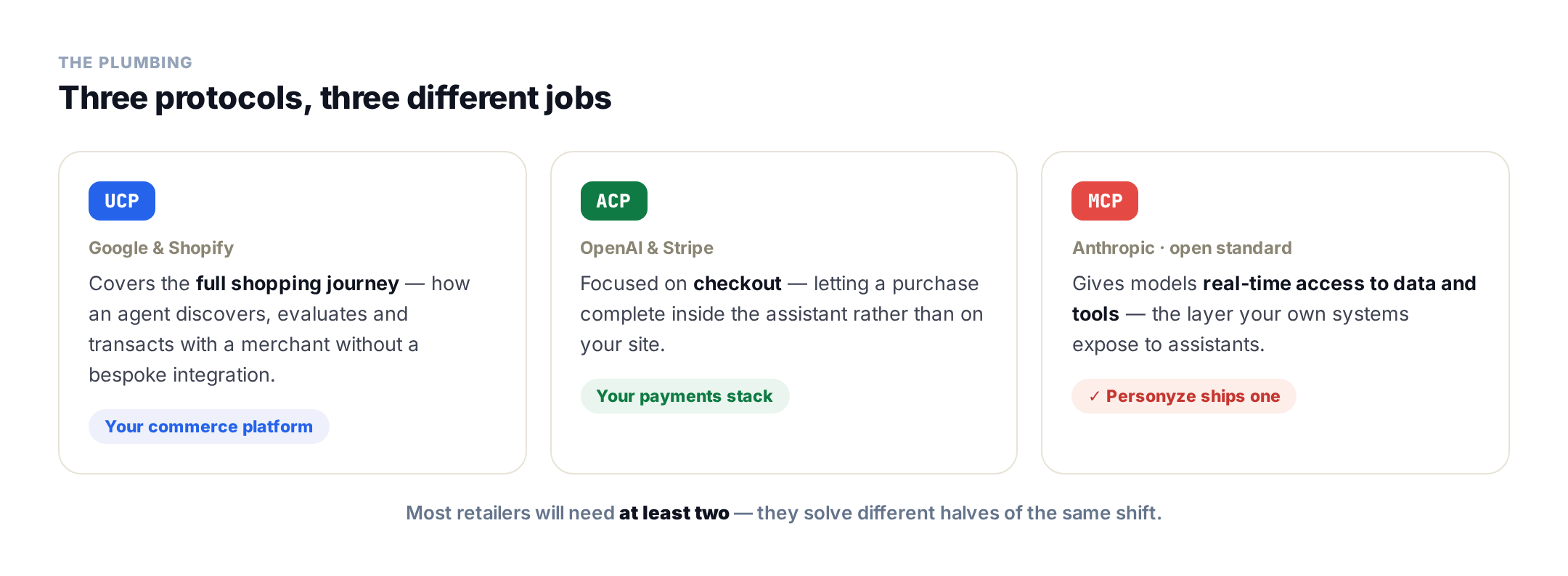
- UCP (Google and Shopify) covers the full shopping journey — how agents interact with merchant systems without a bespoke integration per retailer.
- ACP (OpenAI and Stripe) focuses on checkout — completing the purchase inside the assistant.
- MCP (Anthropic’s open standard) gives models real-time access to data and tools — the layer through which your own systems expose themselves to assistants.
Shopify merchants get UCP and ACP largely abstracted for them. MCP is the one you own directly — and it’s the one Personyze already ships, so an assistant can read your personalization data and act on your account. See the Personyze MCP server.
What breaks
Be clear-eyed: a meaningful slice of personalization tooling assumes a human is looking at a rendered page in a browser session. When an agent is the intermediary, that assumption fails.
- Popups, overlays and exit intent — there is no cursor to leave and no modal to dismiss.
- On-page banners and hero swaps — the agent may never render your page at all.
- Scroll, hover and dwell triggers — behavioural signals that require a body.
- Persuasion copy — an agent weighing options on price, availability and delivery date is unmoved by adjectives.
This does not mean those tactics stop working. Most traffic is still human, and will be for years. It means a growing slice of your traffic can’t be reached that way, and you need a second track for it.
What survives — and gets more valuable
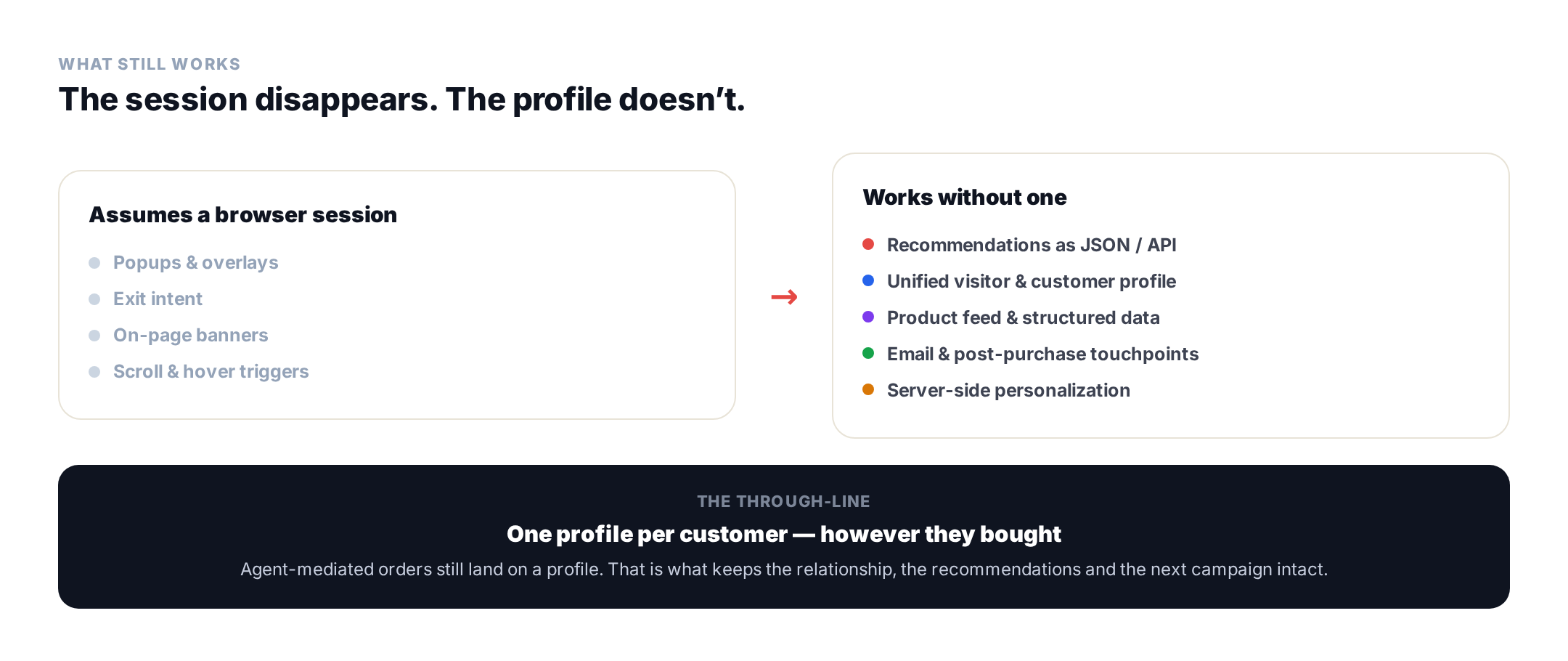
Everything that is data and decision rather than pixels and triggers keeps working — and matters more, because it’s what the agent consumes.
- Recommendations as JSON or API. If your recommendation engine can answer over an API rather than only rendering a widget, it can serve an agent, an app, an email, or a headless front end. That’s the same headless pattern that already decouples decisions from rendering.
- Structured product data. Feeds, attributes, availability and pricing are what an agent evaluates. Clean feed data stops being an SEO chore and becomes the sales pitch.
- The unified customer profile. An agent-mediated order still belongs to a person. If the order lands on their profile, your next recommendation, email and offer stay right.
- Server-side personalization. Decisions made before render — the API path — work whether the consumer is a browser, an app or an agent.
- Email and post-purchase. When the transaction happens inside an assistant, owned channels are how you keep a relationship at all.
The uncomfortable strategic point
If agents mediate discovery, two risks follow. The first is commoditisation: an agent optimising purely on price flattens brand advantage. The second is invisibility: agents favour merchants whose data they can read and verify, so a store with thin structured data quietly loses selection to one with rich data, regardless of who has the better product.
The defensible response is not to fight the channel but to be the merchant an agent can evaluate confidently — and to keep a direct relationship for everything that isn’t a commodity repeat purchase. Personalization’s role shifts from persuading a session to knowing a customer, and the second one is far harder to disintermediate.
Personyze’s own MCP server is live in the Claude connector directory and the ChatGPT app directory — Personyze in the Claude directory.
What to do in the next quarter
- Audit your feed. Completeness, accuracy, availability and delivery data. This is now revenue infrastructure, not a catalogue chore.
- Make recommendations callable. If yours only render as a widget, get the JSON/API path working — that is the version an agent, app or headless front end can use.
- Unify identity. Make sure orders arriving through any channel resolve to one customer profile.
- Expose your own tools. An MCP server is how your systems become usable by assistants your customers and team already run.
- Keep testing the human path. Most of your traffic is still people; agentic readiness is an addition, not a replacement. Run it as an A/B test like anything else.
Some of this is genuinely new engineering — making your catalogue and recommendations callable, and building against protocols that are still moving. If that capacity is the constraint rather than the strategy, generative AI development services are one way to close the gap without hiring for it.
FAQ
What is agentic commerce?
Agentic commerce is delegated shopping: a consumer sets an intent and constraints, and an AI agent researches, compares and completes some or all of the purchase on their behalf. Instead of browsing product pages and clicking add-to-cart, the shopper approves an agent’s choice.
Does agentic commerce make website personalization obsolete?
No, but it splits it. Tactics that assume a browser session – popups, exit intent, hero swaps, scroll triggers – can’t reach an agent. Everything that is data and decision rather than pixels and triggers, such as API-delivered recommendations, structured product data and the unified customer profile, still works and becomes more important.
What are UCP, ACP and MCP?
They are the three protocols behind agentic commerce and they solve different problems. UCP (Google and Shopify) covers the full shopping journey; ACP (OpenAI and Stripe) focuses on checkout; MCP (Anthropic’s open standard) gives AI models real-time access to data and tools. Most retailers will need at least two.
How do I make my store selectable by AI shopping agents?
Focus on what an agent can evaluate: complete and accurate structured product data, real availability and delivery information, corroborating reviews, fast crawlable pages, and API access to your catalogue and recommendations. Agents favour merchants whose data they can read and verify.
Where does Personyze fit in agentic commerce?
Personyze covers the layer that survives the shift: recommendations available as JSON or via API rather than only as a rendered widget, a unified visitor and customer profile that agent-mediated orders still land on, server-side personalization decisions, and an MCP server that exposes your account to AI assistants.
Is agentic commerce actually happening yet, or is it hype?
Both signals exist. A 2026 IBM study found 45% of consumers already use AI for part of the buying journey and Adobe measured AI-driven retail traffic up 4,700% year over year, while long-range figures like McKinsey’s $3-5 trillion by 2030 remain projections. The practical read is that it is early but real, and the preparation work is useful regardless of the pace.
Get started
Make your personalization callable, not just renderable. Book a demo or view plans.
The protocol you own directly: Personyze MCP server.
Related reading
- Personyze MCP server — the protocol you own directly.
- Headless CMS personalization — decoupling decisions from rendering.
- AI personalization agent — the agent working on your side of the glass.
- Ecommerce personalization — the human path, still the majority.
Book a demo with a personalization expert
30 minutes with a personalization expert. Bring your stack, your goals, your skepticism. We'll show you what changes when every visit feels like the only one.