

AI Marketing Agent: Build On-Brand Personalization Campaigns From a Sentence
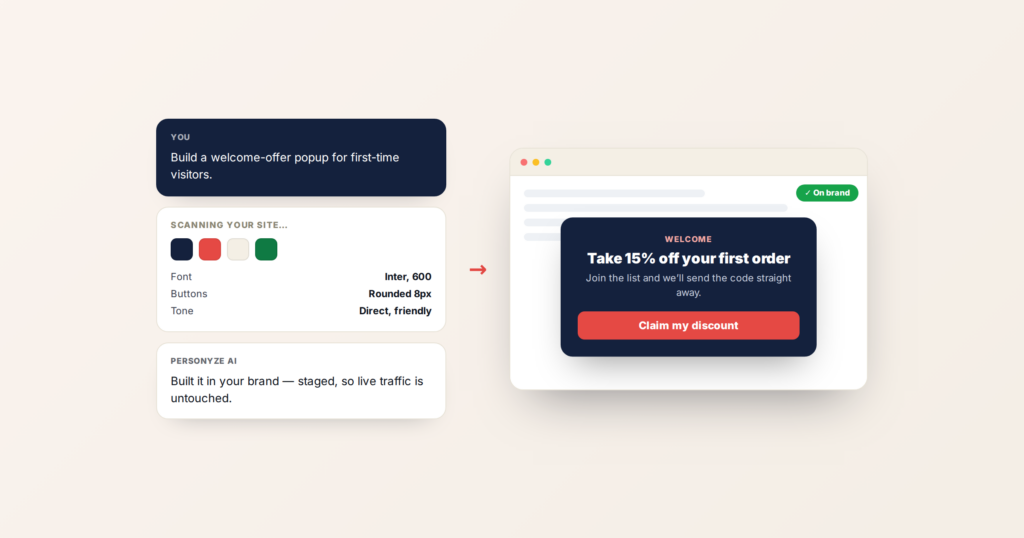
Most “AI” in marketing tools writes you a subject line. An AI agent is a different thing: it doesn’t hand back a suggestion, it does the work — builds the campaign, compiles the targeting, and tells you what to fix next. McKinsey estimates agentic workflows can accelerate campaign creation and execution by 10 to 15 times, and put revenue growth from hyper-personalized marketing in the 10–30% range.
The Personyze AI Agent works inside your account. You describe what you want in plain words; it scans your site, builds the campaign in your brand, stages it safely, and explains what it did.
What an AI marketing agent actually is
The useful distinction isn’t “AI vs no AI” — it’s goal-oriented vs rule-based. Classic automation needs you to specify every step: if this, then that. An agent takes an outcome (“a welcome offer for first-time visitors”) and works out the steps itself — which layout, which rules, which copy — then reports back what it chose so you can correct it.
Three things separate an agent from a chatbot bolted onto a dashboard: it can take actions in the product, it can read your real data to decide, and it operates inside guardrails so a mistake isn’t catastrophic. Personyze’s agent does all three.
It builds campaigns that look like your site
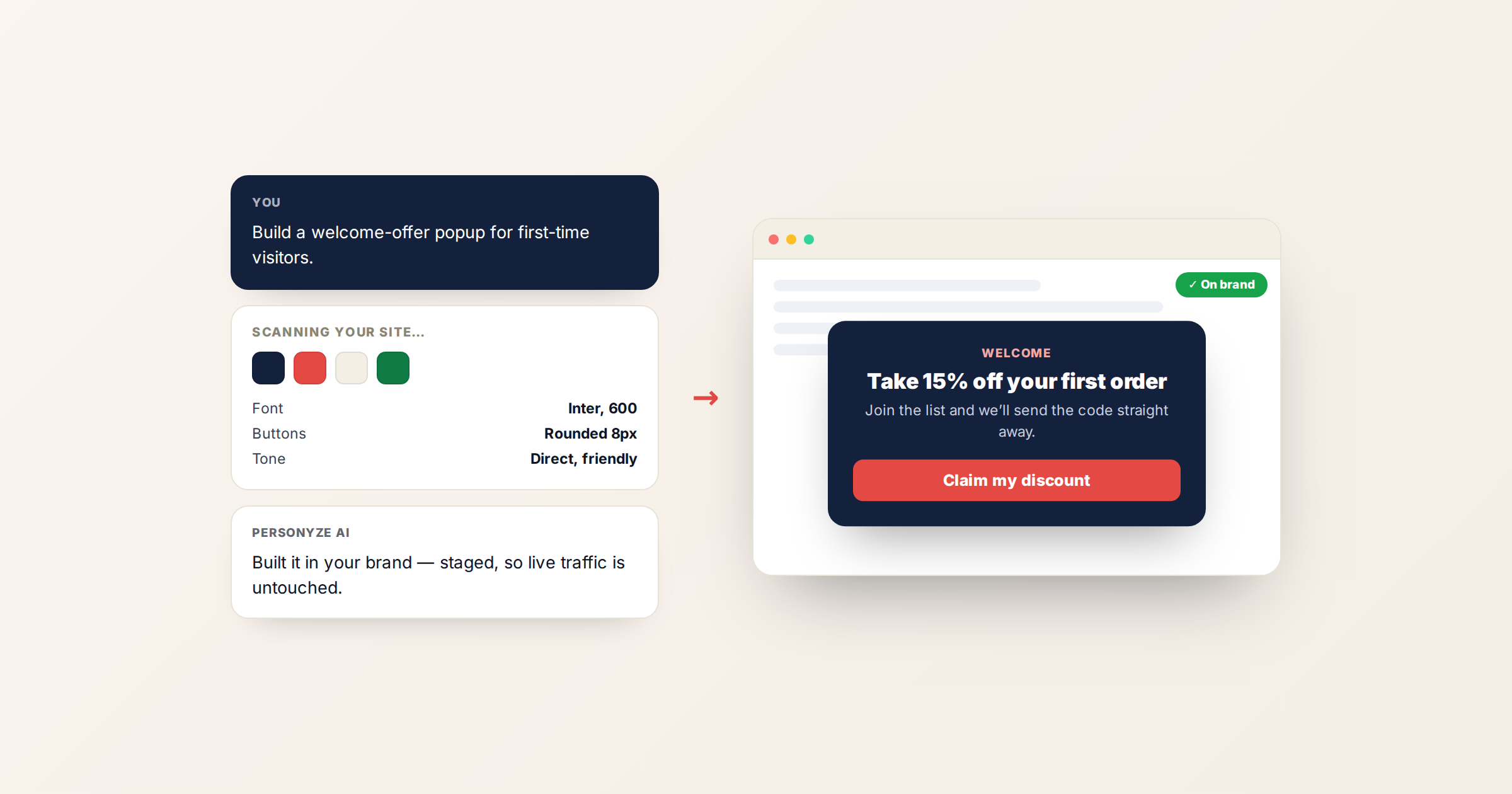
This is the part that decides whether an agent is worth using. Ask for a campaign and the agent scans your website first — reading your brand colors, fonts, button styling, and the tone of your copy — then builds the campaign to match. What comes back looks like your site, not a template dropped on top of it.
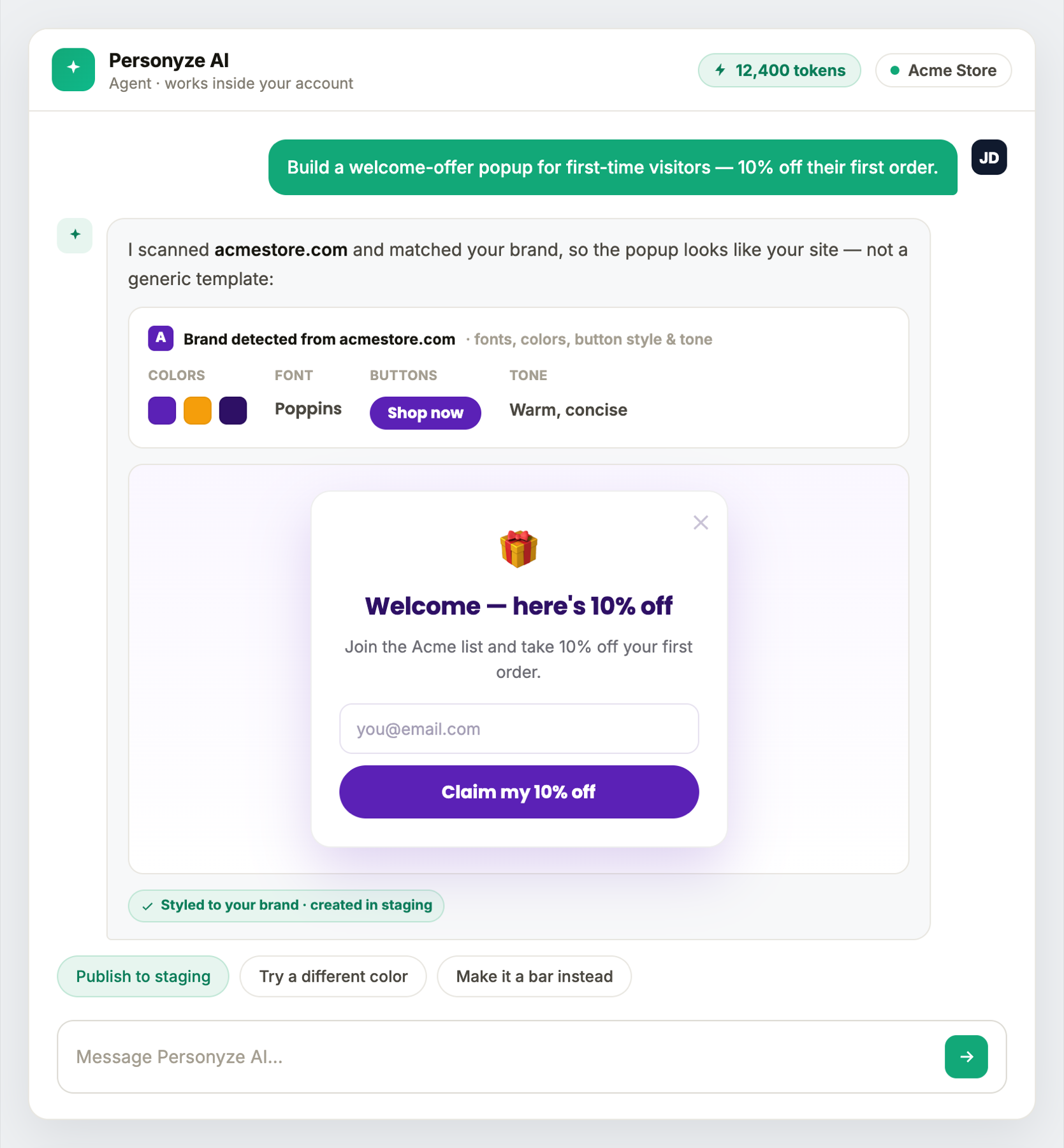
Because the styling is derived from your live pages, a visitor can’t tell it was generated. Don’t like a choice? Say “try a different color” or “make the button square” and it restyles on the spot. You never touch CSS.
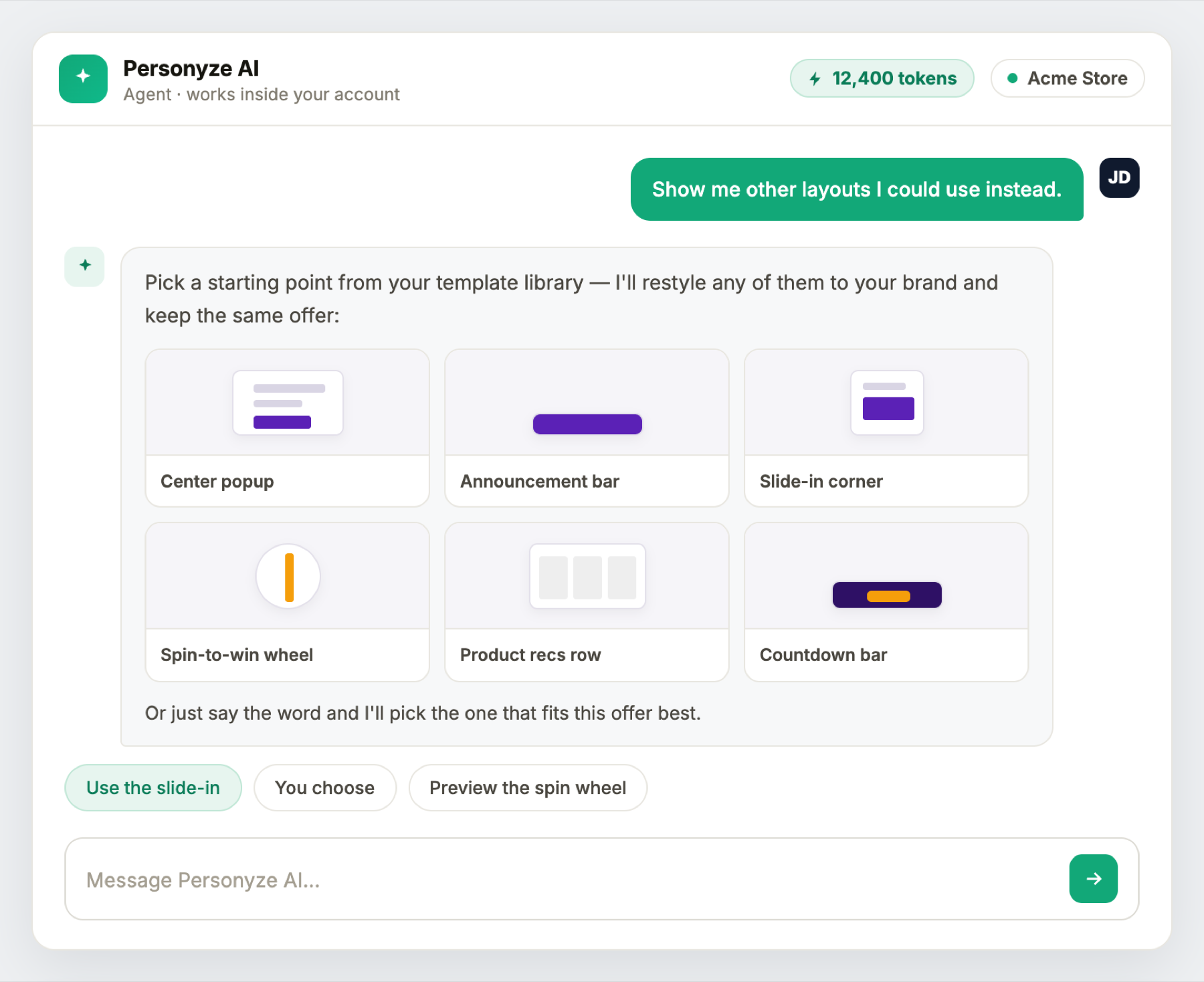
You can also start from the template library — popups, announcement bars, slide-ins, spin-to-win wheels, recommendation rows, countdown bars — and the agent keeps your offer while restyling the template to your brand. Or skip the choice and let it pick the layout that fits the goal.
Plain words become real targeting rules
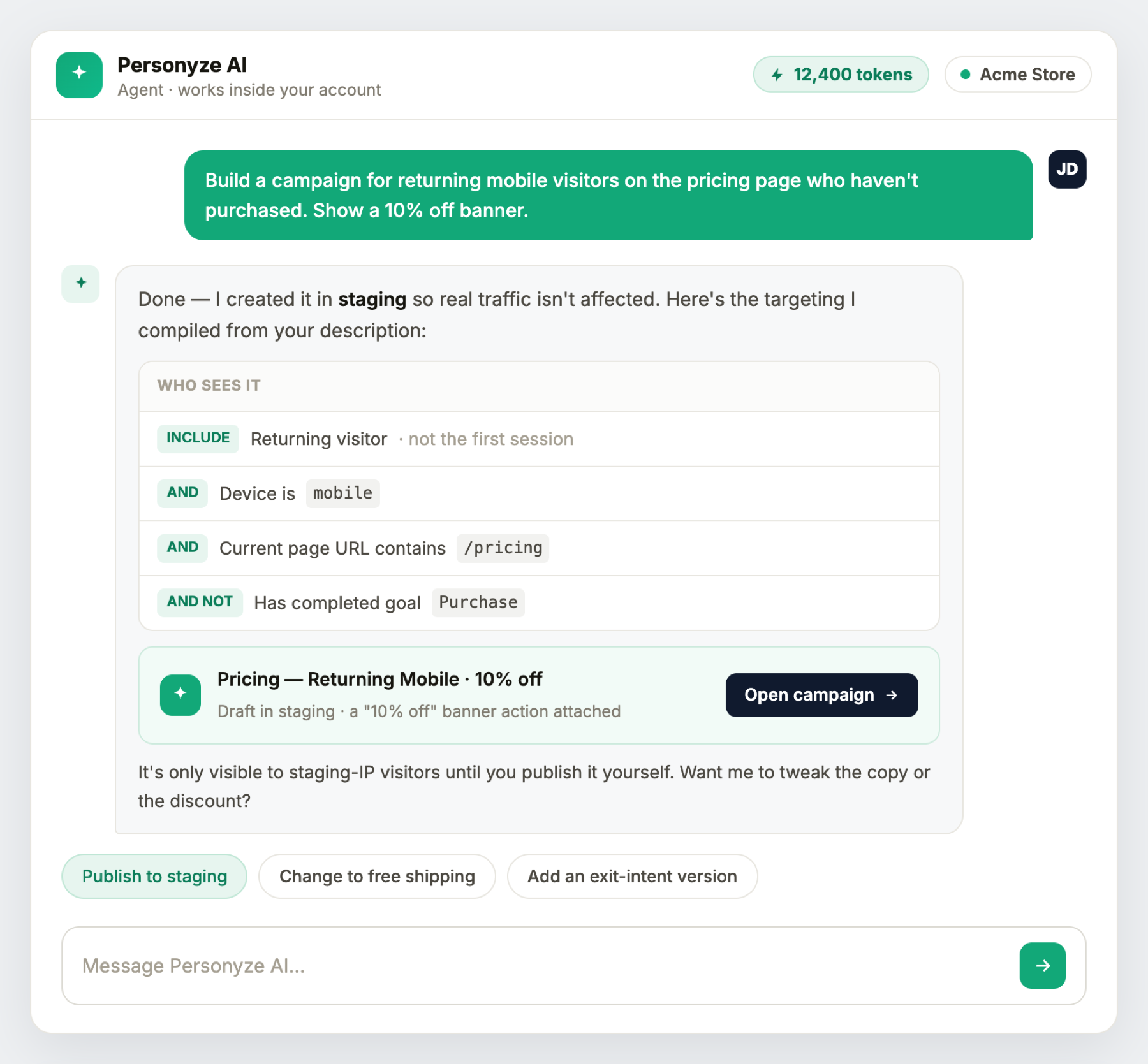
Describe who should see it — “returning mobile visitors on the pricing page who haven’t bought” — and the agent compiles that into actual targeting rules, then reads the compiled result back to you. That read-back matters more than it sounds: a rule that means something slightly different from what you asked looks identical from the outside until it quietly shows the wrong thing to the wrong people.

The guardrails: staging first, live changes confirmed
An agent that can change your website needs limits, and the useful ones are structural rather than a warning label.
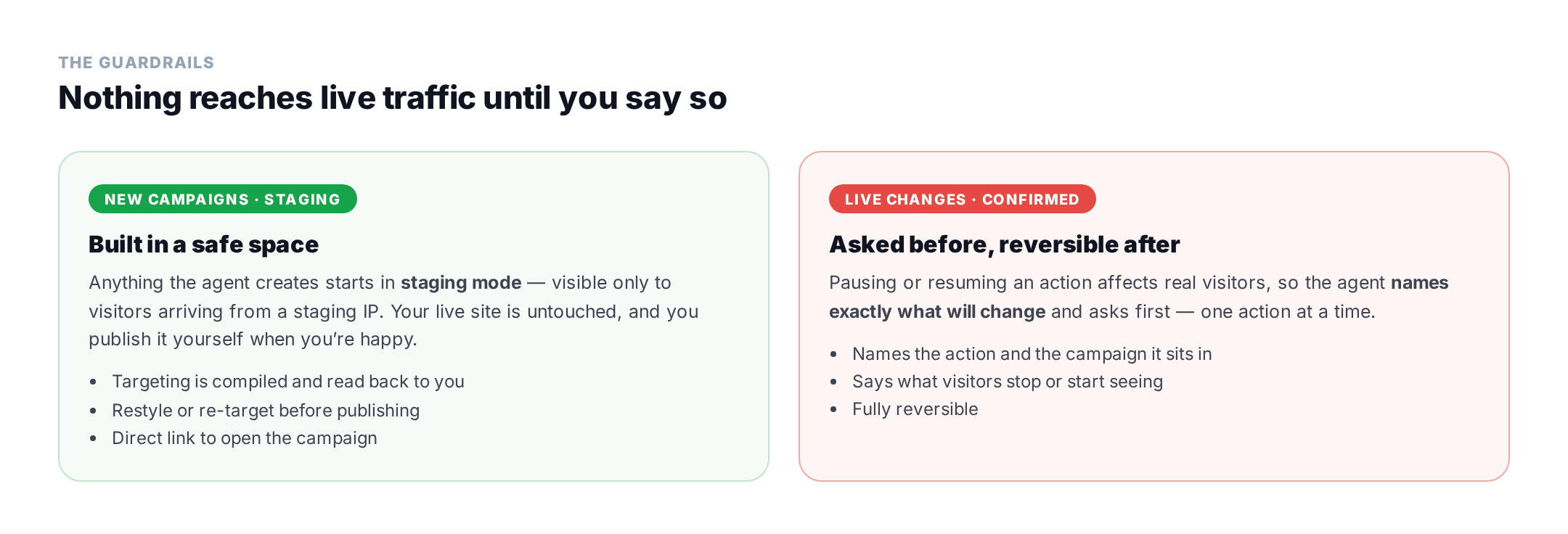
- New campaigns start in staging. They’re shown only to visitors arriving from a staging IP — your live site is untouched, and you publish when you’re happy.
- Live changes are confirmed and reversible. Pausing or resuming an action affects real visitors, so the agent names exactly what will change — the action, the campaign it sits in, what visitors stop or start seeing — and asks first. One action at a time: “pause the campaign” isn’t treated as licence to switch everything off.
It tells you what to improve
You don’t have to know what to ask. Ask “what should I improve this week?” and the agent looks across your pages, products and campaigns and returns ranked, specific opportunities — a page leaking returning visitors, products people view but rarely buy that are worth a discount, a campaign that quietly stopped showing. Each comes with a one-tap action to draft or fix it.
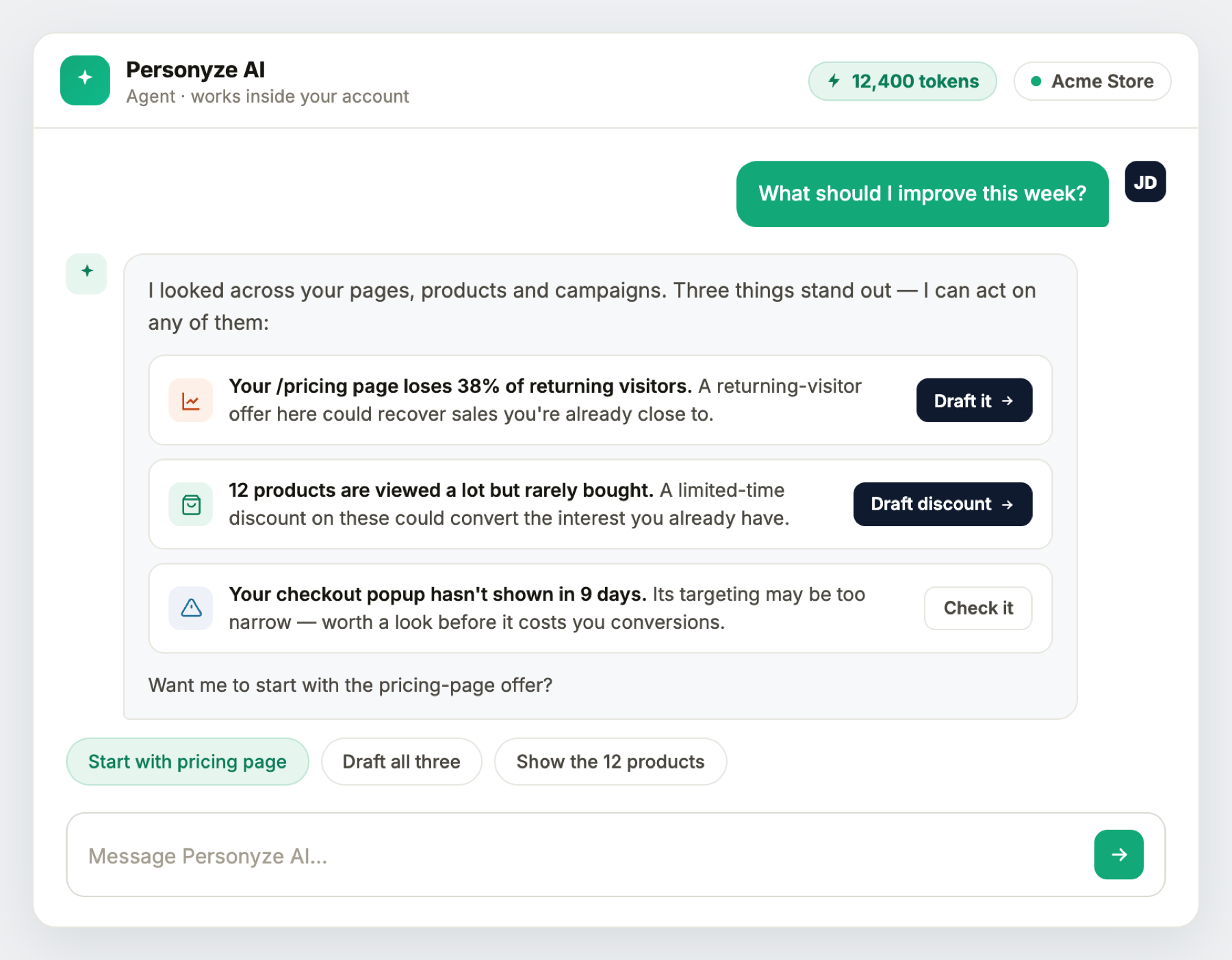
This is the part most teams underestimate. The bottleneck in personalization is rarely the building; it’s knowing which of four hundred pages deserves attention this week.
It answers from your own data
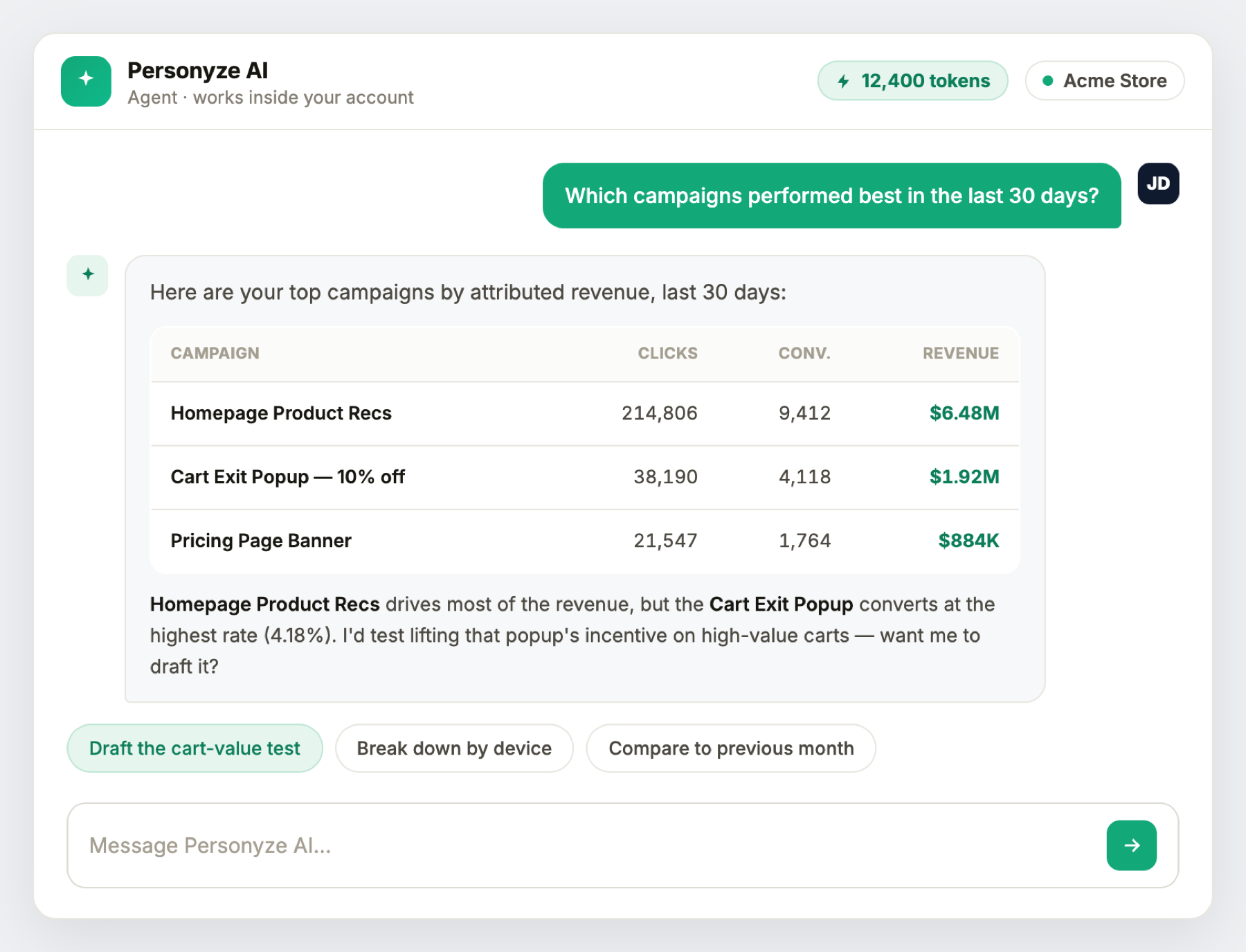
Ask about performance and the agent reads the same numbers the panel reports — per-action results, site-wide traffic by page, source, device and geography, and per-product stats — and turns the answer into a next step. Notably, it won’t quote a click-through rate on a sample too small to mean anything; it says so instead. An agent that confidently reports a 100% conversion rate on three sessions is worse than no agent.
Everything you can ask
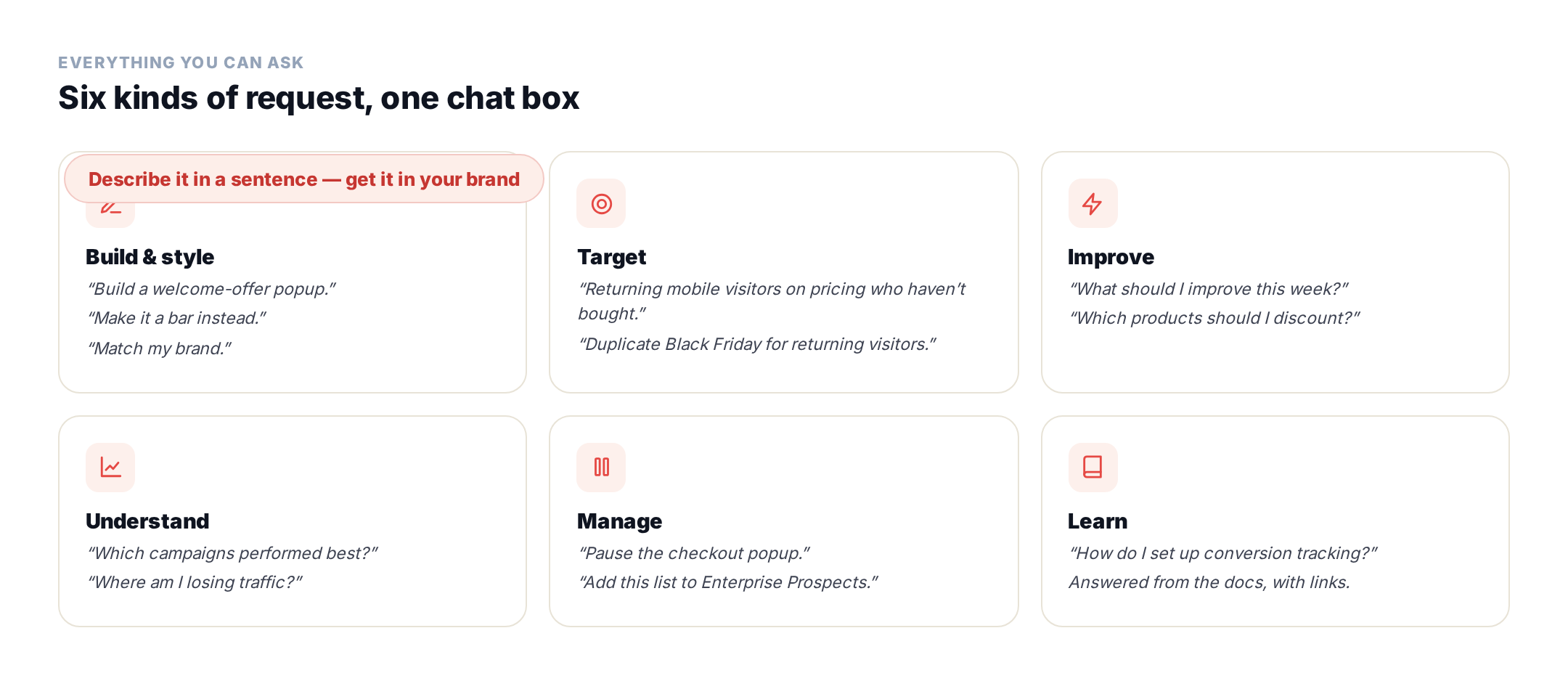
- Build & style — “Build a welcome-offer popup for first-time visitors.” · “Make it a bar instead.”
- Target — “Returning mobile visitors on the pricing page who haven’t bought.” · “Duplicate my Black Friday campaign for returning visitors.”
- Improve — “What should I improve this week?” · “Which products should I discount?”
- Understand — “Which campaigns performed best?” · “Where am I losing traffic?”
- Manage — “Pause the checkout popup.” · “Add everyone in this list to Enterprise Prospects.”
- Learn — “How do I set up conversion tracking?” — answered from the knowledge base, with links.
Where it runs, and what it costs
Open Personyze AI from the top bar of the panel and start typing. The same agent is also reachable from outside — Claude, ChatGPT and other assistants can connect through the Personyze MCP server, so you can work with your account from whichever assistant you already use.
Using the agent spends AI tokens. Your package includes a monthly allowance, the balance is shown as you work, and it resets each billing cycle. There’s no separate AI subscription to buy — see plans for what each package includes.
Personyze is listed in both the Claude connector directory and the ChatGPT app directory, so on either it installs in one click — Personyze in the Claude directory, or read the announcement.
Where an agent helps — and where it doesn’t
An agent is fastest at the work that is well-defined but tedious: standing up a campaign, restyling it, compiling targeting, checking what happened. It is not a substitute for knowing your customers or deciding what your offer should be. Strategy, brand judgement and the decision to run a promotion are still yours — the agent removes the two hours between deciding and shipping.
It also doesn’t remove the need to test. Everything the agent builds can run as an A/B test, and that is usually the honest way to find out whether its version beats yours.
AI marketing agents: FAQ
What is an AI agent in marketing?
An AI agent is goal-oriented rather than rule-based: you give it an outcome and it works out the steps, takes the actions inside your tools, and reports back. That’s different from AI that only drafts copy – an agent can build a campaign, compile targeting rules, pause an action, and read your analytics to decide what to do next.
How is the Personyze AI Agent different from a chatbot?
It works inside your account and can act, not just answer. It scans your site to build campaigns in your brand, compiles plain-language targeting into real rules, reads your actual performance data, and proposes ranked improvements – all with staging and confirmation guardrails.
Will the agent change my live site without asking?
No. New campaigns are created in staging mode and shown only to visitors arriving from a staging IP, so live traffic is untouched until you publish. Anything that does affect live visitors – pausing or resuming an action – is named explicitly and confirmed first, one action at a time, and is reversible.
How does it make campaigns match my brand?
It scans your live website before building – reading brand colors, fonts, button styling and the tone of your copy – then styles the campaign to match. You can adjust it conversationally (“try a different color”, “make the button square”) without editing CSS.
Can it tell me what to improve without me asking a specific question?
Yes. Ask what to improve this week and it looks across pages, products and campaigns and returns ranked opportunities – a page losing returning visitors, products viewed but rarely bought, a campaign that stopped showing – each with a one-tap action.
Does using the AI agent cost extra?
It spends AI tokens from a monthly allowance included in your package, with the balance visible as you work and a reset each billing cycle. There is no separate AI subscription; larger packages include a larger allowance.
Can I use it from Claude or ChatGPT instead of the panel?
Yes. The Personyze MCP server exposes the same capabilities to any MCP-capable assistant, so you can ask Claude or ChatGPT to read performance, build a staged campaign, or manage audiences in your Personyze account.
Get started
Describe the campaign you’ve been meaning to build and let the agent stage it. Book a demo or view plans.
See it in action on the AI personalization agent page.
Related reading
- Personyze MCP server — use the same capabilities from Claude or ChatGPT.
- AI Agent documentation — the full reference.
- AI in Personyze — the assistants built into the editor and targeting.
- Website personalization — the engine the agent drives.
Book a demo with a personalization expert
30 minutes with a personalization expert. Bring your stack, your goals, your skepticism. We'll show you what changes when every visit feels like the only one.