

Personalization ROI: The Metrics That Actually Matter
Personalization ROI is both easy to overstate and easy to under-measure. Teams celebrate impressions and clicks that never tie to revenue — and, just as often, count “reach” that never actually happened, because an action fired but was never seen. Let’s fix both: the metrics that actually matter, and the Personyze-specific nuances that keep them honest.
Related: industry personalization playbooks
Start with the trap: “executed” is not “seen”
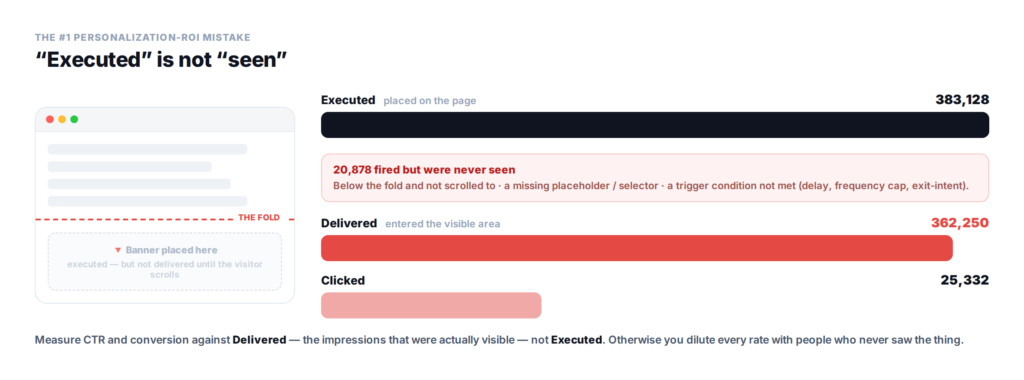
The most common ROI mistake is counting an action as an impression the moment it fires. But firing isn’t the same as being seen. In Personyze terms, an action is executed when it’s placed on the page, and delivered only when its content actually enters the visible area. Content above the fold is delivered the moment the page loads; a banner below the fold is executed immediately, but it isn’t delivered until the visitor scrolls down to it. If they never scroll past the fold, it fired and nobody saw it.
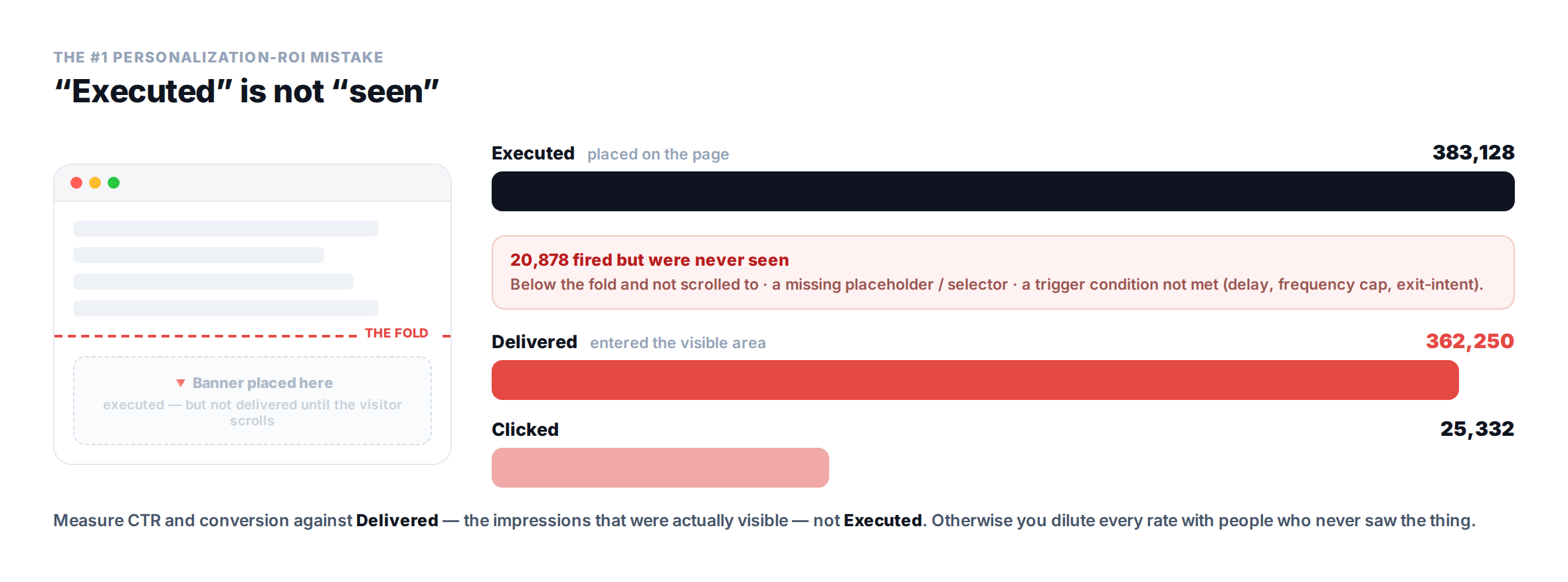
The gap between executed and delivered is usually one of three fixable things: the content sits below the fold and visitors don’t scroll to it, the placeholder or selector is missing on some pages, or a trigger condition simply isn’t met — a delay that runs out after the visitor leaves, a frequency cap (a “don’t show again” rule), page-group scoping, or an exit-intent popup that never triggers. That’s why the number matters twice. It keeps your rates honest — measure CTR and conversion against delivered, not executed, or you dilute every rate with people who never saw the thing. And a low delivered-to-executed ratio is a diagnosis, not a mystery: it points you straight at placement, selectors, or triggers instead of blaming the offer.
The metrics that actually tie to money
Once you’re measuring what was actually seen, these are the ones worth reporting. Personyze breaks them out by campaign type — general campaign performance, product recommendations, and A/B tests each get their own dedicated view — but the principle is the same: tie the metric to money.
Conversion rate — against who saw it
Personyze defines conversion rate as the percentage of visitors who saw the action and then converted. The important part is the denominator: those who were delivered the action, not everyone it fired for. Put a conversion goal on every action — a checkout, a booked demo, a downloaded asset — and you can attribute the result to the exact action that earned it.
Goals and goal value
Not every conversion is worth the same. In Personyze a goal can carry a value (and a single action can achieve more than one), so a demo request can weigh differently from a newsletter signup. Report value, not just counts.
For recommendations: contribution
The single best recommendation metric isn’t clicks — it’s contribution: the revenue from items found through the recommendation widget, divided by total revenue. It answers the only question that matters: how much of our revenue did recommendations actually influence?
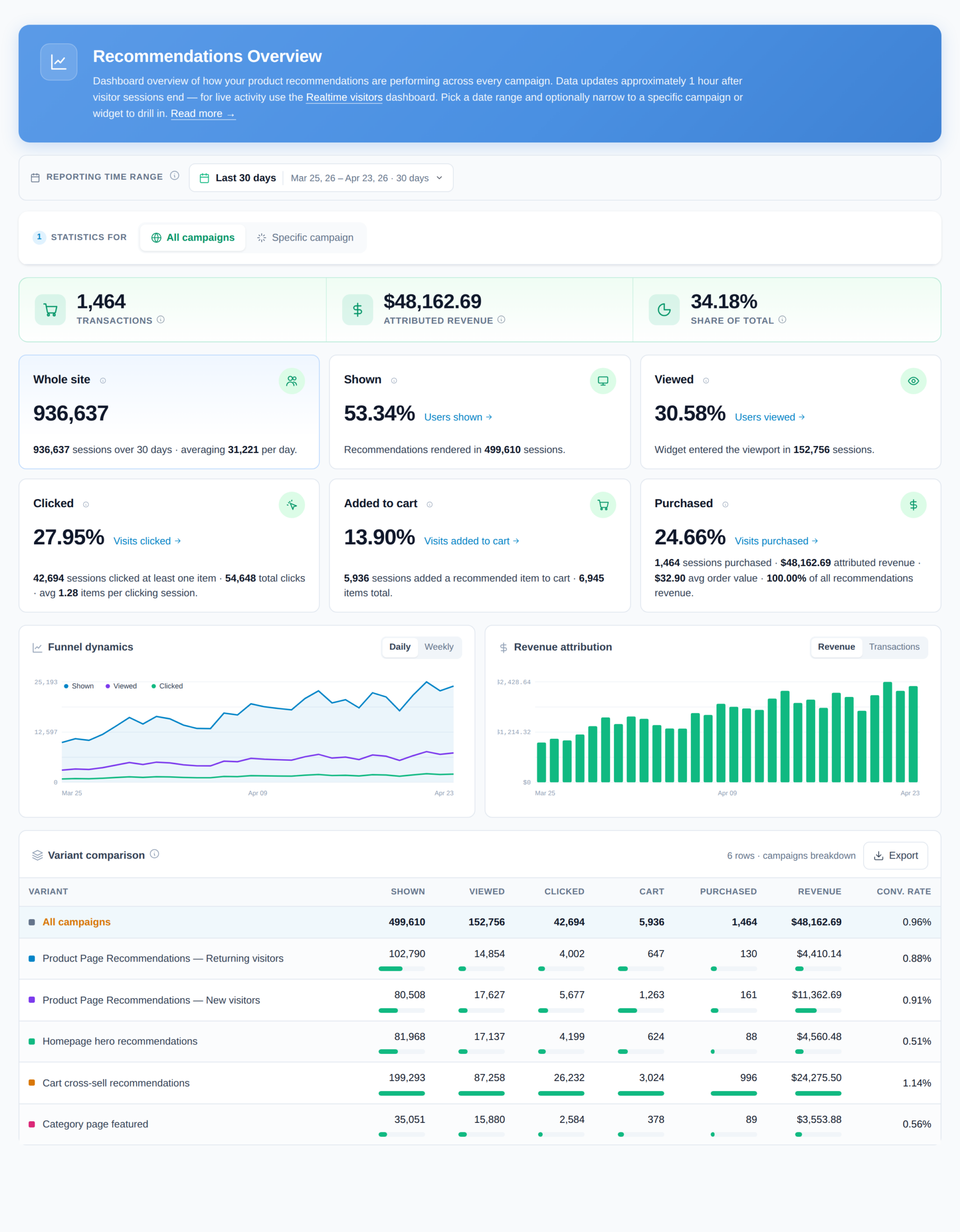
Personyze pairs contribution with contribution (transactions) — the share of orders that included a recommended item — plus sessions added to cart and sessions purchased from the widget. And the attribution is deliberately strict: an item only counts as “found through the widget” when the visitor actually engaged with it there — either clicking the recommended item from the widget, or using the widget’s quick-add-to-cart — and then went on to purchase it. Personyze also tracks the items a visitor adds to a favorites or wish list from the widget. That precision is what separates contribution from a raw click count: it credits the widget only when it genuinely helped drive the sale.
Recommendations aren’t only about products. Personyze reports content recommendations — recommending articles, posts, and resources — in their own overview, so you can see how well they drive reading and on-site engagement, not just revenue.

For A/B tests: the variation that actually won
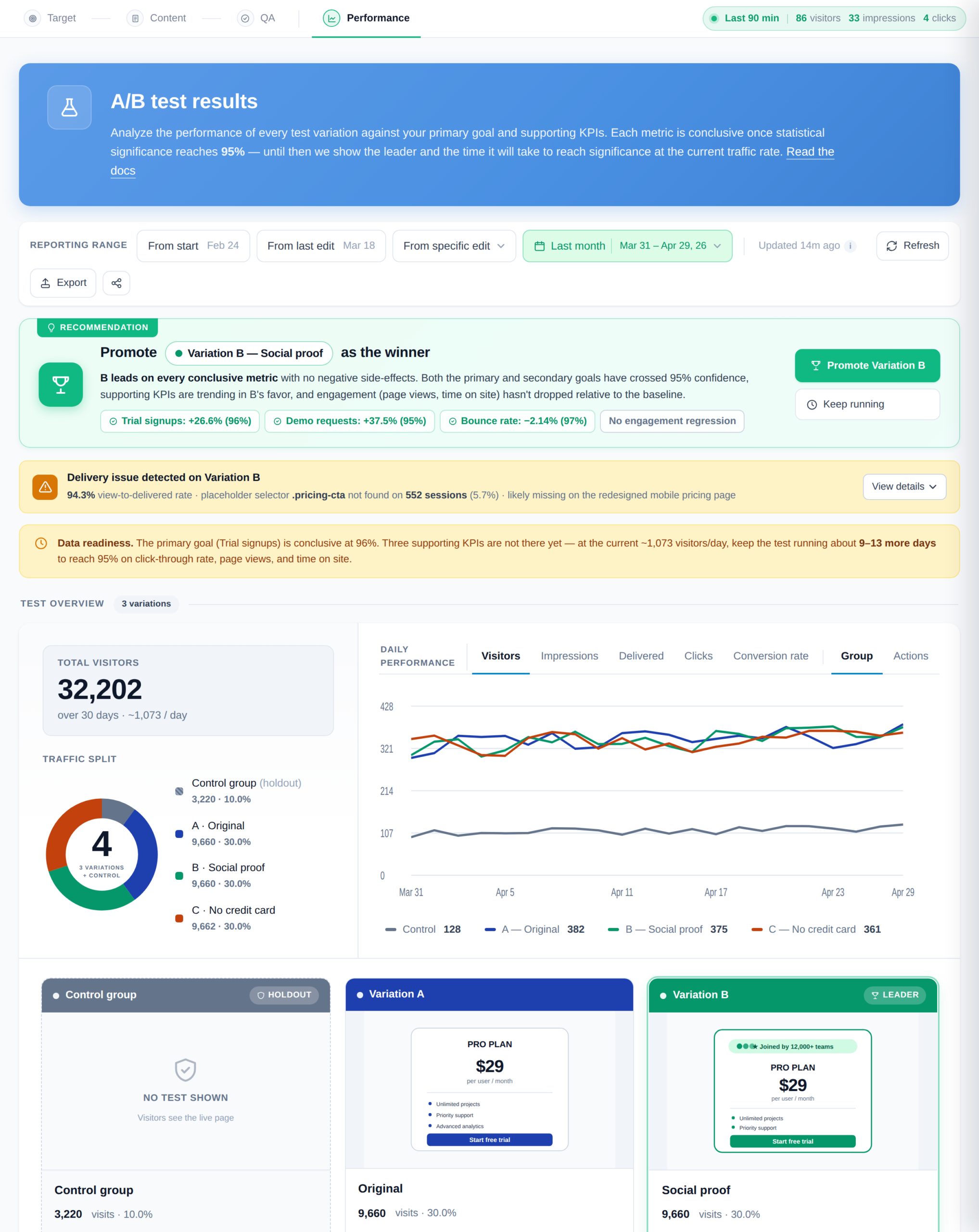
With A/B and multivariate testing, the ROI question narrows to one thing: which variation moved the goal? Personyze reports each variation’s performance against your primary goal and can auto-pick the winner — promoting it automatically once it’s clearly ahead — so you act on lift, not hunches. The same executed-vs-delivered honesty applies: variations are compared on the visitors who actually saw them.
The engagement signals worth watching
Click-through rate (CTR) and CTR of visits — did the content that was seen earn a click — along with bounce rate, pages per visit, and session duration, aren’t the ROI headline, but they’re the leading indicators. They move before revenue does, and they tell you whether the experience is landing. Personyze measures these for the people who actually saw an action, so you can compare an audience that got the experience against one that didn’t.
A number without a comparison is noise
Every metric above needs a reference point. Personyze shows each KPI against the prior period, ranks actions from best- to worst-performing (flagging low-CTR actions as candidates to redesign or cut), and breaks performance down by segment — top pages, referrers, devices, countries, cities, landing pages. Attribution per action against the primary goal tells you which specific action drove the result, so you can test and double down on what works.
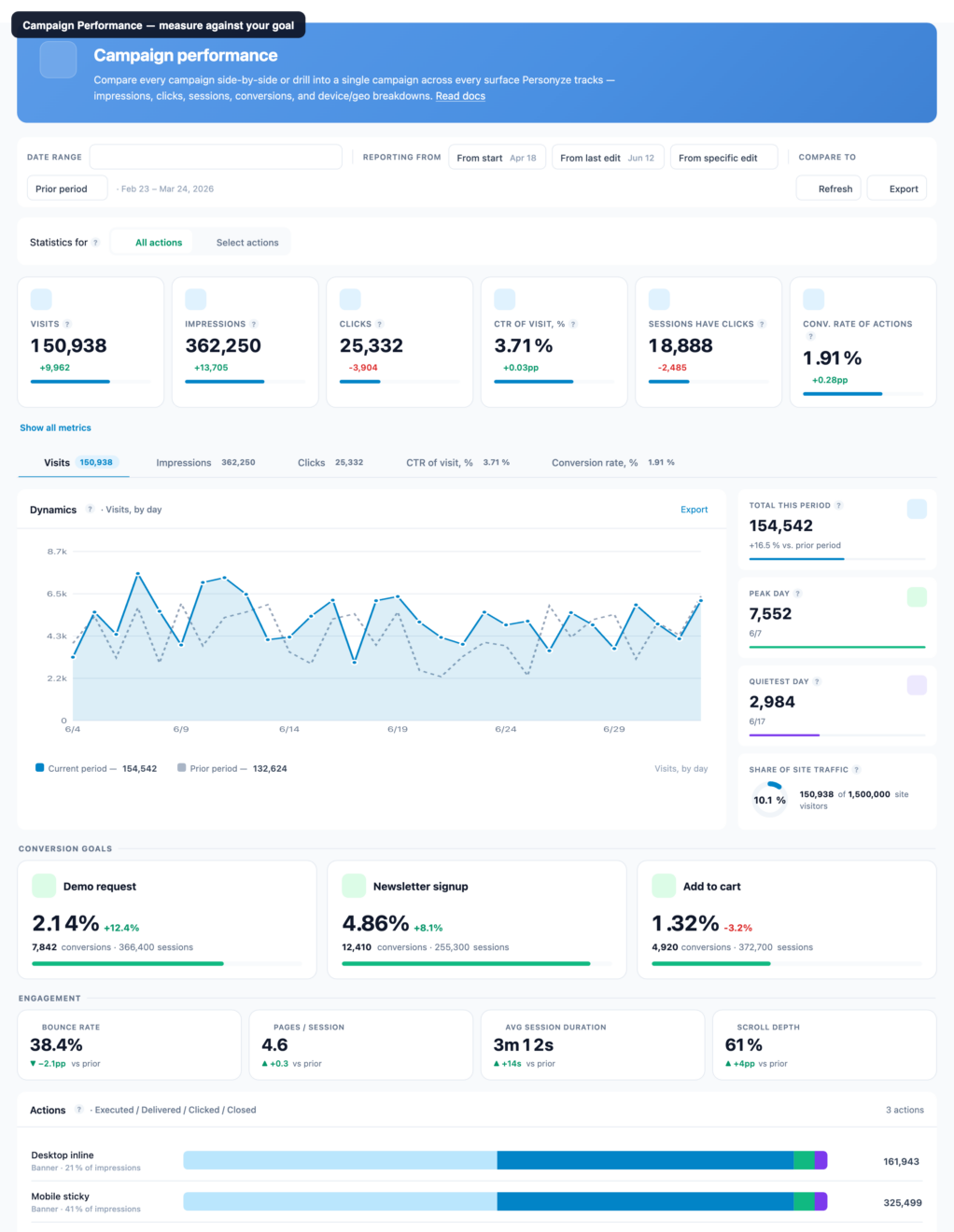
The per-visitor user report closes the loop: see exactly what each visitor saw, clicked, and bought — and diagnose under-delivery by reading real sessions instead of guessing. (It’s the same report we walk through in our lead-generation guide.)
The personalization-ROI checklist
- Measure delivered, not executed — visible impressions only.
- Put a conversion goal (with a value) on every action.
- For recommendations, lead with contribution, not clicks.
- Always compare against a prior period or a control.
- Segment before you conclude.
- Diagnose low delivery (below the fold, a missing selector, a mobile trigger) before blaming the creative.
See the real numbers, not the vanity ones
Personalization only earns its keep if you can prove it — and that starts with measuring what visitors actually saw, and what it actually earned. Personyze reports delivered impressions, recommendation contribution, goal value, and per-action attribution out of the box. Try our personalization ROI calculators to model the upside, book a demo to see it on your own numbers, or explore plans and pricing.
Personalization ROI: FAQ
What’s the difference between “executed” and “delivered” in Personyze?
Executed means the action was placed on the page; delivered means its content actually entered the visible area. A banner at the bottom of the page is executed right away but only delivered once the visitor scrolls to it. If they never scroll – or a placeholder is missing, or a trigger condition isn’t met (a delay, a ‘don’t show again’ cap, page-group scoping, or an exit-intent that never fires) – the action was executed but not delivered.
Why should I measure conversion against delivered instead of executed?
Because executed includes actions that fired but were never seen. If you measure CTR or conversion rate against everything that fired, you dilute the rate with people who never saw the content. Measuring against delivered – the visible impressions – gives you the true performance.
What is recommendation “contribution”?
Contribution is the ratio between revenue from items found through the recommendation widget and total revenue. It shows how much of your revenue recommendations actually influenced. Personyze also reports contribution by transactions, sessions added to cart, and sessions purchased from the widget.
What personalization metrics actually matter for ROI?
Delivered (visible) impressions, conversion rate measured against who saw the action, goal value, and – for recommendations – contribution. Engagement signals like CTR, bounce rate, pages per visit, and session duration are useful leading indicators, but they’re not the headline.
Why is my personalization action under-delivering?
Usually one of three things: the content sits below the fold and visitors don’t scroll to it, the placeholder or selector is missing on some pages, or a trigger condition isn’t met – for example a delay that runs out after the visitor leaves, a frequency cap (a ‘don’t show again’ rule), page-group scoping, or an exit-intent popup that never fires. A low delivered-to-executed ratio points you straight at the cause.
How does Personyze attribute a conversion to a specific action?
By tying each action to a conversion goal and reporting conversion attribution per action against the campaign’s primary goal, compared to the prior period. The per-visitor user report then shows exactly what each visitor saw, clicked, and bought.
How does Personyze report A/B test performance?
Each variation is measured against your primary goal, and Personyze can auto-pick and promote the winning variation once it’s clearly ahead. Variations are compared on the visitors who actually saw them, so the lift you’re acting on is real.
Related reading
- Product recommendation examples — where contribution comes from.
- Personalized lead generation — the campaign report in context.
- Audience-oriented A/B testing — proving which action wins.
- Personalization ROI calculators — model the upside on your own numbers.
Book a demo with a personalization expert
30 minutes with a personalization expert. Bring your stack, your goals, your skepticism. We'll show you what changes when every visit feels like the only one.