AI AgentPlatform
PricingSign inBook a demo
Personyze
Pricing
AI chat agent

An AI chat agent that answers in a second.
And it knows who asked.

A visitor-facing assistant that answers from your own pages and your own catalogue — and already knows the person asking, because the platform has been watching the session all along. It hands over to a person when it should, and tells you every question it could not answer.

4.84.6
The conversation

It never asks
who you are.

Because it already knows. The platform has been watching this session since the visitor arrived — the page they are standing on, the path that got them there, what they bought the last time. Pick a face and read what was actually said.

  • Answers from your own pages Your site, your files, the paragraph you keep retyping. Never a general answer about your industry, borrowed from the internet.
  • Searches your own catalogue Price, stock and attributes exactly as stored — and nothing invented around them, because no tool exists that could.
  • Hands over when it should To a person, or to an email address, with a subject written from what was actually being discussed rather than “Chat request”.
Six visitors, six kinds of site
Alina Petrescu Alina PetrescuUsually replies instantly Knows: page · journey · country
The bubble, on a product page
Will the coat I was looking at get here before Friday?
Nadia Halvorsen
The Merino Travel Coat — yes. Size 12 is in stock, and standard delivery to Ireland runs two to three working days, so Friday is comfortable.
Merino Travel Coat — FernSize 12 · in stock€245
And if it does not fit?
Nadia Halvorsen
Thirty days, free of charge, unworn and with the tags on. You can start it from your order page.
Delivery & returnsIreland · passage 4 of 11

It never asked which coat. The page the visitor is standing on and the path they took to get there are two of the seven things you can let it see.

Where is my order?Do you deliver here? Talk to a person
Ask anything about the site…
AI assistant — answers may be inaccurate
It is an action

One assistant per audience,
not one per site.

The chat is an action inside a campaign, so everything you already use to target a pop-up targets an assistant too — audience, page group, cart value, device, referrer, how often it may appear. Point four campaigns at four audiences and you have four assistants on one site, each with its own slice of the knowledge base, its own tone, its own colours, and its own idea of who to wake up.

Enterprise evaluatorsLIVE
WHO SEES IT
Company size≥ 500ANDCRM account typeEnterpriseANDPage groupPricing, Security
Knowledge

Scoped to the security and contract material, and told to refuse rather than widen into anything else.

Behaviour

Formal. Never quotes a list price. “Procurement” and “contract” skip straight to a person.

Handover

The named account manager, ahead of the general queue.

I can go through security, procurement or the contract — or put you straight onto your account manager.
Ask anything about the site…
Basket over $300LIVE
WHO SEES IT
Cart value≥ $300ANDTime on site> 3 minANDFrequencyOnce a day
Knowledge

Delivery windows, returns and the warranty.

Behaviour

Offers a person in its first reply instead of waiting until it is stuck. Past this basket size, a lost order costs more than the operator’s five minutes.

Handover

Straight to a person. No email fallback on this one.

Before you check out — want me to put you onto somebody who can confirm sizing and the delivery date?
Ask anything about the site…
Trial, day sevenLIVE
WHO SEES IT
Account typeTrialANDDays since signup≥ 7ANDGoal“Integration connected” not reached
Knowledge

Onboarding and the integration guides. Nothing about pricing.

Behaviour

The suggested questions are the setup steps this account has not done, not a generic three.

Handover

Customer success, by email, with the account id attached.

You have not connected an integration yet — want me to walk you through it?
Ask anything about the site…
Third visit, still no orderLIVE
WHO SEES IT
Visits≥ 3ANDOrders0ANDFrequency capOnce a week
Knowledge

Sizing, delivery and returns — the three things that stop a first order.

Behaviour

The greeting carries the code the campaign already holds. The assistant presents an offer; it still cannot compose one.

Handover

Email, and only if they ask.

First order? WELCOME15 takes 15% off — and I can talk you through sizing while you look.
Ask anything about the site…

All four sit on one account and one knowledge base. What differs is which tag each may answer from, what it has been told, and how fast it reaches for a person.

The other shape

Ask it, and it answers
with your catalogue.

The same assistant also comes as a box you drop into a page. Point it at your product catalogue or your content catalogue and it does not stop at a paragraph: it answers in a sentence, then hands back the items themselves — ranked for the person searching by the same engine that orders your recommendations.

ANSWERS FROMProductsArticles
something warm for a wet Irish springAsk

For rain and wind rather than cold, the waxed and shell layers do more than the wool does. All four are in stock in your size.

Fabric & careWaxed cotton · passage 3 of 9DeliveryIreland · passage 1 of 11
FROM YOUR CATALOGUE · RANKED FOR THIS VISITOR
1Merino Travel Coat — FernWool · water-repellent€245NEW INYOU VIEWED THIS
2Waxed Cotton ParkaWaxed cotton · fully taped€189€235−20% THIS WEEK
3Packable Rain ShellShell · folds to a fist€120BACK IN STOCK
4Lambswool Roll-neckWool · mid layer€95BEST SELLER
WHY THIS ORDER
New in the last 30 days82Price cut this week64What this visitor viewed57What people like them bought46In stock, in their size38

The same engine that orders your recommendations, ordering your search results. Keyword search returns the same four to everybody — this does not.

A SENTENCE FIRST, THEN THE ITEMS — A SEARCH THAT ONLY RETURNS AN ESSAY IS NOT A SEARCH

And it can be held to one part of the library. An ask box beside the pricing table can be told to answer from pricing only, and to say so rather than wander into the returns policy.

Everything you can set

Taught, told,
and fenced in.

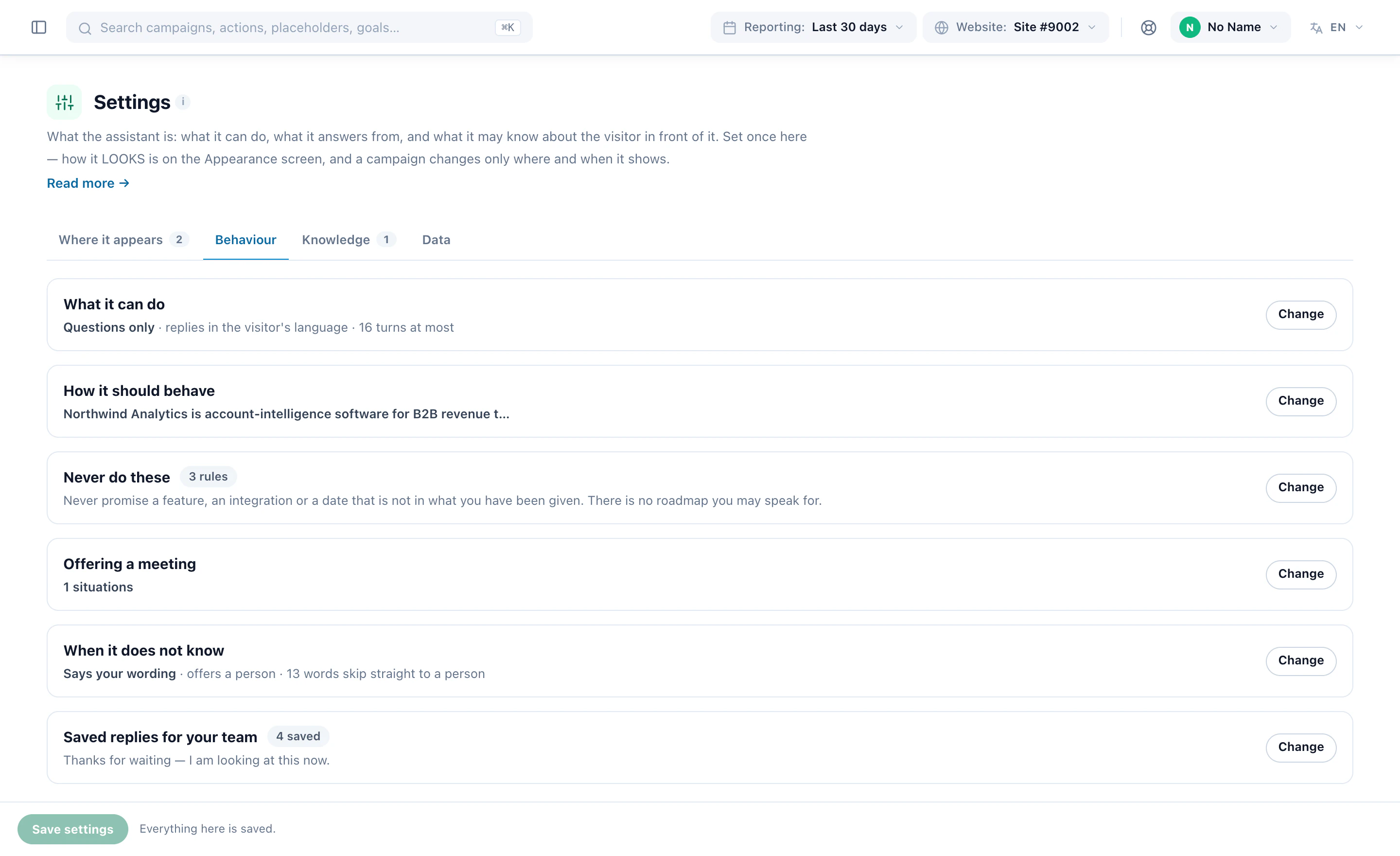
Six families of settings, each one a real field with a real default. This is the whole surface — there is nothing else waiting behind an account manager, and nothing here that only works in the demo.

Knowledge

It reads your site. Nothing else.

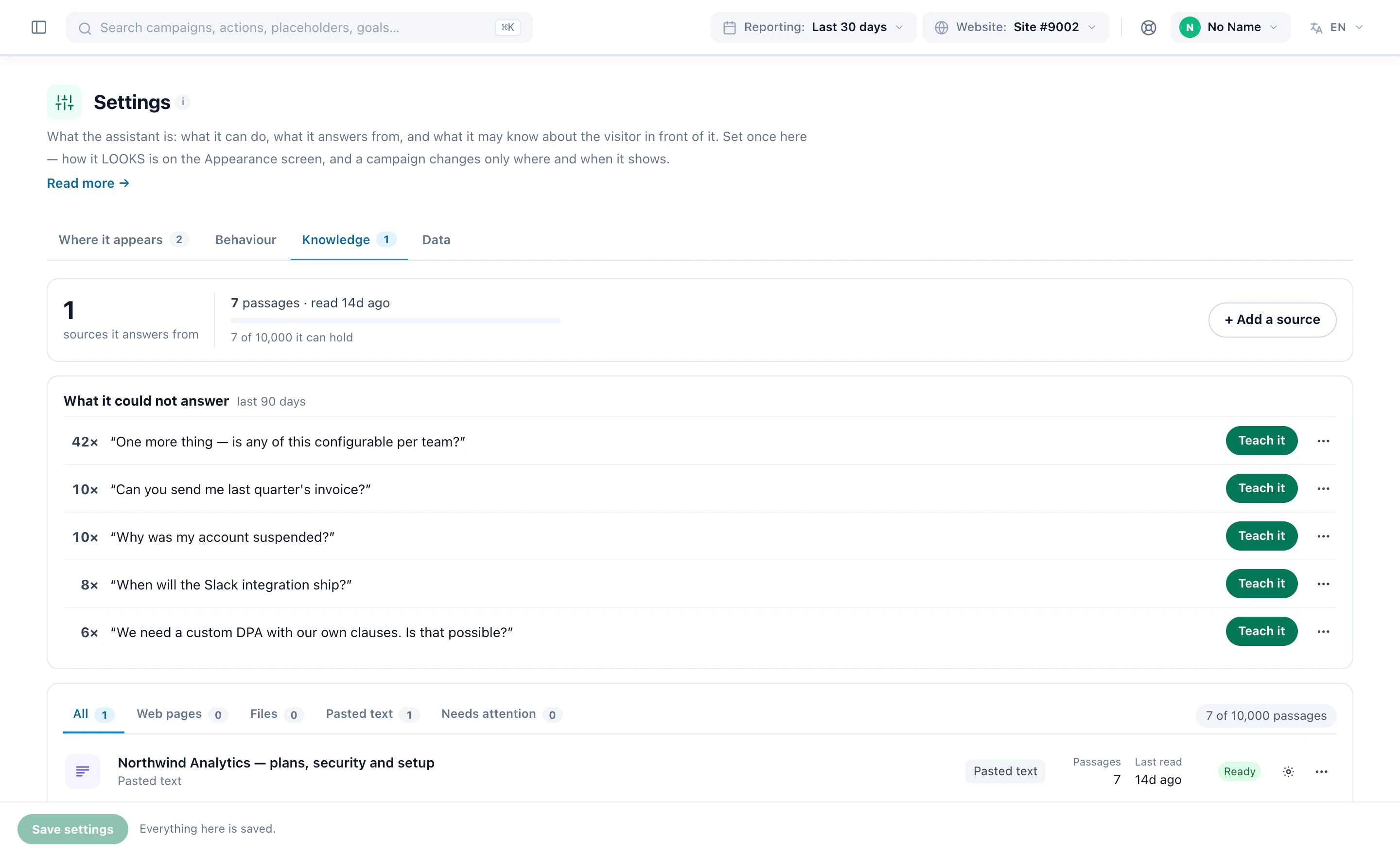
Point it at an address and it crawls; paste the answer you keep retyping and it keeps that too. Everything is cut into passages that carry their own heading, which is how an answer can show you the page it came from.

Three ways in, one shape outA web addressCRAWLED, OR SITEMAPA fileKEPT AS TEXTPasted text200,000 CHARSPASSAGESTARGET900MAXIMUM1,800PER SOURCE400Delivery & returnsSizingWarrantyTHE HEADING TRAVELS WITH THE PASSAGEPDF AND .DOCX ARE REFUSED, NOT MANGLED
A web addresscrawled whole, one level down, or from sitemap.xml
A page ceilingso a large site does not quietly become the whole library
An uploaded filekept as text, because there is nothing to fetch again
Pasted textup to 200,000 characters, then it asks you to split it
PDF and .docx, refuseda PDF read as text is binary noise indexed as knowledge
Passages of about 900 charactersnever splitting a paragraph under 1,800
Up to 400 passages per sourceand the heading travels with every one
Bytes read, and passages madea source that yielded two is not really in there
Behaviour

You write the rules. Some you cannot relax.

Instructions in your own words, guardrails one per line, and a sentence for the moment it does not know. Underneath sits a block of platform rules an account cannot override, because the counterparty is anonymous and often adversarial.

The prompt, in the order it is assembled1Platform rulesYOU CANNOT RELAX THESE2Your instructionsTONE, PRIORITIES, REFUSALS3This placementITS OWN EXTRA RULES4Retrieved passagesUP TO SIX5Visitor factsONLY WHAT YOU SWITCHED ON6The questionTHE BLOCKS EVERY ACCOUNT SHARES COME FIRST, SO THE CACHED PREFIX IS REUSEDAnd the ones you write yourselfNEVER DO THESENo discountsNo delivery datesNo stock promisesWHEN IT DOES NOT KNOW“I cannot confirm that.”THEN: A PERSON · AN EMAIL · OR NOTHING
Instructions, in your own wordstone, what to push, what to refuse, when to give up
The first thing a visitor seesshown verbatim, and never sent to the model
Suggested questionswhat turns a blank box into one people actually use
Reply languageblank follows the page; a code forces one language
Never do thesehard rules, rendered as their own numbered block
What it says when it is stuckthen a person, an email address, or nothing
Words that skip straight to a person“refund” is the one everybody adds first
Saved replies for your teamnever shown to the model, or it would quote them at visitors
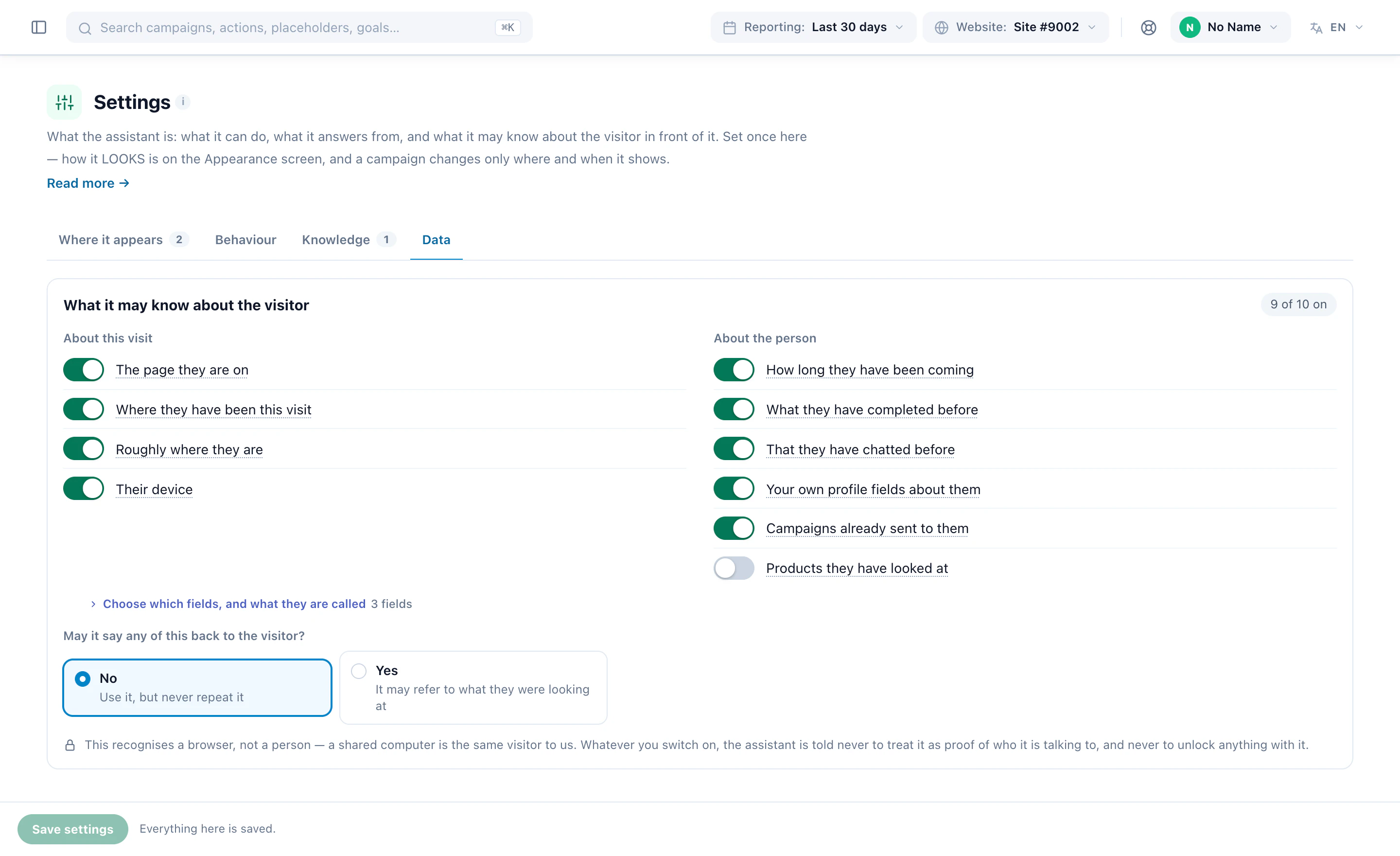
The visitor

Seven switches, and all of them start off.

The platform has watched this visitor all session — pages, products, where they came from, what they bought before. Putting any of that into a prompt is a disclosure decision, so it is opt-in per category, in the words of what it reveals.

Seven categories. Every one of them starts off.The page they are onWhere they have beenRoughly where they areTheir deviceHow long they have comeWhat they finished beforeThat they chatted beforeMay it read any of it back?A COOKIE NAMES A BROWSER, NOT A PERSON — SO TAILORING IS SAFE AND RECITING IS NOT
The page they are onthe address, and the language it is written in
Where they have been this visitthe last few pages of the path they took
Roughly where they arecountry, region and network — not an address
Their devicebrowser and operating system
How long they have been comingvisits, first arrival, and what brought them
What they completed beforegoals reached, and what those were worth
That they have chatted beforethe number, never a word of what was said
Whether it may repeat any of ita separate switch, and also off by default
Tools

It cannot promise what it cannot do.

Most of what a public chat gets talked into is made impossible here rather than merely forbidden. There is no tool that composes an offer, applies a coupon or quotes a price the catalogue does not carry — so the machinery to promise one does not exist.

Four tools, and which pack carries themONLINE SHOPQUESTIONS ONLYsearch_knowledgesearch_productsget_product_detailsrequest_humanNO TOOL CANCompose an offerApply a couponInvent a priceRead “your orders”INSTRUCTIONS ARE ADVISORY. AN ABSENT TOOL IS NOT.
search_knowledgefull-text over this placement’s slice of the library
search_productsyour own catalogue, eight results, wildcards escaped
get_product_detailsprice, stock and attributes, exactly as stored
request_humanopens a ticket and hands the conversation over
An online shop, or questions onlythe second pack has no product search at all
The serving copy of the cataloguenot the reporting archive — somebody is waiting
No tool composes an offeror applies a coupon, or invents a price
No tool reads “your orders”identity-scoped tools wait for a signed handshake
Appearance

A corner, a page, or inside a design.

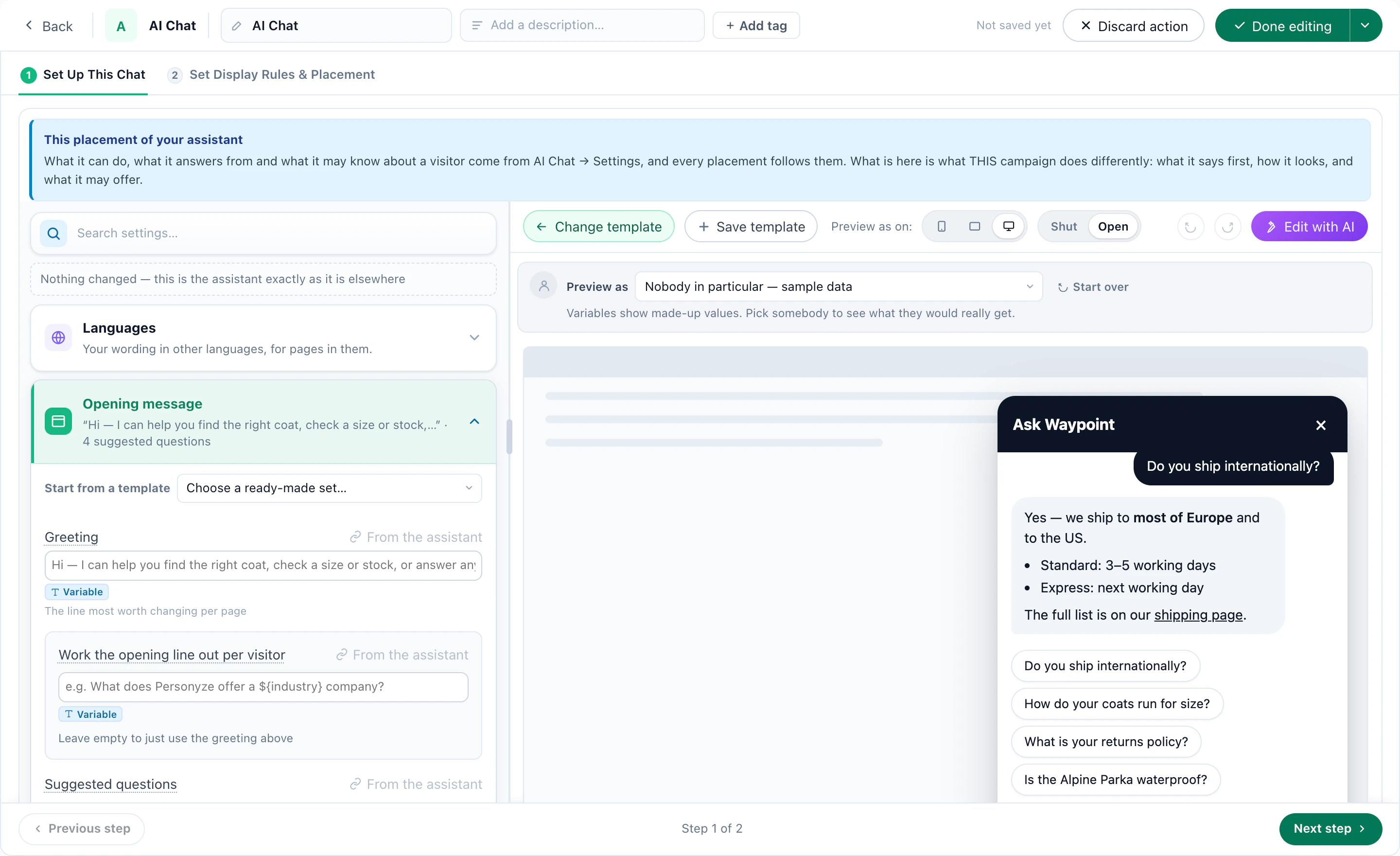
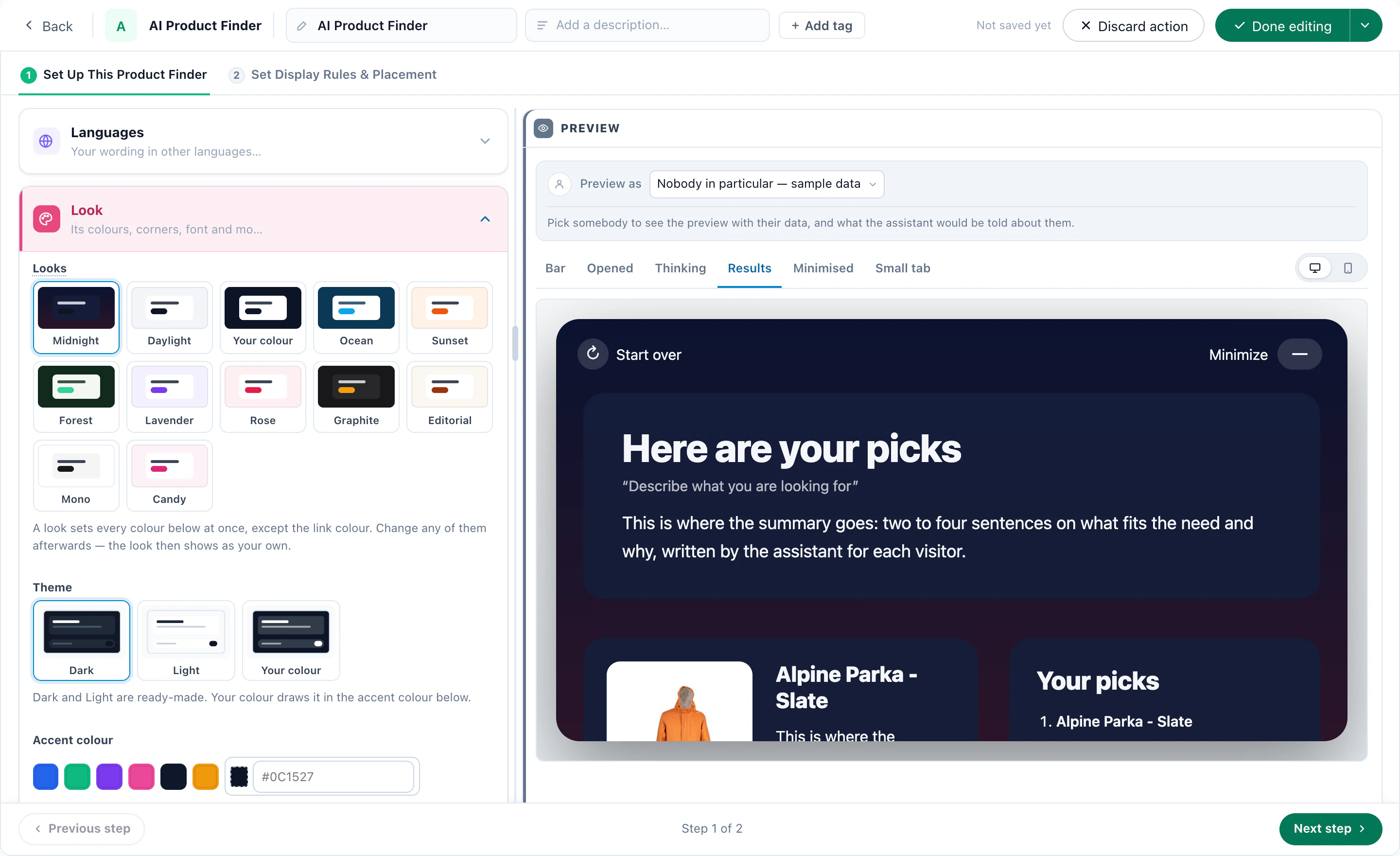
The account sets the defaults; a campaign overrides eleven of them for its own pages, and one that overrides nothing keeps following the account when you change it. The design step runs the real widget, not a second renderer that agrees until it does not.

Where it sitsFOUR CORNERS · AUTO-OPEN DEFAULTS TO 0 SECONDSWho they appear to be talking toJust your logo — no faceOne person, every timeRotate the teamWhoever is signed in right nowAI assistant — answers may be inaccurateCANNOT BE SAVED EMPTY WHILE A FACE IS SHOWN
Six accent presets, or any hexheader, button, the visitor’s own messages, Send
Four cornersand a line of text beside the bubble, or nothing beside it
Open by itself after 0–600 seconds0 is the default, because the alternative gets blocked
Hide it on small screensone switch
A face, or no faceone person, the team in rotation, or whoever is signed in
The small printcannot be saved empty while a face is shown
Eleven keys a placement can overrideand empty means “follow the account”
A Canvas blockso it can sit inside a popup or a landing page, not only a corner
Handover

It knows when to stop talking.

A handover opens a ticket with a subject the model wrote from what was actually being discussed. The person answering reads the conversation itself, in order — and answers from a seat that can do this and nothing else.

From stuck to a person, and what carries acrossThe assistant gives upREQUEST_HUMANA trigger word fires“REFUND”The visitor just asksIN PLAIN LANGUAGEONE TICKETTwo-room booking —asking about a discountSUBJECT WRITTEN FROM THECONVERSATION ITSELFA SEAT, NOT A LOGINAnswers visitorsCampaignsBillingVisitor dataAN OPEN TICKET IS NEVER PURGED, HOWEVER OLD — IT IS UNFINISHED BUSINESS, NOT A RECORD
Three ways it startsthe assistant asks, a word fires, or the visitor says so
A subject from the conversationnot twenty rows all reading “Chat request”
Open, answered, closedand an open ticket is never purged, however old
The thread is the conversationwhat the visitor said, in order, not a summary
A seat is not a panel userit is not in the table the panel authenticates against
Invite by expiring linkan invite that works forever is a password that never rotates
Active and Away are separatethe account’s decision, and this afternoon’s
Nobody on the rosterthen the visitor is offered email instead — and told so
And then

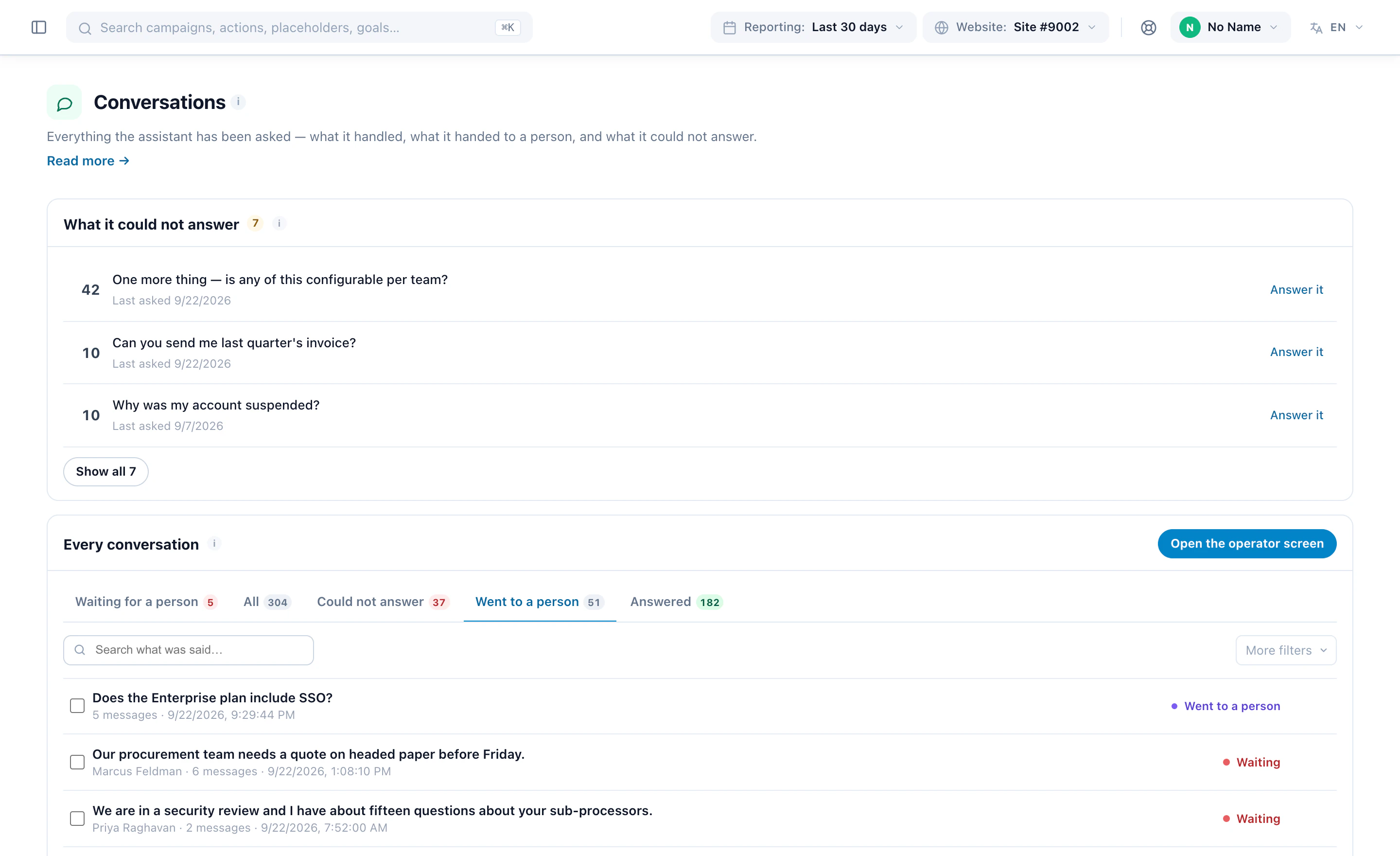
It tells you every question
it could not answer.

Not the transcripts — the list. Anybody who installs a chat finds out what their visitors actually ask, which is reliably not what the FAQ page covers. Every line here is a page you could write that would pay for itself, and the list getting shorter is the honest answer to “is this thing working”.

CONVERSATIONS1,284Last 30 days
ANSWERED1,10686%Outcome recorded per conversation
HANDED TO A PERSON746%Tickets opened from chat
COULD NOT ANSWER104Grouped into 20 questions
Last 30 days Search the questions… Filters Export
Questions it could not answer 20 groups · sorted by how often they came up
QUESTIONASKED TRENDLOOKS LIKE
Do you ship to Norway?41DeliveryAnswer this
Can I change the delivery address after ordering?28OrdersAnswer this
Is the travel coat machine washable?24CareAnswer this
Do you price match?19PricingAnswer this
When is the fern colour back in stock?17StockAnswer this
Can I use two discount codes together?15PricingAnswer this
Do you have a shop I can visit?13CompanyAnswer this
How do I cancel an order that has shipped?11OrdersAnswer this
Is the wool mulesing-free?9MaterialsAnswer this
Do you gift wrap?8OrdersAnswer this
Can I collect in store?7DeliveryAnswer this
What is the warranty on the boots?6CareAnswer this
THE MESSAGES THEMSELVES ARE IN NO QUERY PROFILE — THE PANEL IS HANDED THE AGGREGATE, NOT THE TRANSCRIPTS
“Do you ship to Norway?” Asked 41 times · first seen 12 Aug · grouped from 3 phrasings
WHAT IT SAID INSTEAD
“I cannot confirm that — it is not in anything I have been given. Shall I take an email address and have somebody answer properly?”
THE PHRASINGS IT GROUPED3
“do you deliver to norway”“shipping to oslo?”“can i order from Norway”
WHERE THEY WERE STANDING
/delivery-and-returns18/basket11/coats/merino-travel12
WHAT HAPPENED NEXT41
Asked for a person9Left an email address4Left without either28
ANSWER IT FROM HERE
We ship to Norway. Delivery is 4–6 working days and duties are paid at checkout, so nothing is owed on arrival.
Add to knowledge Ready in about a minute
300 RECENT UNANSWERED TURNS · GROUPED INTO ABOUT TWENTY QUESTIONS

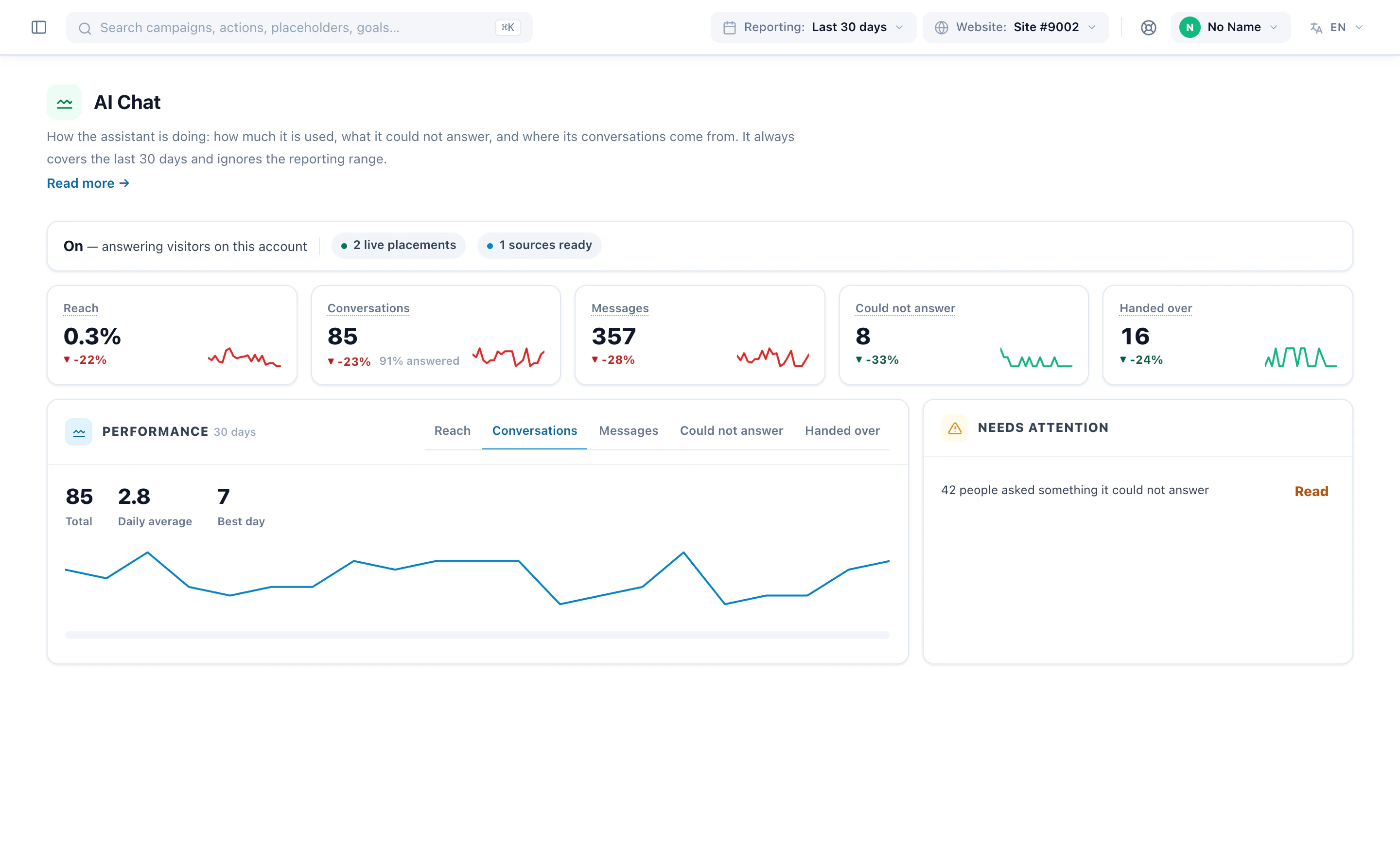
And the rest of the reporting, for when somebody asks what it is doing:

01Conversations, and what share of visits started oneWith a daily average, the best day, and a plain statement when there are not enough days to draw a trend.
02Where it is used mostRanked by the page the conversation started on — which is usually not the page you would have guessed.
03Outcome, kept separate from statusAnswered, unanswered, abandoned, escalated, converted. A conversation can be closed for several different reasons, and “closed” on its own tells you nothing.
04Cost, recorded per conversationNot only per account. When a bill surprises somebody, the useful question is which kind of conversation is the expensive one.
05Conversations used, and leftThe unit you can price and forecast — unlike vendor cost, which moves when a colleague generates a campaign in the panel.
06AI actions left, from the shared allowanceSo a chat that stopped for the second reason says so, rather than blaming the first.
07What needs attentionTickets waiting for a reply, and the assistant being switched off — which is the one thing nobody notices on their own.
Getting it live

Four questions, and it is
on the site.

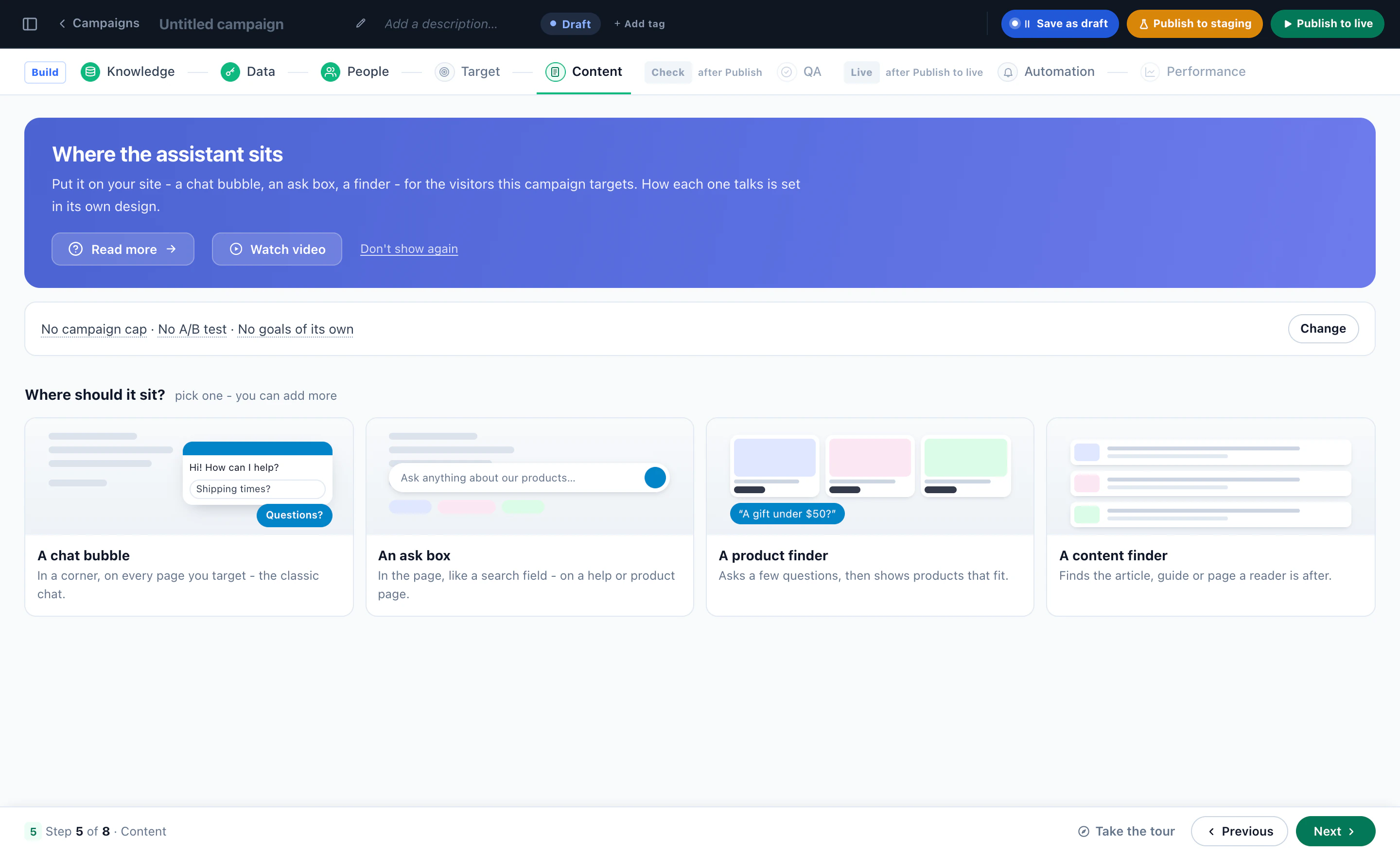
Where it shows, what it says first, how it appears, and whether it starts live or in testing — nothing is written until the last button. The order below is the one that matters, and step two is the one people skip.

01Switch the assistant onOne toggle. Until it is on, campaigns can be built and nothing will answer a visitor.
02Teach it somethingThe step people skip. With no sources it says “I cannot confirm that” to almost everything, which reads as broken rather than as careful. One page — shipping, or returns — moves answer quality more than any other setting here.
03Write the instructionsTone, what to push, what to refuse, when to give up. Free text, in your own words, because this is the field customers rewrite most often.
04Decide what it may knowSeven categories, every one off until you turn it on, and a separate switch for whether it may read any of it back.
05Put it on the siteFour questions: where it shows, what it says first, how it appears, and whether it starts live or in testing. Nothing is written until the last button.
06Staff the handoverOr choose the email fallback deliberately. Nobody on the roster means a visitor asking for a person is quietly offered email instead.
07Test it from stagingA campaign created in testing is visible only from a staging address, so the first real visitor is not also the first test.
08What it costs$99 a month as an add-on, with an allowance of 100 to 1,250 conversations depending on your plan, and a seven-day free trial bounded by that same allowance.
Positions, not features

Three things we will not
let you switch off.

A chat on a public page is the part of a platform most likely to be talked into something. These three are where the product refuses to be helpful, and they are the reason the rest of it can be trusted on a page you do not control.

A cookie is not a login

The visitor identifier names a browser, not a person — a shared desktop, a family laptop, a demo device in a shop. So tailoring an answer is safe: “the coat you were looking at, here is its delivery time”. Reciting one hands somebody’s record to whoever happens to be sitting there. The default is that it may use what it knows without reading it back, and the prompt states the difference as a rule.

An absent tool cannot be argued with

A public chat is asked for discounts it cannot give, told that “the last agent promised” things nobody promised, and instructed to ignore its instructions. Most of that is made impossible here rather than merely forbidden: there is no tool that composes an offer, applies a coupon, or quotes a price your catalogue does not carry. Instructions are advisory. A tool that does not exist is not.

Keep transcripts for less time than we do, never longer

Ninety days by default, and a hard ceiling of 730 that the purge job clamps anything above. These rows are whatever a visitor typed into a box on somebody’s website, and the one setting nobody should be able to switch off is the one that makes that data go away. The transcripts themselves are in no query profile at all — a table nobody can query is a table nobody can query wrong.

Questions

The things people ask
before they install it.

What is an AI chat agent?

A visitor-facing assistant that answers questions on your site in plain language. This one answers from your own pages, files and catalogue rather than from general knowledge about your industry, and it already knows who it is talking to, because the platform has been watching the session since the visitor arrived.

Where do its answers come from?

From sources you point it at — a web address it crawls, an uploaded file, or text you paste. Everything is cut into passages that keep their own heading, so an answer can show the page it came from. On a shop it also searches your catalogue for price, stock and attributes exactly as stored, and invents nothing around them.

What happens when it cannot answer?

It hands over — to a person, or to an email address — with a subject written from what was actually being discussed rather than a generic “Chat request”. Every question it could not answer is also grouped onto one list, which is the most useful thing it produces.

Can I run different assistants for different audiences?

Yes, and this is the part a bolt-on widget cannot do. The chat is an action inside a campaign, so all the targeting you already use applies to it: audience, page group, cart value, device, referrer, and how often it may appear. Four campaigns can put four different assistants on four parts of the site, each with its own knowledge, tone, colours and handover route.

Does the search work on articles as well as products?

Yes. Point the ask box at a product catalogue or a content catalogue; it answers in a sentence and then hands back the items themselves, ranked for that visitor by the same engine that orders your recommendations.

What does it cost?

It is a paid add-on at $99 a month, with an allowance of 100 to 1,250 conversations depending on your plan, and a seven-day free trial bounded by the same allowance. Cost is also recorded per conversation rather than only per account, so you can see which kind of conversation is the expensive one.

What does the assistant send to the AI model about a visitor?

Only the categories you switched on, and every category is off by default. Where they are enabled that means the page the visitor is on and how they got there, their device and rough location, what they have completed before — and a small set of profile fields: industry, account type, lead source, and your own custom fields. Stored contact details are not among them.

Are stored contact details ever sent?

No. Email address, first and last name, phone number, birthday, postal code and geographic coordinates sit on the visitor profile and are never included in what the assistant is given. That is enforced in the code rather than left to configuration, and a test fails the build if anybody adds one of those columns to the query.

Are there exceptions to that?

Three, and they are worth stating plainly. Your own custom fields: if you put an email address in a custom field it is sent, because the whole point of a custom field is that we do not know what is in it. Whatever the visitor types: if somebody types their own address into the chat, it is in the conversation. Handover: when a visitor asks to be contacted, they are asked for a name and email so somebody can reply — optional, given deliberately, and the one place personal data is collected on purpose.

If I switch a data category off, is it filtered out?

It is never fetched. A category that is off is not read and then removed — it is simply not part of what gets looked up. The switches are the query plan, so “we only send what you allowed” is true of the database traffic and not just of the prompt.

Does chat data leave my account?

No. Every query is scoped to your account, and conversations are stored in your account like any other Personyze data. Nothing is copied out to a shared store.

Can it use what it knows to identify someone, or to unlock anything?

No. What it sees describes a browser, not a verified person — it may be a shared desktop or a family laptop. It is told to treat none of it as proof of who it is speaking to, never to accept a visitor’s claim to be someone as confirmation, and never to use any of it to grant access to anything.

Will it repeat back what it knows about a visitor?

Not unless you turn that on. Reciting profile details to the visitor is off by default: the assistant may act on what it knows — “the coat you were looking at” — without reading the record back.

How reliable is the industry or account type it sees?

Treat it as an inference. Enrichment of that kind is a guess made from a network or an email domain and is confidently wrong often enough to matter, so the assistant is told to treat it as a hint and never to state it back as fact.

How long are transcripts kept?

For the retention period you set, 90 days by default and never longer than the platform ceiling of 730. One exception: a handover that is still open is kept until it is closed, so the person replying still has the context.

What about the AI provider, encryption, data residency and sub-processors?

Those are contractual and infrastructure questions rather than things the software does, so they belong in the privacy policy rather than on a product page. See the privacy policy for the current position.

Ready when you are

Put it where they
already are.

One campaign, four questions, and it is answering on the page — from what you taught it, about the person in front of it, and handing over the moment it should.

AN ADD-ON FROM $99 A MONTH · SEVEN-DAY FREE TRIAL · TRANSCRIPTS KEPT 90 DAYS BY DEFAULT