
Recommendation Algorithms Explained: Collaborative Filtering, Bought-Together, Trending, and More
Recommendation widgets all look the same from the outside — a row of products or articles under a heading. What actually decides whether they lift revenue or just fill space is the algorithm behind them. Match the right one to the placement and you get relevance; pick wrong and you get noise.
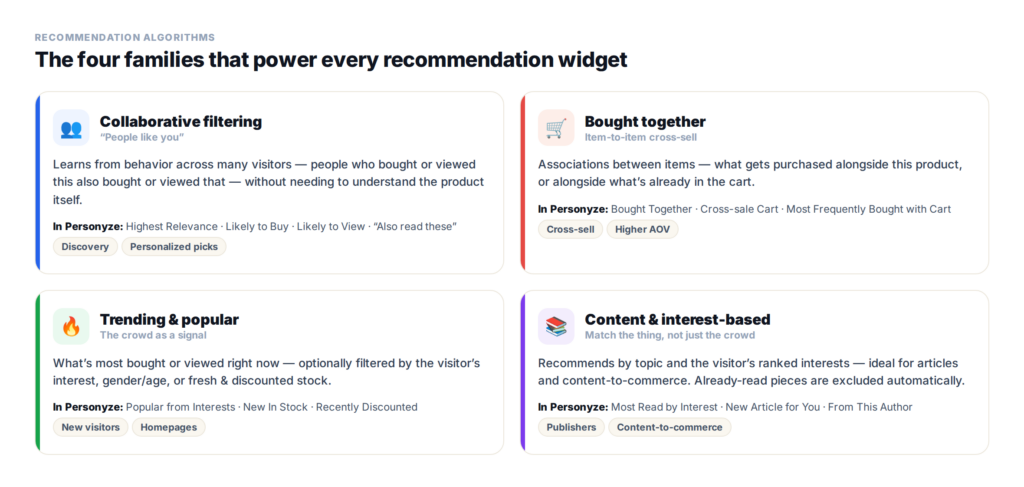
Here are the four families of recommendation algorithms — collaborative filtering, bought-together, trending, and content/interest-based — what each is good for, and how they map to the algorithms Personyze ships. (For the machinery that powers them, see what’s under the personalization hood.)

First, the cold-start problem
Every algorithm has to answer one awkward question: what do you show a brand-new visitor with no history? Personyze’s approach is to start from crowd data — what’s popular across everyone — and switch to personalized the moment it learns an interest. Interests are ranked and updated as the visitor browses, so the same widget gets sharper with every click. Keep that in mind as you read on: most of the algorithms below quietly fall back to crowd data until there’s enough signal to personalize.
AI recommendations: predicting what each visitor will buy
The most powerful recommendations aren’t a single rule — they’re a prediction. Personyze’s personalized (AI) recommendations combine many data points at once to work out what each visitor is most likely to buy or engage with next:
- Your product feed and catalog — attributes, categories, price, availability.
- The site itself, crawled, so the engine understands your products and content.
- The visitor’s own profile — CRM fields, demographics, location.
- Other visitors’ behavior — the crowd patterns behind “people like you.”
- What this visitor clicks, views, and adds to cart, in real time.
- What they — and everyone else — actually purchased.
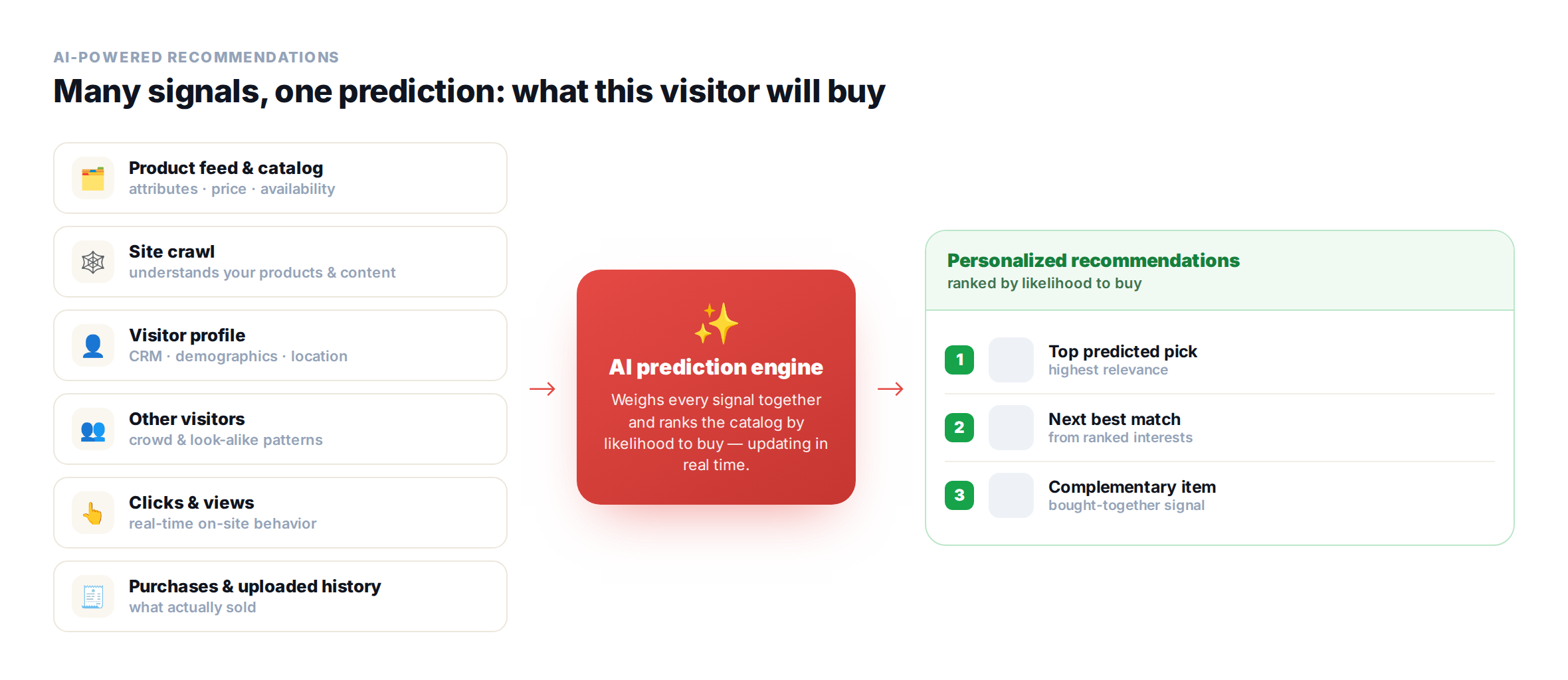
Instead of leaning on one signal, the engine weighs the catalog, the crowd, and the individual together, ranks your catalog by how likely this visitor is to buy, and gets sharper with every interaction. That’s what powers Personyze’s Highest Relevance / Personalized Recommendations — the truest form of “personalized.”
Because recommendations are built on transaction statistics, a brand-new setup would normally take a little while to gather enough data. You can skip the wait by uploading your past or offline transactions — feeding the engine your purchase history (including in-store sales) so it reaches relevance from day one.
Collaborative filtering: “people like you”
Collaborative filtering is the workhorse of recommendations. It learns from behavior across many visitors — people who bought or viewed this also bought or viewed that — without needing to understand the product itself. It’s how “you might also like” works.
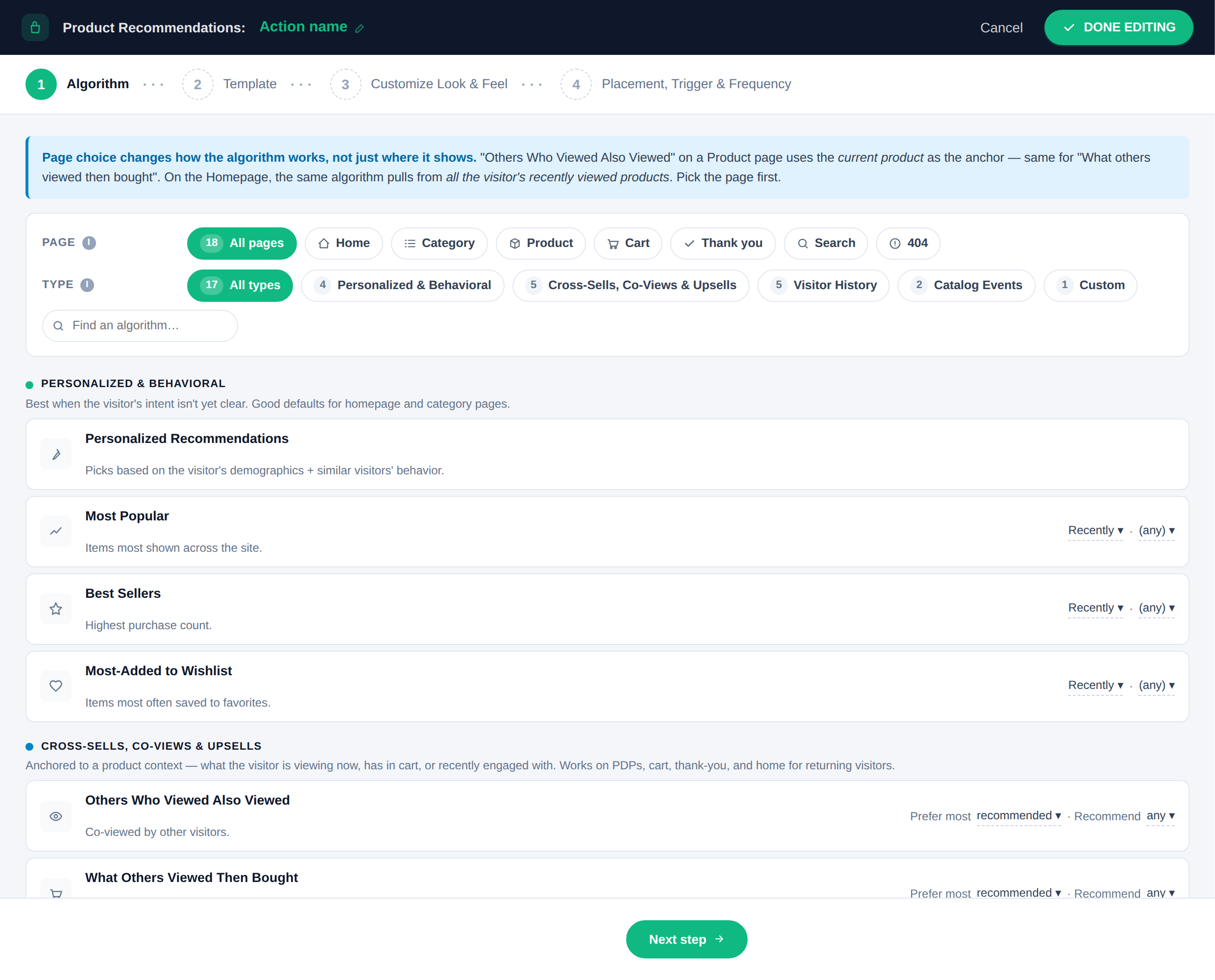
In Personyze, this family includes Highest Relevance (a personalized mix based on visitors with similar demographics and interactions), Likely to Buy (items bought by those who viewed the current one), and Likely to View (items viewed by those who viewed it). On the content side, Visitors Who Read This Also Read These is the same idea for articles. Best for discovery and personalized picks.
Bought together: the cross-sell engine
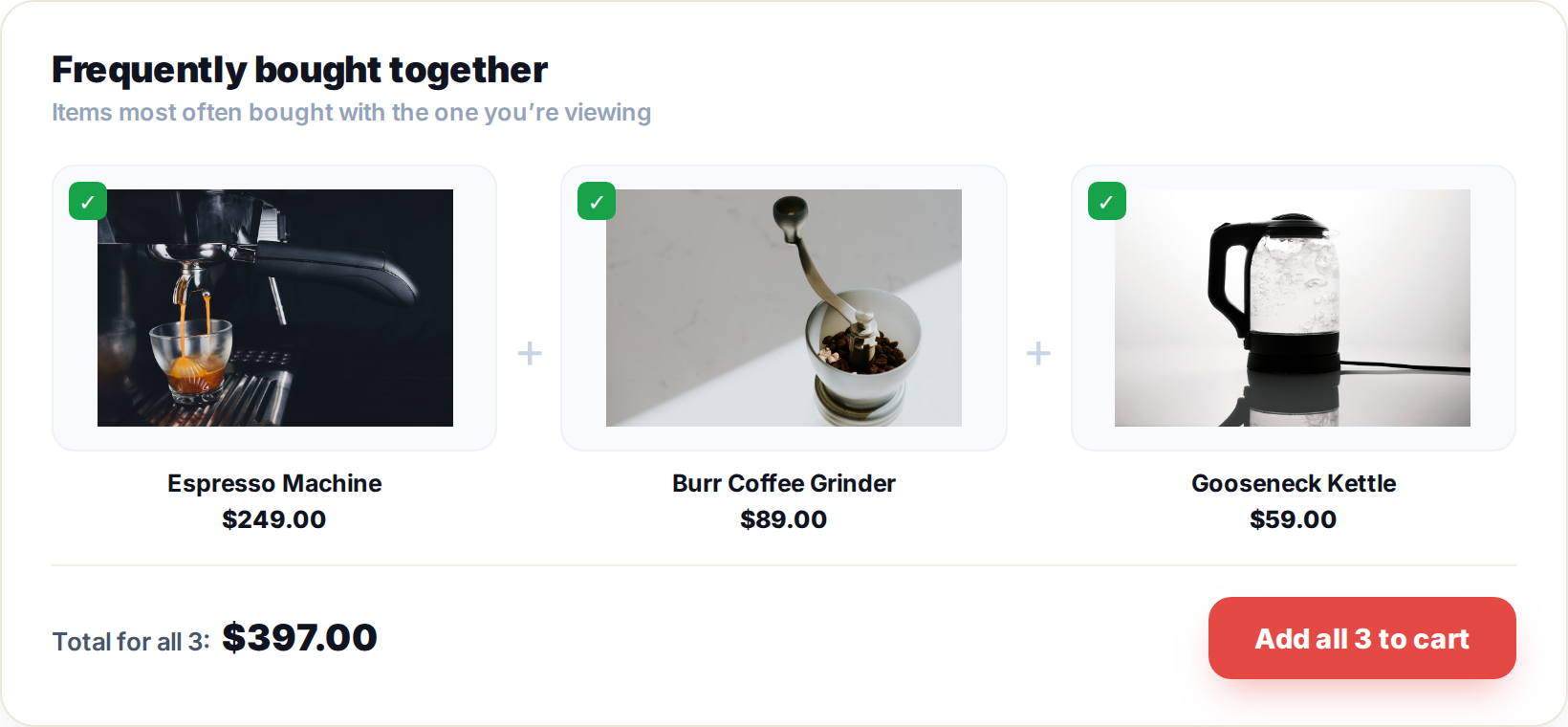
Where collaborative filtering finds “people like you,” bought-together finds item-to-item associations: what gets purchased alongside a specific product, or alongside whatever’s already in the cart. It’s the most direct lever on average order value.
Personyze’s Bought Together (for product pages) shows the items most frequently bought by people who bought the current item, while Cross-sale Cart Recommendation and Most Frequently Bought with Cart do the same for the cart. Best for cross-sell on product and cart pages.
Trending and popular: the crowd as a signal
Sometimes the smartest move is to show what’s working right now. Popularity-based algorithms surface the most bought or viewed items — optionally filtered by the visitor’s interest, or by fresh and discounted stock — and they’re the natural answer to cold-start.
Personyze offers Popular from Most Recent Interest and Popular from Recent Interests, plus merchandising-friendly variants like New In Stock, Recently Discounted, Price Recently Changed, and even most popular by gender/age. Best for new visitors, homepages, and promoting fresh or discounted inventory.
Content and interest-based: match the thing, not just the crowd
For articles — and for interest matching generally — you often want to recommend by topic and the visitor’s ranked interests, not only by co-behavior. Personyze’s content engine does exactly this, and automatically excludes pieces the visitor has already read.
It includes Most Read Based on Interest(s), New Article Based on Your Interests, Most Popular from This Author, and conversion-minded options like Content That Led to Most Conversions and Likely to Read and Buy for content-to-commerce. Best for publishers and any site that uses content to drive sales.
History-based: what they already did
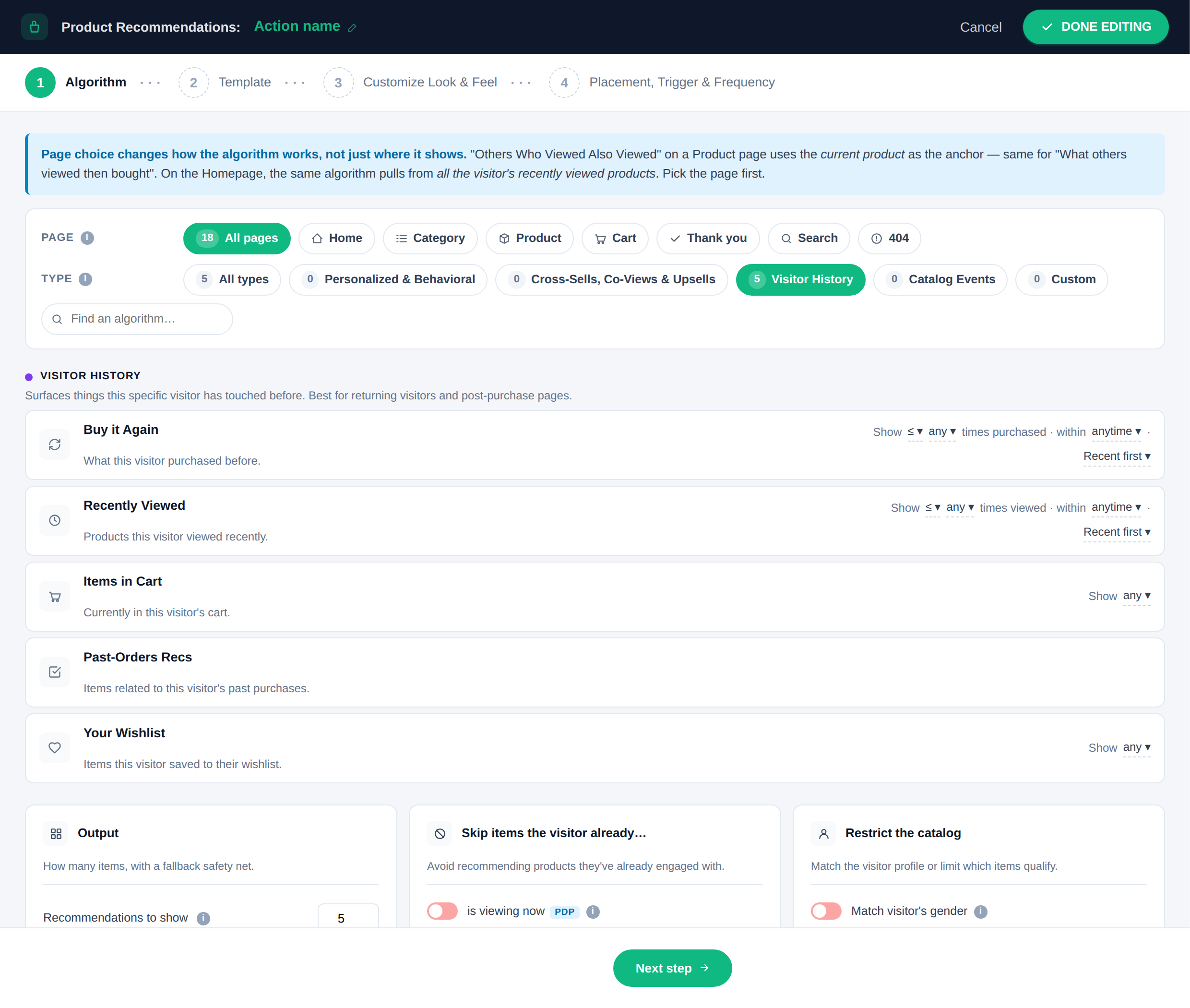
The simplest algorithms are often the highest-converting, because they lean on the visitor’s own history. Buy It Again resurfaces past purchases in order, View It Again brings back browsed items, and In Your Cart reminds them what’s waiting. Best for reorders, reminders, and cart recovery.
How to pick the right algorithm for each placement
You choose one algorithm per widget — with an optional fallback if it can’t fill — and match it to the placement:
- Homepage: trending or interest-based, so new and returning visitors both see something relevant.
- Product page: bought-together plus likely-to-buy, to drive discovery and order value.
- Cart: cross-sell based on what’s already in the basket.
- Article or blog: content and interest-based, excluding what they’ve already read.
- Category page: trending or popular within the category, tuned to the visitor’s interests.
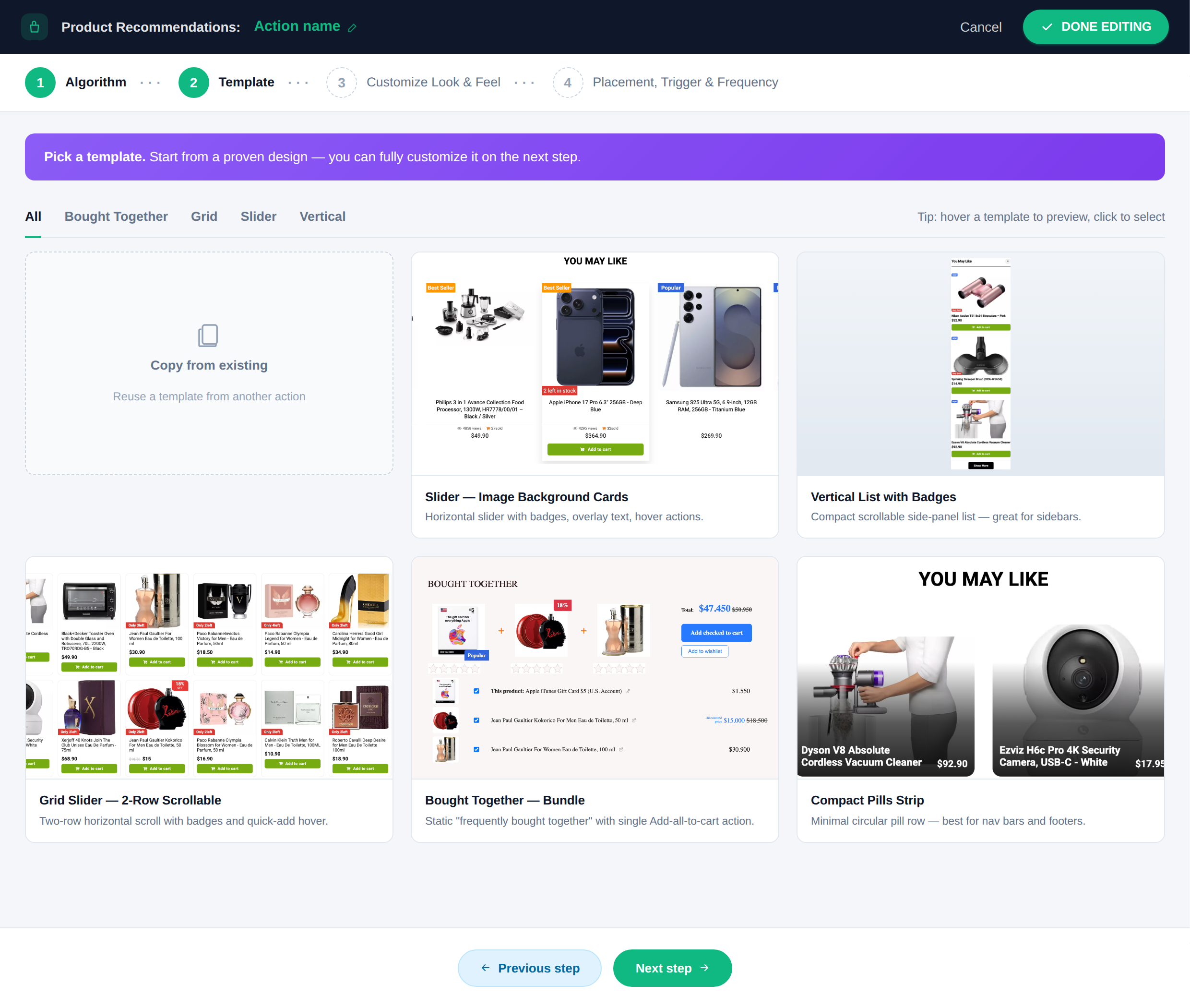
In Personyze each widget runs a single algorithm — with a fallback for when it can’t fill — and you choose a design from the recommendation template gallery, then apply filters and display options like direct add-to-cart or showing the recommendations as a popup (including exit-intent).
Delivered your way: a managed widget or raw JSON
Choosing the algorithm is one decision; how you deliver the recommendations is another — and Personyze supports both ends of the spectrum.
The usual path is a managed widget: pick a ready-made design from the recommendation template gallery, customize the look and feel, and drop it in — no code required. You preview exactly what visitors will see before you publish.
For full control, pull the recommendations as JSON instead — through a client-side JavaScript API or a JSON feed — and render them in your own front end or on the server. Headless storefronts, mobile apps, and fully custom layouts all work: the algorithm and personalization run in Personyze, while you own the presentation. The same recommendation engine can power a no-code widget or a bespoke, server-side component.
How Personyze fits
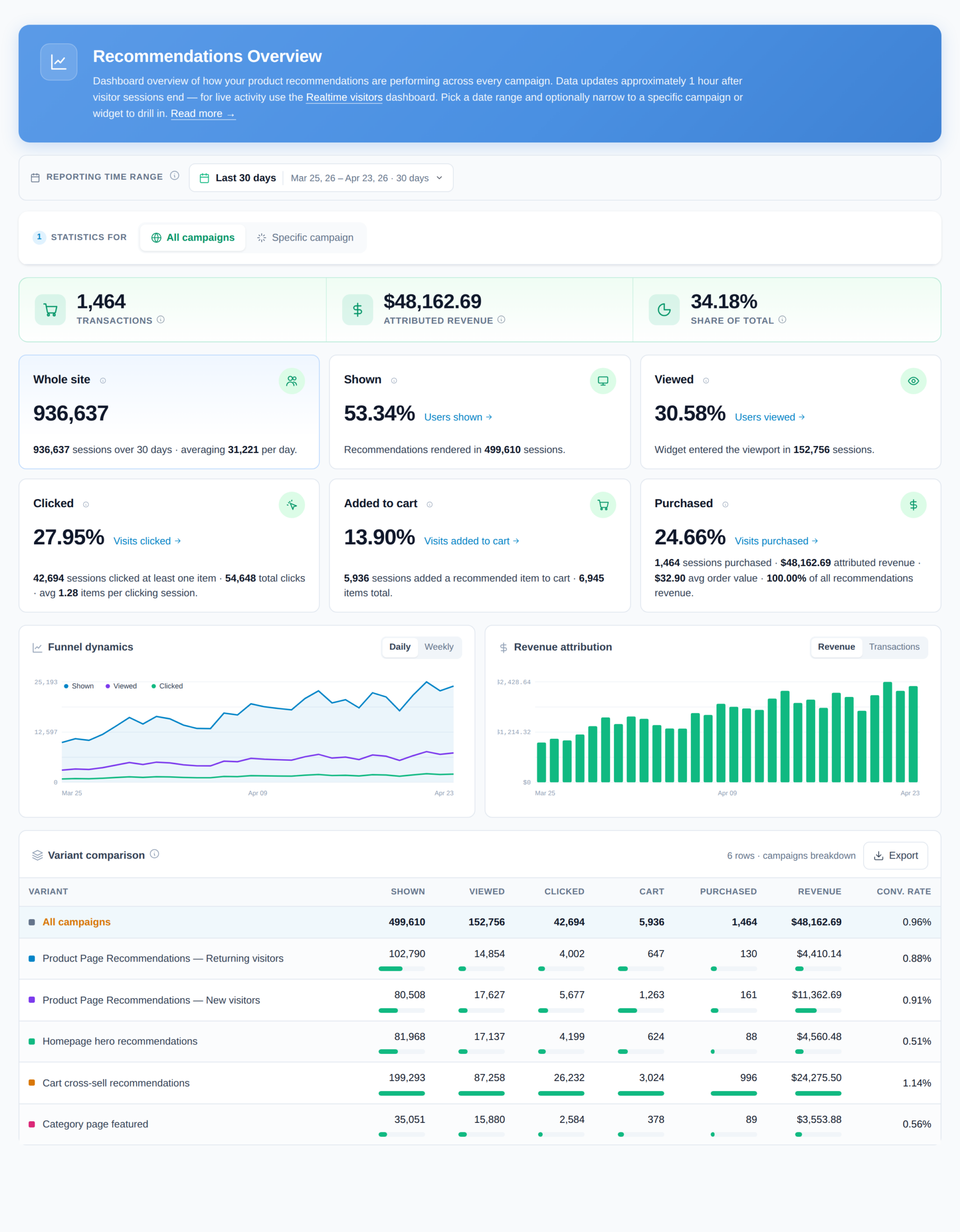
Personyze ships every algorithm above out of the box, blends crowd data with the visitor’s ranked interests, and lets you place the right one on every surface — product, cart, homepage, or article. See them in action in our product recommendation examples, and when you’re ready to measure the payoff, our personalization ROI guide covers how to read recommendation contribution — the revenue recommendations actually influence.
Book a demo to see the algorithms running on your own catalog, or explore plans and pricing.
Recommendation algorithms: FAQ
What is collaborative filtering in recommendations?
Collaborative filtering learns from behavior across many visitors – people who bought or viewed one item also bought or viewed another – and recommends on those patterns, without needing to understand the product itself. It powers most “you might also like” widgets.
What’s the difference between “bought together” and collaborative filtering?
Bought-together looks at item-to-item associations for a specific product or cart – what’s purchased alongside it. Collaborative filtering is broader “people like you” matching across the catalog. Bought-together is best for cross-sell and order value; collaborative filtering is best for discovery.
What is a content-based recommendation?
A content-based recommendation matches by topic and attributes and the visitor’s ranked interests, rather than only by co-behavior. It’s used mainly for articles and content, and in Personyze it automatically excludes pieces the visitor has already read.
How do recommendations handle a brand-new visitor (cold start)?
They start from crowd data – what’s popular across all visitors – and switch to personalized as soon as an interest is learned. Personyze ranks and updates interests as the visitor browses, so the same widget gets more relevant with each click.
Which recommendation algorithm should I use on a product page?
On product pages, bought-together plus likely-to-buy work best – they drive discovery and average order value by surfacing items commonly bought or viewed alongside the current product.
Does Personyze support content recommendations, not just products?
Yes. Alongside its product algorithms, Personyze has a content recommendation engine with options like most-read by interest, new articles for your interests, most popular from an author, and content that led to the most conversions – and it excludes already-read articles automatically.
Can I get Personyze recommendations as JSON or render them myself?
Yes. Besides the managed widget, Personyze can deliver recommendations as JSON through a client-side JavaScript API or a JSON feed, so you can render them in your own front end or server-side — useful for headless storefronts, mobile apps, and fully custom layouts.
Are there ready-made recommendation widget templates?
Yes. Personyze has a recommendation template gallery of pre-built widget designs you can pick, customize, and preview, then drop in without code.
What data do AI or personalized recommendations use?
Personyze’s personalized recommendations combine your product feed and catalog, a crawl of your site, the visitor’s own profile (CRM, demographics, location), other visitors’ behavior, and the individual’s own clicks, views, and purchases — weighing them together to predict what each visitor is most likely to buy.
Can I upload past transactions to bootstrap recommendations?
Yes. You can upload your past or offline (in-store) transactions so the recommendation engine has purchase history from day one and reaches relevance much faster than building the data from scratch by tracking on-site behavior.
More on AI in Personyze
- AI personalization agent — describe a campaign and it builds it, styled to your brand.
- AI marketing agent — how plain-language requests become staged campaigns.
- Personyze MCP server — run all of it from Claude or ChatGPT.
- Add Personyze to Claude — install the connector from the Claude directory.
Related reading
- Product recommendation examples — 14 ways to put these algorithms to work.
- What’s under the personalization hood — the components of the recommendation engine.
- Personalization ROI: the metrics that matter — measuring recommendation contribution.
Book a demo with a personalization expert
30 minutes with a personalization expert. Bring your stack, your goals, your skepticism. We'll show you what changes when every visit feels like the only one.