

How AI Is Changing Website Personalization (and What’s Just Hype)

Every personalization vendor now claims to be “AI-powered.” Most of the time that phrase hides more than it reveals. So it’s worth cutting through the noise: AI has genuinely changed website personalization, but not evenly, and not always where the marketing suggests. Some of it is real leverage that saves your team hours and lifts conversions. Some of it is a chatbot bolted onto a dashboard. This post separates the two — and shows where AI does actual work inside a personalization platform.
The short version: AI’s biggest impact isn’t on what personalization can do, but on how fast and how intelligently you can do it. It removes the manual bottlenecks that used to make personalization slow, and it makes targeting decisions a human team couldn’t make at scale.
Where AI actually moves the needle
Four areas are where AI delivers real, measurable value in personalization today — as opposed to where it’s mostly decoration.
1. Smarter recommendations. This is the oldest and most proven application of AI in personalization. Instead of static “related products” rules, machine-learning models analyze what each visitor browses and buys, what similar visitors did, and which combinations actually convert — then surface the items most likely to drive the next purchase. With Personyze’s recommendation engine you can pick the algorithm or let AI decide, across both product and content recommendations, and the picks adapt to each visitor in real time — served in milliseconds rather than showing everyone the same shelf. Layer on recommendation badges, and track every click to prove the revenue each widget drives.

2. Continuous, self-optimizing testing. Traditional A/B testing makes you pick a winner and move on. AI-driven testing keeps optimizing automatically — shifting traffic toward the better-performing variation as results come in, so you stop leaving conversions on the table while you wait for significance. Personyze’s A/B testing software brings statistical rigor without the statistician: a sample-size planner, Bayesian inference in real time, guardrails on the metrics that matter, and auto-promotion when the winner is real. It also powers automated and continuous A/B and multivariate testing, so optimization runs in the background instead of demanding constant manual attention.

3. Predictive segmentation. Rather than waiting for a visitor to fit a rule you wrote by hand, models can predict intent — likelihood to convert, to churn, to respond to a discount — and let you target on those predictions. This turns behavioral targeting from reactive to anticipatory.
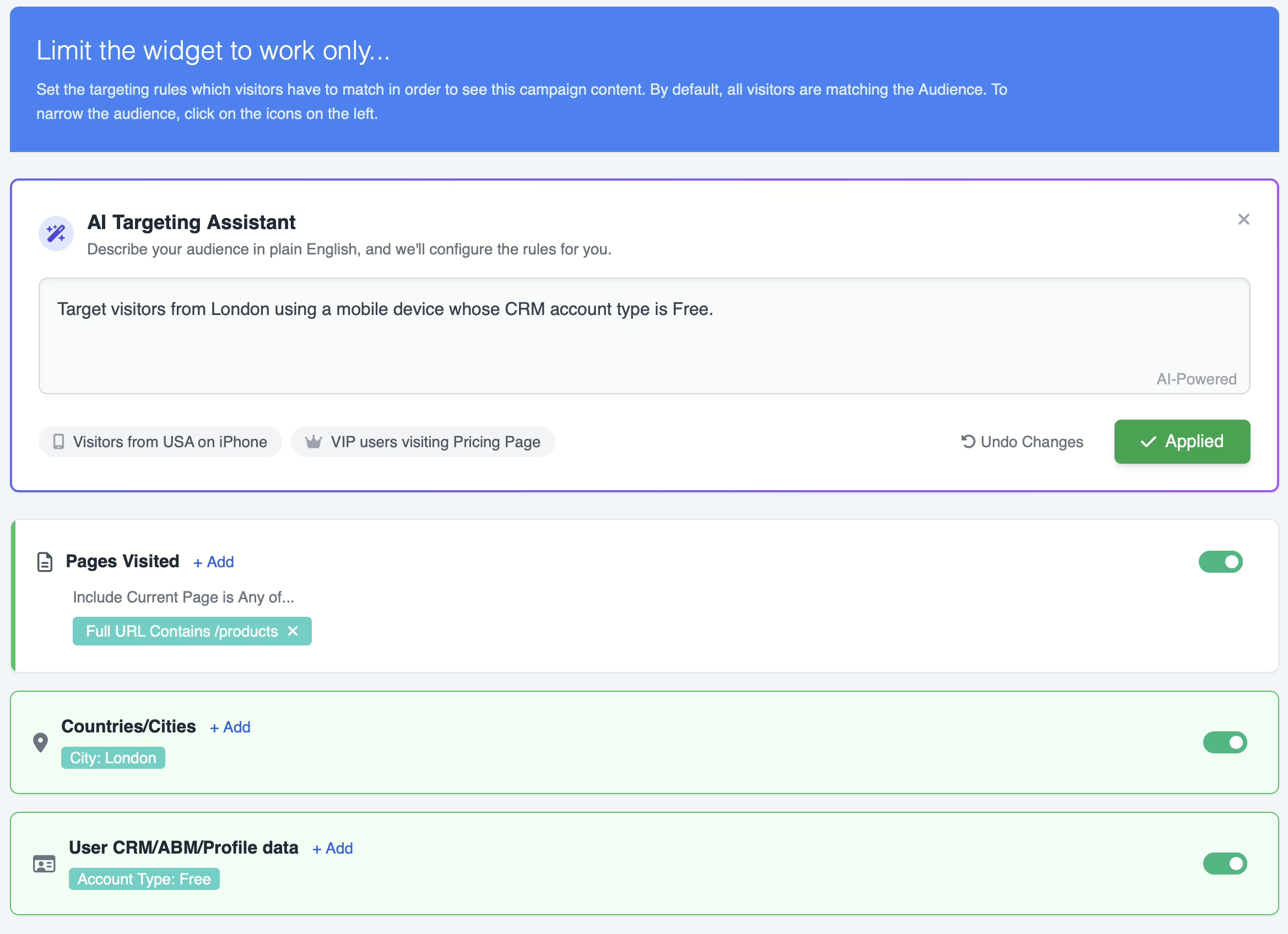
4. Faster campaign creation. The newest and most practical shift: using AI to do the setup work. Describing a target audience or a piece of content in plain language and letting the platform configure it is a real time-saver for busy marketing teams — which is exactly what we built with natural language processing in Personyze.
What AI doesn’t replace
It’s just as important to be clear about the limits, because overpromising on AI is how teams end up disappointed. AI doesn’t replace knowing your customers, your offer, or your strategy. It optimizes execution — it doesn’t decide what’s worth saying. A model can tell you which headline converts better; it can’t tell you what your brand should stand for. The best results come from pairing human judgment about the message with AI’s ability to deliver and optimize that message at a scale and speed people can’t match manually.
This matters for mid-market teams especially. You don’t need a data science department to benefit from AI personalization — but you do need a platform that turns AI into something a marketer can actually use, rather than a black box that needs an engineer to operate. The value is in accessible AI, not impressive-sounding AI.
How to evaluate “AI-powered” personalization
When a vendor says AI, ask what it actually does. A few questions cut through the marketing quickly:
- Does it personalize per visitor, or per segment? Real AI personalization adapts to the individual; rule-based tools just sort people into buckets.
- Does it optimize on its own, or only report results? Self-optimizing testing is leverage; a dashboard that shows you numbers is not.
- Can a marketer use it without a developer? If AI features require engineering to deploy, they won’t get used.
- Does it work across web, email, and recommendations? Personalization siloed to one channel limits what AI can learn and act on.
If you’re weighing platforms on these questions, our competitor comparisons break down how Personyze stacks up against the enterprise tools and point solutions — including where “AI-powered” claims hold up and where they don’t.
Frequently asked questions
Does AI replace manual personalization work?
It removes manual bottlenecks and makes targeting decisions at a scale humans can’t, but people still set the strategy.
Is every “AI-powered” claim meaningful?
Not always — some of it is a chatbot bolted onto a dashboard. The real value is faster setup and smarter targeting.
Want to see practical AI personalization on your own site — recommendations, self-optimizing tests, and plain-language campaign setup? Explore the Personyze platform, find the plan that fits, or book a demo.
Book a demo with a personalization expert
30 minutes with a personalization expert. Bring your stack, your goals, your skepticism. We'll show you what changes when every visit feels like the only one.