
First-Party Data Personalization in 2026: Life After Third-Party Cookies
For years, third-party cookies were the quiet engine behind most “personalized” web experiences. That engine is now gone for practical purposes — and the marketing teams still relying on it are flying blind. Safari and Firefox blocked third-party cookies years ago, ad-blockers keep climbing, and even where cookies technically still work, signal loss and consent requirements have made them unreliable. The takeaway for 2026 is simple: the brands winning at personalization aren’t mourning the cookie. They’re building on data they actually own.
That data has a name — first-party and zero-party data — and it’s more durable, more accurate, and more compliant than anything the old third-party ecosystem offered. This guide covers what changed, why owned data wins, and how to run real-time personalization on it without a single third-party cookie.
Here’s the bottom line up front: Personyze was built around first-party and zero-party data, so the cookieless shift was never a problem to solve — it’s simply how the platform already works.
What actually changed
The “cookieless future” stopped being a future and became the present. A few realities now define the landscape:
- Browser-level blocking is the norm. Safari’s Intelligent Tracking Prevention and Firefox’s Enhanced Tracking Protection block third-party cookies outright, and they account for a large share of mobile traffic.
- Consent is mandatory, not optional. Between GDPR, CCPA, and a growing list of regional laws, tracking without explicit consent is a legal risk — and a trust problem with your visitors.
- Signal loss is everywhere. Even “working” cookies expire fast, get cleared, or are stripped by privacy tools, leaving you with fragmented, unreliable profiles.
Trying to rebuild the old third-party approach on top of this is a losing battle. The smarter move is to stop renting data and start owning it.
First-party vs. zero-party data — and why both win
First-party data is information you collect directly from your own visitors: pages they view, products they browse, what they put in the cart, where they came from, what they bought, how often they return. It lives on your domain, under your control, with no dependency on another company’s cookie.
Zero-party data goes one step further — it’s information visitors volunteer. Their industry, their preferences, what they’re shopping for, what they want to hear about. Because they hand it to you intentionally, it’s the most accurate signal you can get, and it sidesteps the guesswork that third-party data always required.
Together, these two data types let you personalize with more precision than third-party cookies ever delivered — and you keep working even as the rest of the tracking ecosystem erodes. The only requirement is a platform built to capture and act on owned data in real time.
How to personalize on owned data with Personyze
Here’s how those pieces fit together in practice.
Capture zero-party data the moment a visitor offers it. Use Personyze Forms to ask a simple, well-placed question — industry, shopping intent, content interest — and feed the answer straight into the visitor’s profile. From that point on, every banner, recommendation, and message can react to what they told you.
Track first-party behavior on your own domain. Personyze records on-site behavior — pages, clicks, products viewed, cart activity, visit frequency — as first-party data tied to your site. That powers behavioral targeting without any cross-site tracking.
Recognize the same person across devices and sessions. A first-party cookie identifies a returning visitor on the same browser — but real people switch between phone, laptop, and work computer. Personyze closes that gap with cross-device tracking: when a visitor identifies themselves with a stable key like an email or username — at login, or in a form — Personyze matches it against known users and merges all their sessions, browsing history, segments, and even offline CRM data into one profile, regardless of which device or cookie they’re on. That’s durable, accurate identity built entirely on data you own — no third-party tracking required.
Unify it with your CRM and CDP. Owned data is strongest when it’s connected. Personyze integrates with customer data platforms and CRMs so first-party behavior, zero-party answers, and account records build into a single profile you can target on — no third-party identifiers required.
Act on it in real time. Once the profile exists, dynamic content replacement lets you reshape headlines, offers, product recommendations, and entire page sections to match the visitor — instantly, and without touching code.
Personalization that earns trust
There’s an upside to owned-data personalization that goes beyond compliance: it’s honest. When you personalize based on what a visitor actually did on your site, or what they explicitly told you they want, the experience feels helpful rather than creepy. You’re not following them around the internet — you’re responding to them on your own site, with their consent. That’s a better experience and a more defensible one.
The brands that treated the cookie’s decline as an emergency are still scrambling. The ones that invested in first-party and zero-party data are personalizing more accurately than before, with full consent, and with no exposure to the next round of tracking restrictions. In 2026, owning your data isn’t the safe choice — it’s the competitive one.
Ready to personalize without third-party cookies? See how Personyze’s personalization platform turns first-party and zero-party data into real-time experiences, and find the plan that fits your team — or book a demo to see it on your own site.
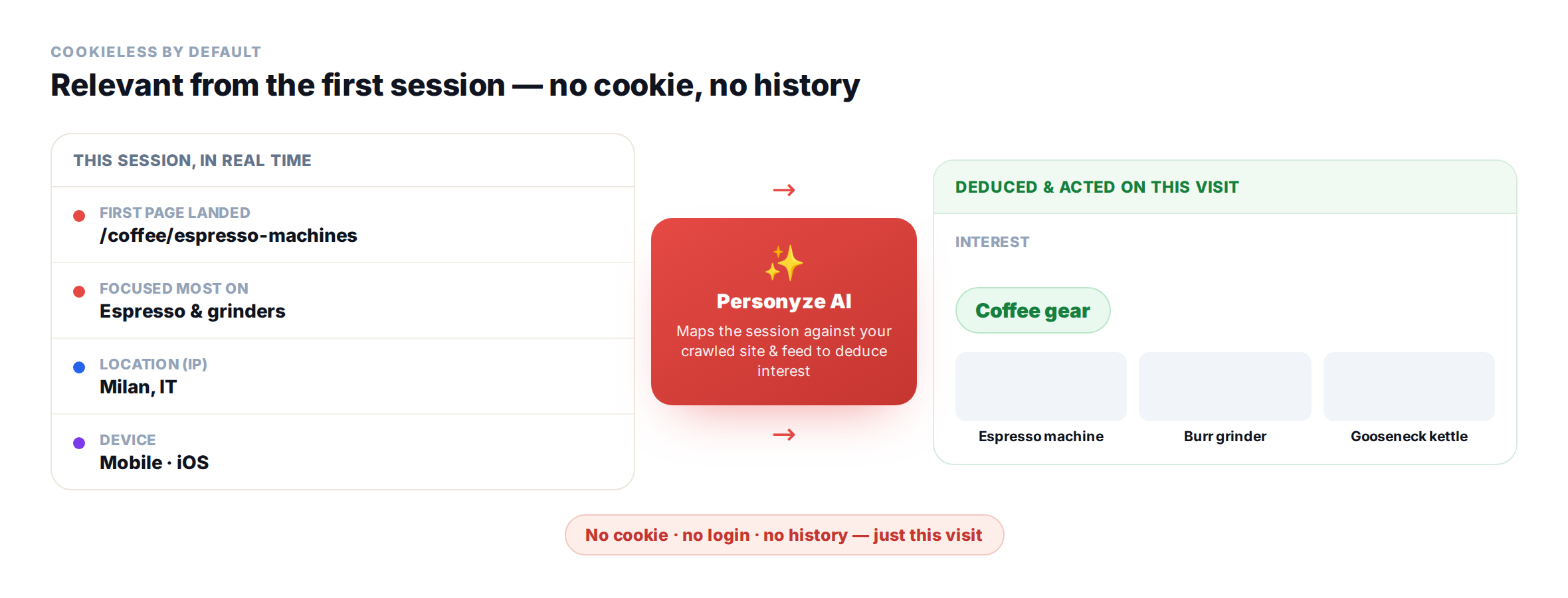
Personalize from the very first visit — no cookie required. Even before a visitor identifies themselves, Personyze provides many targeting variables drawn entirely from the current session: their browsing behavior (the pages and content they engage with), their location (from IP), and their device. The standout is AI-based interest: if you let Personyze crawl and map your site’s content and products — or point it at a feed — it watches the session as it happens, noting the first page the visitor landed on and the content they focus on most, and deduces their interest from it. So a brand-new, anonymous, cookieless visitor gets a relevant experience within the same visit — no history, no login, no third-party data.

Cookieless personalization: FAQ
Can Personyze personalize without third-party cookies?
Yes. Personyze runs entirely on first-party and zero-party data – on-site behavior, information visitors volunteer, location, device, and CRM records – so it never needs third-party cookies.
How does Personyze personalize a brand-new, anonymous visitor?
It uses in-session signals only: the visitor’s browsing behavior, location from IP, device, and an AI-deduced interest based on the first page they landed on and the content they focus on most, matched against your crawled site or feed. No cookie, login, or history required.
What targeting variables does Personyze provide by default?
Out of the box you get browsing behavior, location, device, AI-based interest, and even live weather from the visitor’s IP location – plus, through integrations, account-based firmographics such as company name, size, and industry, and any zero-party answers or CRM data once a visitor shares them.
How does Personyze know a first-time visitor’s interest?
If Personyze has crawled and mapped your content and products (or you provide a feed), it watches which pages and content the visitor focuses on during the session and deduces their interest in real time, so it can recommend and personalize on the first visit.
Two more signals round this out, and neither needs a cookie. Personyze can read live weather from the visitor’s IP location — so you can promote rain gear when it’s actually raining where they are, or cold-weather items during a freeze. And for B2B, through integrations with account-based data providers (reverse-IP company lookup), Personyze can surface the company a visitor is browsing from — its name, size, and industry — so you can run account-based personalization before a single form is filled.
Book a demo with a personalization expert
30 minutes with a personalization expert. Bring your stack, your goals, your skepticism. We'll show you what changes when every visit feels like the only one.