
Reverse IP Technology Vendors for Account-Based Marketing: How It Works, Costs, and Limits
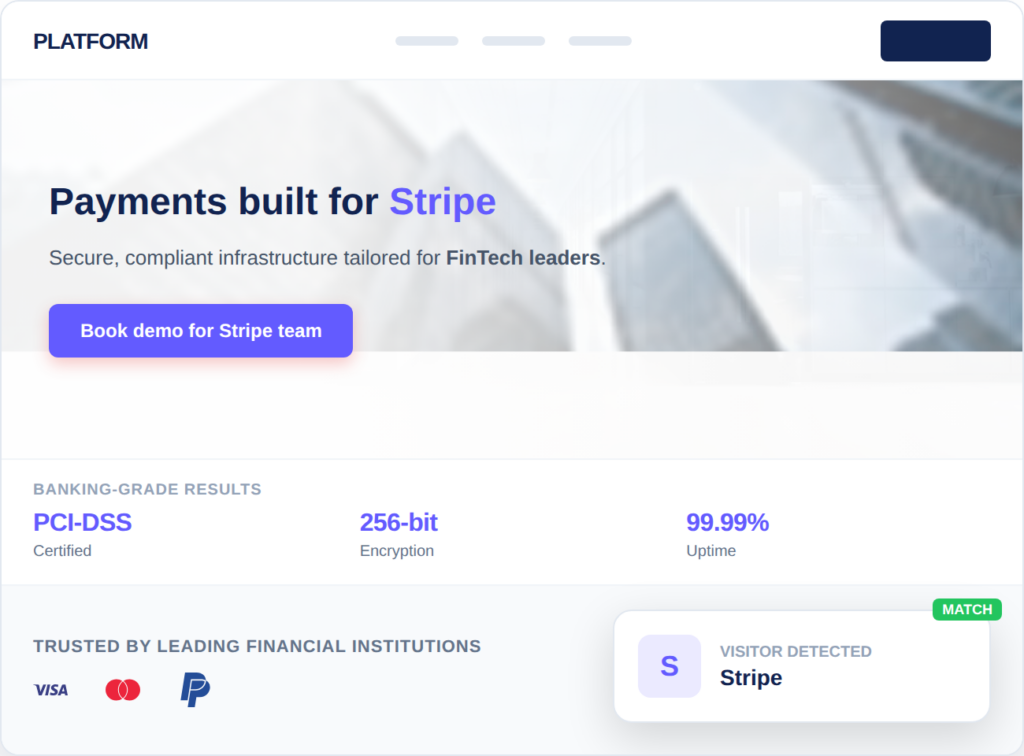
Most of the people researching your product never fill out a form. Form-fill rates on B2B sites are routinely estimated at around 2% of traffic, which means the overwhelming majority of your pipeline browses, compares, and leaves without a name attached. Reverse IP technology is one of the oldest ways to claw some of that visibility back: it turns an anonymous visit into the name of the company behind it, so account-based marketing (ABM) teams can see which target accounts are actually on the site.
Related: B2B website personalization playbook
It isn’t magic, and it isn’t precise. This guide covers what reverse IP technology is, how it works, how reliable it really is, what it costs, where it breaks down — and how to turn a company match into something a visitor actually feels on the page.
What is reverse IP technology?
Reverse IP technology — also called reverse IP lookup, IP-to-company resolution, or B2B IP tracking — identifies the organization associated with a website visitor’s IP address. A normal DNS lookup turns a domain name into an IP address; a reverse lookup goes the other way, starting with the visitor’s IP and resolving it back to the company that owns or leases that address.
When someone visits from a corporate network, their request carries the company’s public IP. Match that IP against a database of known business IP ranges and you get the company name — usually along with firmographics like industry, employee count, revenue band, and location. No form, no login, and no personal data about the individual.
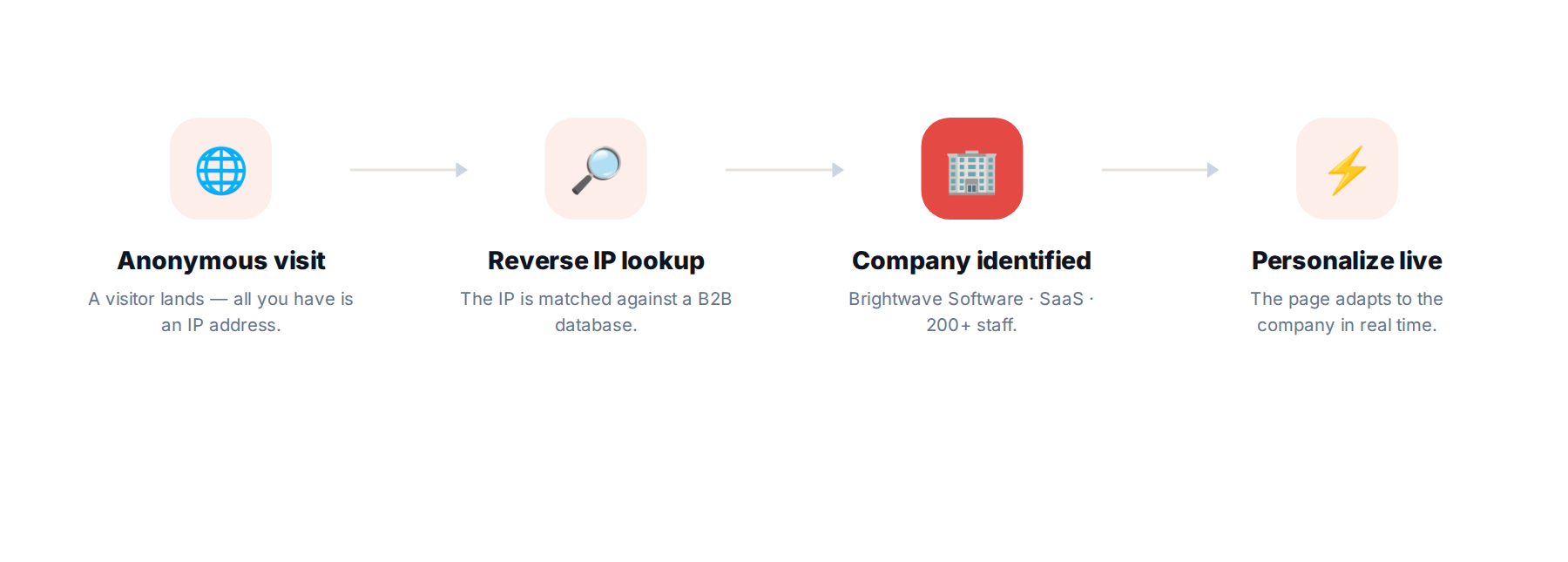
How reverse IP works: a technical overview
Every device that loads your site sends a request from a public IP address. Reverse IP tools capture that address and cross-reference it against large databases of corporate IP ranges — built from public registries (the regional internet registries and WHOIS records) and, in stronger tools, proprietary private data that’s cleaner and more current than the public record.
The match happens in the milliseconds it takes a page to load, which is what makes real-time personalization possible. It works best when the visitor is on a static, business-registered IP — typical of corporate offices and larger enterprises with dedicated ranges. Dynamic and residential IPs are far less reliable.
The databases are a moving target. Providers consistently report that roughly 7–10% of IP addresses change organizational ownership every month through acquisitions, reallocations, and new ranges — so a map that isn’t refreshed frequently goes stale fast. When you evaluate a vendor, ask how often their IP-to-company data updates; monthly is a floor, weekly or daily signals a more serious data operation.
Reverse IP in account-based marketing
For ABM, the appeal is obvious: you can see whether your target accounts are researching you before they ever raise a hand. That unlocks a few plays:
- Account prioritization. Weight visits from named target accounts in your scoring so reps work the warmest accounts first.
- Timely sales alerts. Notify the owning rep the moment a tier-1 account hits high-intent pages like pricing or a demo.
- Expansion and churn signals. An existing customer repeatedly on your competitor-comparison page is a churn flag; one on advanced-feature pages is an expansion opening.
- On-site personalization. The highest-leverage play — tailoring the page itself to the identified account, not just adding it to a list.
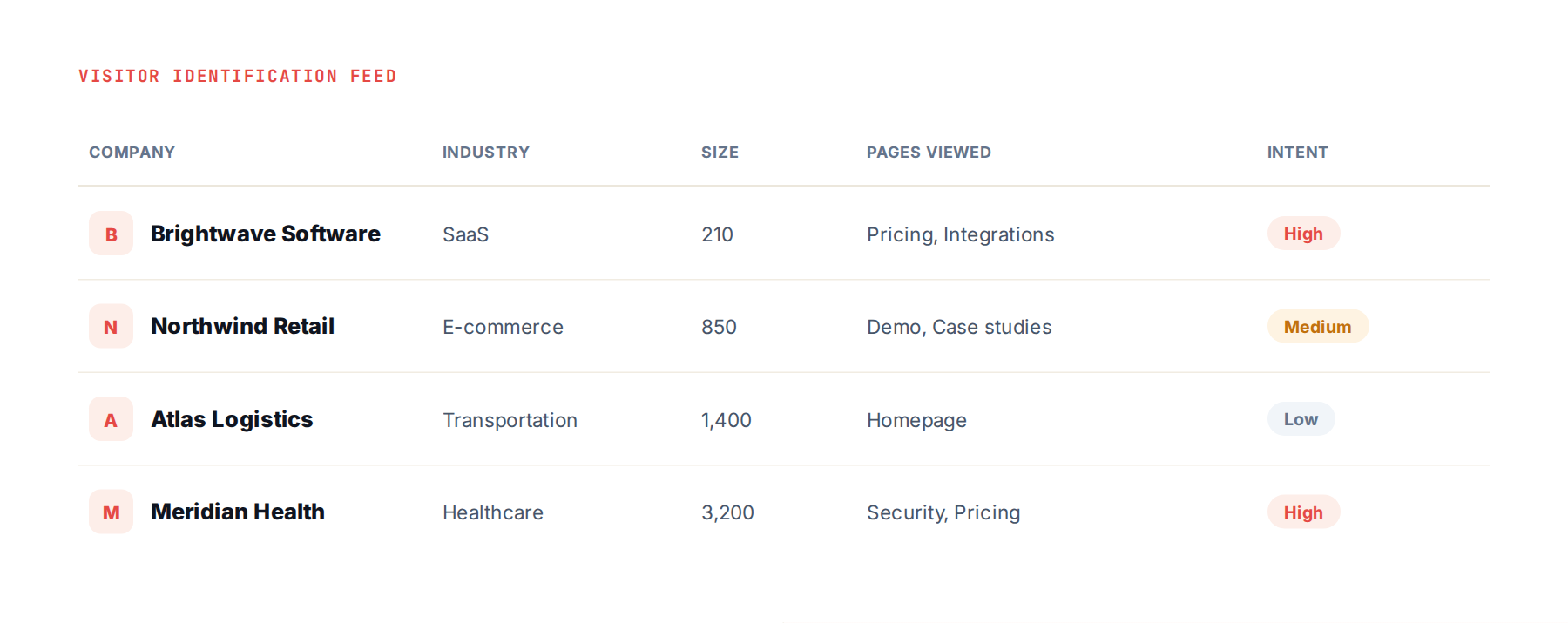
That last point is the difference between a tool that fills a spreadsheet and one that changes what the buyer sees. Once you know the company — and its industry, size, and the pages it cares about — you can swap the headline, surface the right case studies, and route the right CTA in real time. More on that below.
How reliable is reverse IP, really?
Honest answer: useful, but partial. Company-level match rates for B2B traffic generally land in the 30–60% range — broad B2B traffic often sits around 30–40%, while enterprise-focused US sites can reach as high as 60–78%. Pure reverse-IP tools without additional data sources tend to come in lower, sometimes 10–20%.
The realistic ceiling for company-level identification is roughly 60–70%, and hitting it requires blending IP data with cookies, first-party data, and third-party enrichment. If a vendor claims 90%+ match rates, treat it as a red flag and ask them to walk you through the methodology on your traffic.
Match rates have also been declining. Remote and hybrid work is the main culprit — analyses put the drop at roughly 15–25% versus pre-2020 — because an employee working from home shows up on a residential ISP, not the corporate range.
The limitations you need to plan for
- Company, not contact. Even a perfect IP match tells you the organization, never the individual. Naming the person requires a form, a login, or a consent-based identity tool — a separate, more regulated capability.
- Remote and hybrid workers. A VP browsing from home resolves to their home ISP, not their employer, so the visit is invisible or misattributed.
- Mobile and VPN traffic. Carrier-grade NAT pools share one IP across thousands of users, and VPN or cloud exit nodes can mislabel the visitor’s true organization.
- Shared and coworking IPs. A single coworking-space IP can be shared by dozens of companies, so every visit looks like it came from the coworking brand rather than the real business.
- Stale data. With ~7–10% of IPs changing hands monthly, an out-of-date database produces confident-but-wrong matches.
- Public-data quality. Registry data is largely self-reported and unverified, so tools that lean only on public records carry more errors than those with curated private data.
Is reverse IP GDPR-friendly?
Generally, yes — with a caveat. Company-level reverse IP that resolves only to an organization (not a person) is widely treated as low-risk, because an IP that maps to a company rather than an identifiable individual is usually defensible under legitimate interest. That’s part of why reverse IP remains popular with European teams.
The line to watch is person-level identification of EU or UK residents, which typically requires a lawful basis — almost always explicit consent through a compliant banner. None of this is legal advice; confirm your specific setup with counsel. But as a rule of thumb, company-level reverse IP sits on the privacy-safer end of the spectrum.
What reverse IP technology costs
Pricing almost always scales with the number of companies a tool identifies (or your traffic volume), and it spans a wide range:
- Entry / SMB (under ~$100/month). Lighter tools live here — Albacross starts around $40/month for a small lead volume, alongside options like Visitor Queue, Leadinfo (from ~€69), and Salespanel.
- Mid-market (~$100–500/month). Leadfeeder (now part of Dealfront) starts around $99/month billed annually; Albacross and Leadinfo scale up through this band with more identified companies and integrations.
- Enterprise ($500–$10,000+/month). Full ABM platforms like 6sense and Demandbase run from several hundred to many thousands per month; Lead Forensics is quote-only, with third-party estimates around £4,500/year and up.
As a rule, you’re paying for volume of identified companies and the depth of firmographic enrichment — not for higher match rates. The underlying reverse-IP limitations apply across every tier.
Two ways vendors resolve a company
Not every reverse-IP provider works the same way — and the difference explains the gap in both coverage and price.
Registry ownership — the lightweight approach
The simplest providers resolve the owner of the IP range from registry data. They query the five regional internet registries — ARIN, RIPE, APNIC, LACNIC, and AFRINIC — for who registered a block of addresses, then enrich that with public registries, company websites, and industry databases to attach a domain and a company type. Tools like ipapi.is work this way. Because a domain isn’t always in WHOIS — many companies keep registration private — they cross-reference other public sources to fill the gaps. The output is essentially a name, domain, and company type: lightweight and inexpensive, but only as reliable as how cleanly the IP block is registered.
Proprietary firmographic graph — the deep approach
ZoomInfo, Clearbit, and 6sense work differently. They maintain a proprietary B2B firmographic graph and resolve the employer behind the visit, not just the registrant of the IP block. They supplement public data with their own collection — browser-side signals, partnership data, and machine-learning models — which is how they catch traffic where the IP isn’t cleanly registered to the company (cloud, VPN, shared networks), as enrichment guides note. It’s also why their records arrive loaded with industry, size, revenue, and tech stack rather than just a name and domain.
So the two differences come down to:
- Match mechanism & coverage. Registry-ownership lookups only resolve cleanly-registered blocks; firmographic graphs add behavioral matching that resolves more of the ambiguous middle — cloud, VPN, and shared networks.
- Data depth. A registry lookup gives you a name, domain, and type; a firmographic platform gives you full firmographics — industry, size, revenue, and tech stack.
Personyze is vendor-agnostic here: it doesn’t own a company database, it orchestrates whichever provider you already use. Plug in a lightweight registry lookup or a full firmographic platform, and Personyze turns the match into account-based personalization either way.
Reverse-IP vendors, compared
Reverse IP isn’t a single data source — it’s a category of vendors with different coverage, data, and price. Personyze integrates natively with the major ones, so you can plug in the provider you already pay for (or choose a new one) and turn its company data into live personalization. Here’s how the main options line up.
First, set expectations on the one number that caps everything: match rate is the real ceiling. Reverse IP doesn’t fire for every visitor anymore — remote work, VPNs, and carrier-grade NAT (CGNAT) have pushed company-level match rates down to roughly 30–60% of B2B traffic, from 80%+ a decade ago. No vendor escapes this, so the winning plan is to personalize hard for the matched slice and keep a strong default for everyone else.
| Vendor | Personyze | Data it provides | Indicative pricing |
|---|---|---|---|
| ZoomInfo | ✓ Native | Firmographics, technographics & intent | From ~$15,000/yr |
| 6sense | ✓ Native | Firmographics, technographics & intent | Enterprise (~$58K/yr median) |
| Clearbit / Breeze Intelligence | ✓ Native | Firmographics & tech tags | Via HubSpot Breeze, credit-based — no standalone API for new sign-ups (2026) |
| Leadfeeder (Dealfront) | ✓ Native | Firmographics & company ID | Free tier; paid from ~€99/mo |
| Albacross | ✓ Native | Firmographics, company ID & intent | Custom / mid-market |
| Leadrebel | ✓ Native | Firmographics & company ID | From ~€49/mo |
| Kickfire | On request | Firmographics (IP-to-company) | Mid-market (custom) |
| Demandbase | On request | Firmographics & intent | Enterprise (custom) |
| RB2B | On request | Person & company ID (US-focused) | Free tier; paid plans |
Pricing is indicative, varies by plan and region, and changes often — check each vendor for a current quote.
If you want firmographics, technographics, and intent from a single vendor, ZoomInfo, 6sense, and (historically) Clearbit are the all-in-one options. ZoomInfo is the most complete and wires in through a single API; 6sense adds the richest intent layer but is enterprise-tier and a heavier implementation; Clearbit Reveal used to return firmographics and tech tags in one call, but the standalone Clearbit API is being sunset in 2026 and folded into HubSpot’s Breeze Intelligence (credit-based, no standalone API for new sign-ups) — so it mainly makes sense if you’re already deep in HubSpot.
Stack multiple vendors to lift the reveal rate
Because Personyze is vendor-agnostic, you’re not limited to one provider — you can run several reverse-IP vendors at once. When more than one returns a match for the same visit, the last vendor to resolve wins and overrides the earlier result, so you can order them by which you trust most. The payoff is coverage: match rates vary by region and network, so a vendor that’s strong in the US may be weaker across Europe, and vice versa. Stacking complementary vendors fills each other’s gaps and pushes your overall reveal rate past what any single one reaches alone — the most practical way to claw back some of that 30–60% ceiling.
When the data arrives — and why it matters
The moment a vendor’s company data becomes available differs by provider, and it decides what you can personalize on the very first view. Personyze handles all three cases:
- Before the page renders. For some vendors Personyze resolves the company early enough that the first impression is already personalized — no flash of generic content.
- Only after the page is visualized. Others return the lookup after the page has painted; Personyze applies the personalization the instant the data lands, so it appears a beat later or on the next step.
- Already on the client. A few vendors — 6sense in particular — expose their data in a client-side data layer / local storage, so it’s present in the browser immediately and Personyze reads it without waiting on a server round-trip.
Don’t see your vendor in the table? Some of our integrations aren’t listed publicly, and if you use something we don’t support yet, we can usually add it. See the full integrations page, or talk to us and we’ll map it to your stack.
From a company match to an experience the buyer feels
Reverse IP answers “which account is on my site?” Personyze answers “so what should they see?” Knowing the company is only valuable if you act on it before the visitor leaves — and the highest-leverage action is changing the page itself.
With the account and its firmographics in hand, Personyze can personalize your site in real time for that visitor: lead with an industry-specific headline, surface the case studies that match their vertical and size, reorder content to the pages they care about, route them to the right CTA, and trigger a targeted popup or banner for the account — all from a unified visitor profile and without code.
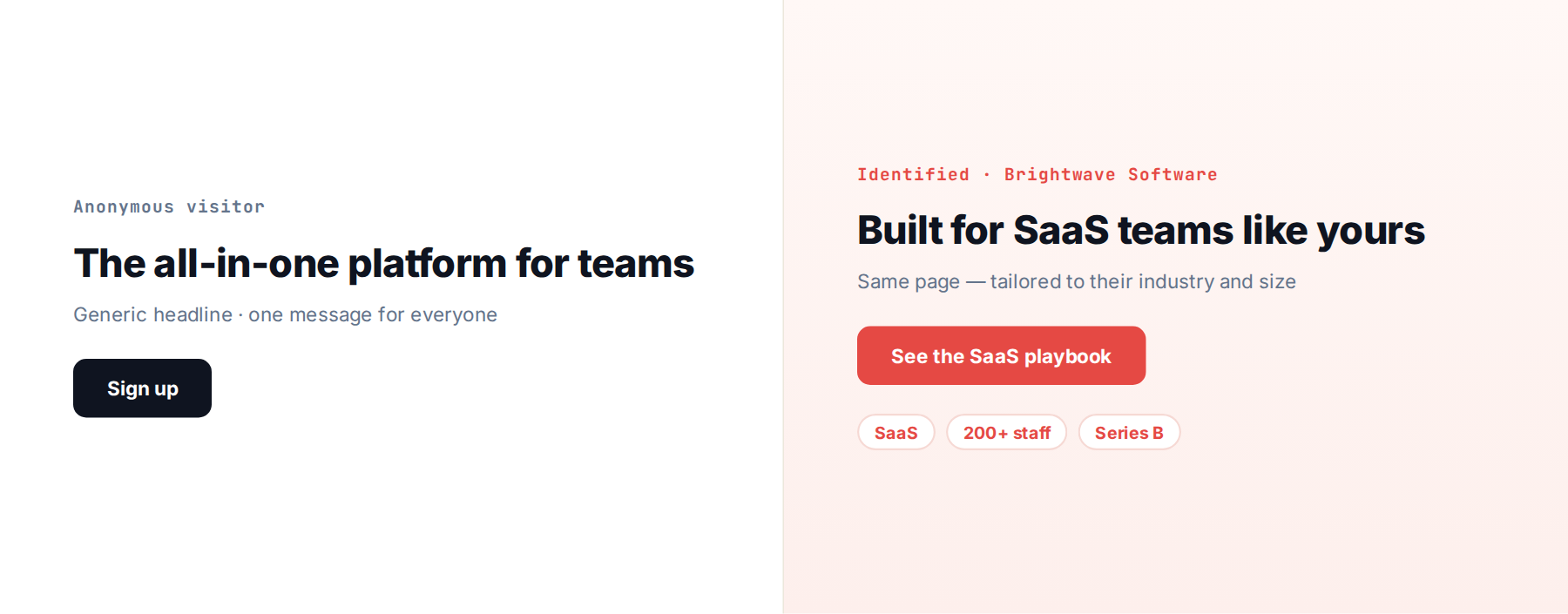
Personyze isn’t a reverse-IP database itself — it’s the personalization layer that puts the signal to work. It has built-in integrations with the CRM, email, CDP, ad, and analytics tools that supply the company match, so the firmographic signal flows straight into your on-site experience. See how Personyze handles account-based marketing and B2B personalization, and how the options compare in our guide to account-based marketing software.
If you’re evaluating where the company match comes from, established examples of reverse-IP and visitor-identification tools include Leadfeeder (Dealfront), Albacross, and enterprise ABM platforms like 6sense. Most pair reverse IP with additional data sources to lift match rates.
The takeaway
Reverse IP technology is a genuinely useful ABM signal — it surfaces in-market accounts that would otherwise stay anonymous, it’s privacy-friendly at the company level, and it starts cheap. Just size your expectations: it identifies companies, not people; match rates sit well below 100% and slip further with remote work; and the data is only as good as its refresh cadence. Treat it as one strong input, then make it pay off by turning each identified account into a personalized, on-site experience.
Reverse IP technology: FAQ
What is reverse IP technology?
Reverse IP technology identifies the company behind a website visit by matching the visitor’s public IP address against databases of known corporate IP ranges. It returns the organization and firmographics like industry, size, and location — without a form or any personal data about the individual.
How accurate is reverse IP lookup for ABM?
Company-level match rates typically range from about 30–60% of B2B traffic, with broad traffic around 30–40% and enterprise-focused US sites reaching 60–78%. The realistic ceiling is roughly 60–70%, and only when IP data is combined with cookies and first-party data. Claims above 90% should be treated skeptically.
Can reverse IP identify the individual visitor, not just the company?
No. Reverse IP resolves to the organization only. Identifying the specific person requires a form, a login, or a consent-based identity tool, which is a separate and more heavily regulated capability.
How much does reverse IP / visitor identification software cost?
Pricing scales with identified companies or traffic. Entry tools start under ~$100/month (Albacross from ~$40, Leadinfo from ~€69), mid-market tools run ~$100–500/month (Leadfeeder from ~$99 annually), and enterprise ABM platforms like 6sense or Demandbase range from several hundred to $10,000+/month.
Setup documentation
Connecting one of these providers to Personyze — API key, field mapping, and the targeting rules they unlock:
- Albacross integration setup
- Clearbit integration setup
- 6sense integration setup
- ZoomInfo integration setup
- Leadfeeder integration setup
- LeadRebel integration setup
Is reverse IP lookup GDPR compliant?
Company-level reverse IP that resolves only to an organization is generally considered low-risk and is often defensible under legitimate interest. Person-level identification of EU or UK residents typically requires a lawful basis, usually explicit consent. Confirm your specific use with legal counsel.
Want every identified account to land on a page built for them? See how Personyze personalizes your site in real time — start free or book a demo.
Book a demo with a personalization expert
30 minutes with a personalization expert. Bring your stack, your goals, your skepticism. We'll show you what changes when every visit feels like the only one.